Why counting every possible predicate equally makes all distinct pairs tie, and why useful financial similarity requires a chosen representation and weighting.
Ugly duckling theorem
The ugly duckling theorem shows that, on a finite universe of distinguishable objects, counting every possible subset predicate with equal weight gives the same similarity score to every distinct pair. For a quant comparing securities or market states, the practical lesson is that a useful notion of “similar” needs a chosen representation and a reason to favour some attributes over others.
The result is associated with Satosi Watanabe. His later primary exposition explicitly connects the equal-predicate result to the need for purpose-dependent weighting. It does not establish that every useful similarity measure must give equal scores. Watanabe, §§1.7 and 3.2–3.3
Eight predicates, three objects, one tie
Take a universe U={A,B,C}. For each subset S of U, define a predicate pS(x) that is true precisely when x∈S. We count subsets once each: different verbal descriptions of the same subset do not get additional votes.
There are eight predicates: membership in the empty set, each of the three singleton sets, each of the three two-object sets, and the whole universe. The empty-set predicate is false for every object; the whole-universe predicate is true for every object. This includes all subset predicates, not merely a few observed features such as industry or volatility.
Define the score to count jointly true predicates:
s(x,y)=S⊆U∑1{x∈S}1{y∈S}.
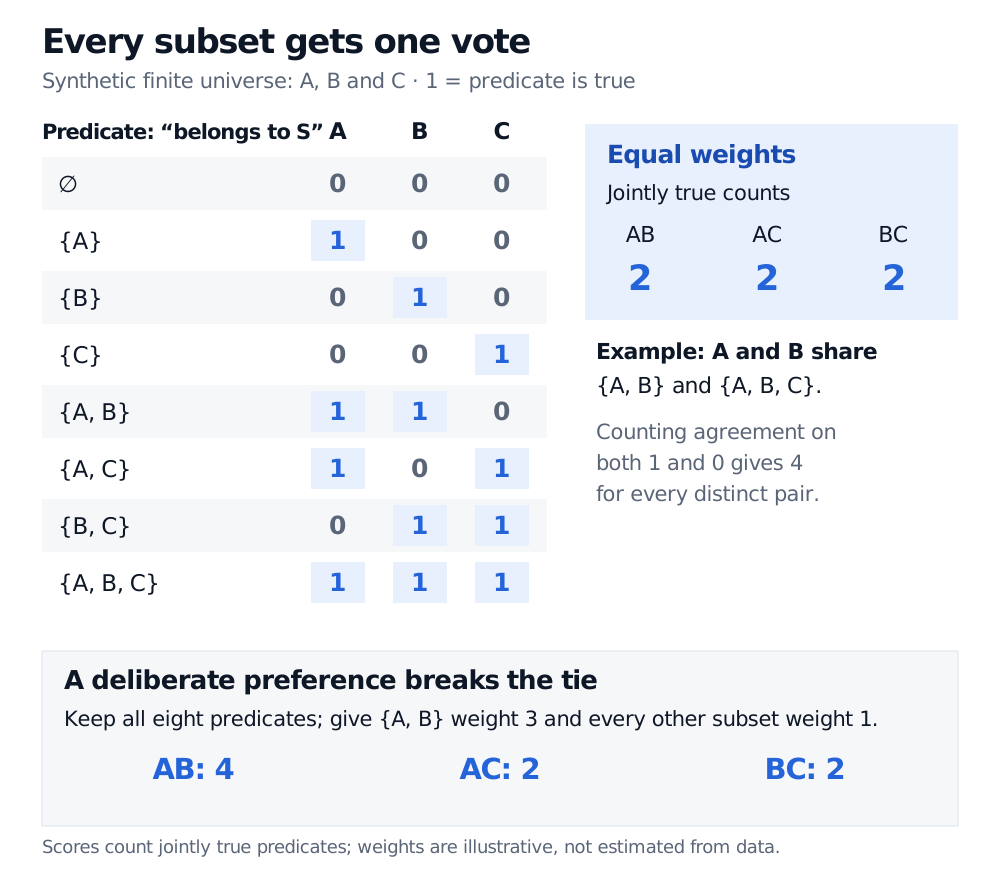
For A and B, only the subsets {A,B} and {A,B,C} contribute, so their score is 2. For A and C, the contributing subsets are {A,C} and {A,B,C}: again 2. The third pair also scores 2. The tie follows from the counting rule, regardless of what the three objects represent.
All eight subset predicates for A, B and C give jointly true counts AB 2, AC 2 and BC 2. Counting true-or-false agreement gives 4 for every pair. Giving subset A B weight 3 while all other weights stay 1 changes the jointly true scores to AB 4, AC 2 and BC 2.
Original finite-universe illustration. Equal weighting makes every distinct pair tie; a specified preference changes the score without changing the objects.
Some presentations count agreement on either truth value instead. Under that convention, A and B also agree by both being absent from the empty set and from {C}. Their agreement count is 4, as is every other distinct pair’s. These are different score conventions; neither gives this example a preferred pair.
The general count is just as direct. For n≥2 distinct objects and a fixed distinct pair, require both objects to be included. Each of the remaining n−2 objects may independently be included or excluded. Thus
s(x,y)=2n−2,x=y.
Counting both-true and both-false agreement doubles that count to 2n−1. This finite statement assumes that the predicate collection contains every subset. If one starts from primitive attributes and closes them under Boolean operations, obtaining every subset requires those attributes to distinguish the objects. Two objects with identical primitive descriptions cannot be separated by recombining those descriptions.
A preference is part of the model
Keep the same eight predicates, but give membership in {A,B} weight 3 and every other predicate weight 1. The weighted jointly true scores become
sw(A,B)=3+1=4,sw(A,C)=sw(B,C)=1+1=2.
Nothing about the objects changed. We supplied a preference, so the equal-weight symmetry no longer applies. This is an illustrative preference, not a fitted model or evidence that A and B belong together for any particular task.
In financial research, feature engineering makes analogous choices before an algorithm runs. Comparing securities using return histories asks a different question from comparing their sector labels, liquidity or cash-flow exposures. Selecting variables, transforming their scales and choosing a distance or kernel all help determine which differences matter. These choices express inductive bias: assumptions that guide the method beyond the observations alone.
For a concrete mathematical continuation, the kernel-feature-map lesson defines similarity through an inner product in a selected feature space. It has a public preview; the full lesson requires membership. Such a representation can distinguish pairs because it does not give every possible subset predicate an equal vote.
A useful research question is therefore: Similar for which decision, using which information? For example, a representation intended to find comparable trading costs need not produce the same neighbours as one intended to compare business exposures. The theorem does not choose the right representation. A defensible economic purpose and evaluation on the intended task must do that work.
What the theorem leaves open
The result is not a proof that learning is impossible, that all financial patterns are equally credible, or that carefully chosen similarities are arbitrary in their consequences. It identifies a degeneracy in one fully symmetric counting construction. It supplies neither a prediction-error bound nor evidence of profitable trading.
It also differs from the no free lunch theorem. The ugly duckling argument here counts predicates shared by objects. Wolpert and Macready’s optimization results compare algorithm performance across problem classes under specified averaging assumptions. Both draw attention to assumptions that favour some structure, but they are different mathematical statements. Wolpert and Macready, abstract
Sources
Satosi Watanabe, The Foundations of Cognitive Relativity (1991), §§1.7 and 3.2–3.3: the author’s account of equal predicate weighting and purpose-dependent classification. This article uses that accessible later exposition; the original Knowing and Guessing (1969) text was not available for direct verification.