Period-end funding is borrowing or lending over a month-end, quarter-end or year-end reporting date. The turn is the short interval that crosses that boundary. A turn adjustment isolates the extra cost or discount implied for that interval when building a forward curve. It matters when two trades have similar tenors but only one spans the reporting date.
Why rates move at the turn
Some banks and dealers reduce the balance sheet they use for financing trades around reporting dates. If fewer dealers are willing to intermediate while borrowers still need cash, overnight repo rates can rise. If particular securities are scarce, cash lenders may accept lower repo rates to obtain that collateral. The sign and size depend on the market. The New York Fed documented upward pressure in U.S. repo at the 2025 year-end while the effective federal funds rate stayed within its target range. The ECB documented falling euro-area repo rates at the 2021 and 2022 year-ends, when collateral was scarce and cash liquidity was abundant. New York Fed’s 2025 year-end analysis, ECB’s Euro Money Market Study 2024, §2.1.4
For a desk that rolls overnight financing, the relevant cash cost is the repo rate it can trade on its collateral. The published Secured Overnight Financing Rate (SOFR), the main U.S. dollar overnight risk-free-rate benchmark, measures a broad segment of overnight U.S. Treasury repo. A fixed-rate term repo agreed in advance has its own contractual rate across the whole term, even if SOFR later jumps. New York Fed’s SOFR definition, New York Fed’s account of term and forward-starting repo before year-end
The fixing’s calendar weight
Take a synthetic USD 100 million compounded overnight cash flow. Assume three separate one-calendar-day accruals under ACT/360, with annualised rates of 4%, 6%, 4%. The middle interval spans the turn in this stylised schedule. The baseline uses 4% throughout. The extra interest, in dollars, is
Only the middle factor changes. The two unchanged 4% factors account for the balance entering the turn and the interest earned on that difference afterwards. The 200-basis-point bump in a single annualised overnight rate raises the annualised three-day compounded rate by about 66.68 basis points when both period returns are scaled by .
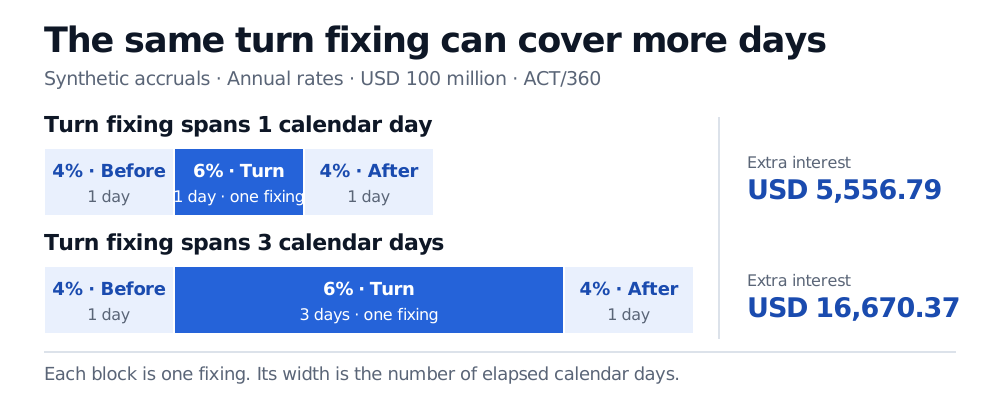
Each block is one fixing and each equal unit of width is one calendar day. Extra interest compares each schedule with its own all-4% baseline.
The real accrual weight comes from the benchmark calendar and the contract’s observation schedule. In the New York Fed’s SOFR Averages and Index, a fixing that applies for calendar days contributes the single factor , where is the annual rate in decimal form. If a weekend or holiday leaves three calendar days between business dates, use with no intermediate compounding. In the synthetic example that change alone triples the extra cash to USD 16,670.37. The administrator ordinarily publishes SOFR on the business day after its value date, so the print may arrive in January even when the underlying accrual starts in December. Contractual lookbacks or observation shifts can change which fixing a coupon uses. New York Fed’s SOFR Averages and Index methodology, ARRC’s sample observation-shift provisions
Where the adjustment belongs in a curve
During curve bootstrapping, a quant can fit the underlying forward rates and allow a separate adjustment on the turn interval. For example, replacing the baseline simple forward with changes its ACT/360 accrual factor from to . A forward that spans the interval picks up this altered factor. A forward starting after the interval has no direct exposure to it. Smoothing a turn premium across neighbouring dates would move their implied forwards too. In a single-curve setup, the discount factor across the turn is the reciprocal of its accrual factor, so the same adjustment can be expressed as a multiplier on discount factors beyond the turn.
Short-dated overnight indexed swaps or interest-rate futures that span the turn can help estimate the adjustment relative to quotes that miss it. Use each instrument’s actual reference dates and settlement convention. A single multi-day quote constrains the aggregate accrual and leaves its allocation across individual dates dependent on the curve model. Once a contractual benchmark observation is known, the floating payment uses that fixing according to its terms. The fitted adjustment still informs valuation wherever future accruals or discount factors depend on it. Ametrano and Bianchetti’s curve construction and turn example, §5.9, CME’s worked example of inferring a turn from futures
When the funding crosses currencies
A foreign exchange swap exchanges two currencies on a near date and reverses the exchange on a far date. If those value dates straddle the reporting boundary, its forward points can reflect both the relative funding cost of the two currencies and a premium for scarce intermediation. A kink in FX points can therefore reflect a change in the cross-currency basis as well as a change in either currency’s rates. The ECB’s study found that year-end dollar borrowing pressures in FX swaps varied across years. BIS on FX swaps and the basis, ECB’s Euro Money Market Study 2024, §2.4.4
The SelfMadeQuant lesson Liquidity and Limits to Arbitrage shows how dealer balance-sheet limits can leave a gap between quoted FX forwards and covered interest parity around quarter-end. The public page previews the lesson. The full lesson requires membership.