A tracking stock is a class or series of common stock that an issuer designs to reflect the performance of a particular business or group within the company. Holders own shares of the issuer. The tracked business helps explain what drives the share price, while the charter and applicable law govern what the shares can pay and how holders can vote. Liberty Media, June 2025 attributed financial information · Liberty Media’s 2023 charter, Article IV
What the profit figure tells you
Fictional Northline Holdings attributes USD 20 million of quarterly profit to Group A and USD 30 million to Group B. Assume all profit is attributed to these two groups and there are no other items or consolidation adjustments. Northline reports USD 50 million of consolidated profit. Its Group A tracking stock references the business that earned USD 20 million. Northline is the legal issuer of the shares.
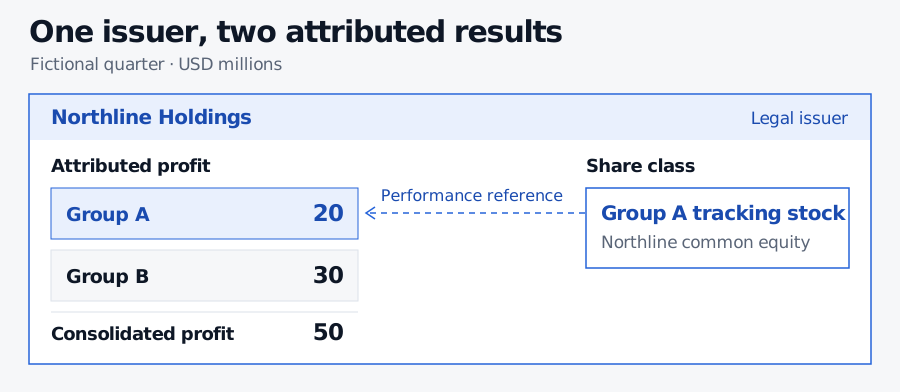
The dashed arrow shows which business the stock is designed to track. Both reported groups and the share class sit within the same issuer.
The USD 20 million helps an analyst forecast Group A’s earnings. The dividend, if declared, and the class’s share of any liquidation proceeds depend on Northline’s charter and applicable law. The reported profit is an accounting attribution. Any claim on residual assets comes through the shares in Northline. A loss elsewhere in Northline can still matter to tracking shareholders if it weakens the issuer’s capacity to pay dividends. In actual filings, reconcile the attributed results to the consolidated statements and check how the issuer allocates shared costs, cash and debt before valuing the class. Liberty Media, June 2025 attributed financial information
What the charter can change
Liberty Media’s historical Delaware charter illustrates why the share series matters. The Series A and B shares carried different voting power even when they tracked the same group. Dividends on Liberty Formula One common stock were subject to both the corporation’s legally available assets and a group-specific limit, with the board retaining discretion over payment. The board could elect to convert Formula One tracking shares into Liberty Live tracking shares under a specified exchange formula. In a liquidation, the charter used per-share liquidation units to divide the corporation’s residual assets after debts and preferred claims. For any tracking stock, check the charter or prospectus for the particular series and the terms in force on the date being analysed. Liberty Media eliminated its remaining tracking stock structure when it reincorporated in May 2026. Liberty Media’s 2023 charter, Article IV A.2 · Liberty Media, May 2026 Form 8-K
When investors get shares in the business itself
An equity carve-out sells shares in a separate subsidiary to public investors through an IPO. The parent can retain control. In a spin-off, the parent distributes shares in the separate company to its existing shareholders, typically pro rata. In both transactions the recipients get equity in the separate company. A tracking share gives its holder equity in the original issuer with an economic reference to the business. Kenvue’s 2023 IPO prospectus · GE and GE Vernova’s 2024 distribution agreement, §5.01
When subsidiary shares are distributed in a spin-off, an analyst measuring the parent’s return needs to account for the value delivered. The SelfMadeQuant lesson on equities, indices and corporate actions explains how data vendors make that adjustment. The full lesson requires membership. Equities, Indices and Corporate Actions