See how the U.S. Volcker Rule distinguishes customer market-making inventory from a short-term directional trade, even when both desks hold the same bond.
The Volcker Rule and Proprietary Trading Limits
The Volcker Rule is a U.S. restriction on proprietary trading by banking entities. Enacted through Section 619 of the 2010 Dodd–Frank Act, it generally bars a banking entity from buying or selling covered financial instruments as principal for its trading account, subject to exclusions and permitted activities. For a desk quant, the same bond position and P&L can arise from customer market making or from a short-term directional bet. The position report alone cannot tell you which activity produced it. 12 U.S.C. § 1851(a), (d) and (h), 12 CFR § 248.3.
Start with the entity and the trade
Entity. The definition generally covers insured depository institutions, their controlling companies, certain foreign banking organisations and the relevant affiliates and subsidiaries. The statute excludes qualifying smaller institutions based on consolidated assets and trading activity, including the applicable tests for their controlling companies. 12 U.S.C. § 1851(h)(1), 12 CFR § 248.2(c).
Instrument and capacity. Securities, derivatives, commodity futures and related options can fall within scope. A bank that buys a bond into inventory acts as principal and takes the market risk. Executing solely as an agent is an exclusion under the trading rule. 12 CFR § 248.3(a), (c) and (d).
Trading account. The applicable test can capture positions taken primarily for short-term resale, price moves, arbitrage or hedging those positions. Where the market-risk capital test applies, it generally takes the place of the short-term-intent test and looks to covered trading positions and certain related hedges. A separate dealer test captures trades connected to the relevant dealing activity, including activities requiring dealer registration. The classification follows the regulatory tests rather than the account name. 12 CFR § 248.3(b).
Once a trade is in scope and no exclusion applies, the next question is whether a permitted activity covers it. Regulation VV sets out conditions for activities including underwriting, market making and risk-mitigating hedging, and permits trading in specified government obligations. Those permissions remain subject to § 248.7, including its limits on material conflicts of interest, material exposure to high-risk assets or strategies, and threats to the bank's safety and soundness or to U.S. financial stability. The rule has a separate branch for ownership, sponsorship and certain relationships involving covered funds. Regulation VV, Subparts B and C.
Two desks buy the same bond
Suppose two desks at a covered banking entity each buy USD 10 million face value of the same corporate bond as principal for its trading account. Assume neither purchase meets a § 248.3 exclusion. Both buy at 100.00 per 100 of face value and later mark the bond at 99.50. With both positions still open, the clean-price change produces the same mark-to-market loss for each desk, before accrued interest, hedges, funding or fees.
Price P&L per desk=10,000,000×10099.50−100.00=−50,000USD.
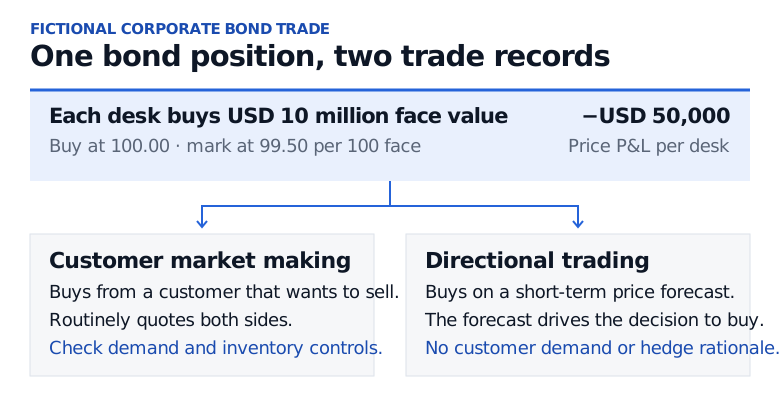
Two fictional desks each buy USD 10 million face value of the same corporate bond and mark a USD 50,000 price loss. The market maker buys from a customer while quoting both sides. The directional desk buys on a short-term price forecast without a customer demand or hedge rationale.
The trade blotter can show an identical position and mark on both desks. Customer flow, quotes and risk records tell you how each desk came to hold the bond.
Customer market-making desk. A client wants to sell immediately. The desk routinely stands ready to buy and sell this type of bond, so it buys from the client and holds inventory while it looks for buyers. The market-making permission can cover that purchase if the desk meets the rule's conditions. Among them, its activity must be designed on an ongoing basis to stay within reasonably expected near-term demand from clients, customers or counterparties, taking account of the market's liquidity, maturity and depth. The desk can assess expected demand before it has a matching buyer. A customer fill explains why the desk took on some inventory, while its activity and controls provide evidence about how much it can carry. The rule also addresses compensation incentives and applicable licensing or registration. 12 CFR § 248.4(b).
Directional desk. A trader buys the bond because the desk expects its price to rise over the next few days. The purchase has no customer-demand or risk-mitigation rationale in this example. On these stipulated facts it does not qualify as market making and, absent another permitted activity, the proprietary-trading prohibition applies. A later sale to a client would leave the original rationale unchanged. 12 CFR §§ 248.3(a) and 248.4(b).
What the desk can measure
A desk assessing demand could combine recent customer fills, requests for quotes and executable market depth to set limits on inventory and holding periods. It can monitor risk-factor exposures, such as the change in inventory value for a given shift in credit spreads. Quote requests are indications of interest, so the desk needs to account for which ones turn into trades and how market conditions affect that relationship. If demand thins, an unchanged position can age and become harder to sell.
Under § 248.4(c), a desk can qualify for a rebuttable presumption on the demand condition by establishing and enforcing internal limits that meet the rule. These cover market-maker positions, permitted risk-management instruments and exposures, risk-factor exposures and holding periods. Limit breaches or increases require records and prescribed handling if the entity is to keep relying on the presumption, including prompt action to bring the desk back within limits after a breach. The presumption concerns the demand condition alone. A banking entity with significant trading assets and liabilities that relies on the market-making permission also faces specific compliance programme and quantitative reporting requirements. 12 CFR § 248.4(b)–(c), 12 CFR § 248.20 and Appendix A to Part 248.
A credit hedge illustrates why the desk should track the risk alongside the position. If it relies on the separate risk-mitigating hedging permission, the hedge must be designed at inception to reduce or significantly mitigate a specific, identifiable risk arising from identified holdings. As the desk sells the bonds, the hedge may need resizing to keep it aligned with the remaining exposure. 12 CFR § 248.5.
The SelfMadeQuant Market Participants lesson shows how a dealer taking the other side of a client's trade differs from a broker acting as agent, and how hedging and speculation can use the same instrument. The preview is public and the full lesson requires membership. Market Participants.