Technical reserves are amounts insurers recognise for obligations under their policies. The claims component covers expected payments for insured events that have already happened. A claims development triangle shows how the amounts paid or reported for groups of claims change as those claims mature. Actuaries use the pattern to estimate what an insurer still expects to pay, including for events that have yet to be reported. EIOPA, Solvency II Directive, Article 76 · Friedland, Estimating Unpaid Claims Using Basic Techniques, chapters 1 and 5
Read across for age and along a diagonal for date
Each row groups claims by origin period, here the accident year in which the insured events occurred. Each column gives a development age. In a cumulative paid triangle, a cell is everything paid for that row’s claims up to that age. The difference between adjacent observed cells in a row is what was paid during the intervening period.
At 31 December 2025, the 2024 cohort is at 24 months and the 2025 cohort is at 12 months. Those cells share a calendar valuation date, so they form the latest diagonal. The 2025 cohort’s 24-month cell lies in the future. A structural blank records that the cohort has yet to reach that age. A zero records an observed amount, and a missing observation at an age the cohort has already reached calls for a data check. Friedland, chapters 5 and 7
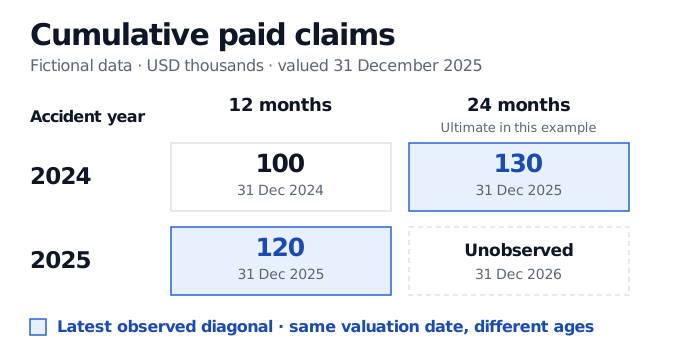
Read across the 2024 row to estimate development. Read the blue cells together to see what had been paid for each cohort at the same valuation date.
From 120 paid to 36 still unpaid
Suppose the fictional insurer settles all claims by 24 months. All amounts are in USD thousands, before reinsurance and excluding claim-handling expenses. The older cohort went from 100 at 12 months to an ultimate total of 130. If the newer cohort has the same relative payment pattern, its estimated ultimate and unpaid claims are
This is a one-step version of chain ladder. With more ages, estimate each age-to-age factor using cohorts observed at both ages, then multiply the selected factors from the latest age to ultimate. A tail factor can allow for development beyond the oldest observed age. Here, one observed pair gives a point estimate with very little evidence for a stable pattern. Faster settlement, for example, can bring more payments into the first year without changing ultimate claims. Applying the old factor to those higher early payments would then overstate the ultimate. Friedland, chapter 7
Which subtraction gives IBNR?
A paid triangle uses cash paid. A case-incurred or reported triangle, as defined here, adds case reserves to paid claims at each valuation. A case reserve is the claim handler’s estimate of what remains to be paid on a known claim. Check the label before comparing triangles. Some exhibits use “incurred” for amounts that already include an allowance for unreported claims. Friedland, chapter 1
If the 2025 cohort has case reserves of 20, reported claims are . With the same estimated ultimate of 156, ultimate minus paid gives total unpaid claims of 36. Ultimate minus reported gives , the estimate above the case reserves. In the broad actuarial use of IBNR (incurred but not reported), this residual includes both claims yet to be reported and further development on claims already known. The narrower use of IBNR covers only claims yet to be reported. Separating those components requires additional information such as claim reporting histories. Friedland, chapters 1 and 7
From the estimate to the accounts
The 36 is an undiscounted estimate of future claim payments for one cohort. The liability for incurred claims in an insurer’s financial statements follows the applicable measurement basis. IFRS 17, for example, measures it using future cash flows for past service, an adjustment for non-financial risk, and discounting where required. Its claims development disclosure compares actual claims with earlier estimates of undiscounted claims and reconciles the disclosure to the reported carrying amount for incurred claims. That disclosure lets a reader trace how earlier estimates changed. The simple paid triangle above illustrates how an actuary might build an estimate in the first place. IFRS Foundation, IFRS 17, paragraphs 33–37, 40(b), 59(b), 100(c) and 130