A tariff is a customs duty on imported goods. It adds to the cost of bringing an affected product into the country. For a quant analysing a trade-policy announcement, the first calculation is the duty on each exposed shipment. The next is a scenario for how suppliers, importers and customers share the cost as prices and quantities adjust. World Trade Organization, Tariffs
From the tariff schedule to the customs bill
For an ad valorem tariff, multiply the applicable rate by the customs value. A specific duty instead charges a fixed amount per unit, kilogram or other stated quantity. Some duties combine a percentage and a charge per unit. A fixed duty per kilogram takes a larger share of the value of a cheap shipment than of an expensive one with the same weight. WTO, Technical Information on Customs Valuation
A shipment-level calculation needs three inputs.
- Product classification. The Harmonized System (HS) provides the international product codes. The importing jurisdiction's tariff schedule determines the applicable tariff line and may subdivide the HS code. World Customs Organization, Harmonized System FAQ
- Country of origin. Origin is determined under customs rules. A shipment routed through a third country can keep its original origin. A trade preference can lower the duty if the good meets the relevant origin rules and the importer satisfies the claim requirements. Check any applicable exemptions and the schedule in force for the entry. WCO, Rules of Origin FAQ
- Customs value. Transaction value usually starts with the price paid or payable for the goods, subject to the applicable valuation rules and adjustments. The invoice amount and the customs value can differ. WCO, Customs Valuation FAQ
The customs bill and the shelf price
Suppose a retailer imports a lamp with a supplier invoice and customs value of 100 currency units. A hypothetical 25% ad valorem tariff replaces a zero rate. For this shipment, the supplier keeps the same price and the invoice equals the customs value. The duty and the cost including duty are
The 125 is the importer's cost before any separate freight, brokerage, other taxes or domestic selling costs. The legal obligation to pay is the statutory incidence. In the United States, for example, the importer is liable for duties and may pay through a customs broker. 19 CFR §141.1(b), Payment of duties
Economic incidence describes who bears the cost after prices adjust. Suppose the same retailer raises the shelf price from 160 to 175 and other per-unit costs stay fixed. The customer pays 15 more, or 60% of the duty. The retailer absorbs the other 10 through a smaller margin per unit. The shelf price rises by 9.375% because the 15 is measured against the original shelf price of 160. The three percentages have different denominators.
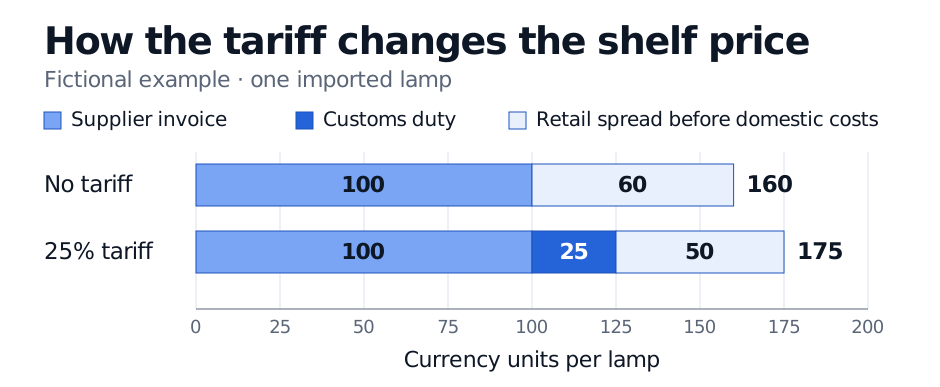
The retailer recovers 15 of the 25 duty at the shelf. The spread shown is before domestic costs.
A supplier that discounts its invoice can bear some of the cost, and a retailer can delay repricing until existing inventory sells. The ease of switching suppliers or products affects how much each party can pass on. A Federal Reserve staff study found that retail price increases emerged gradually in its sample of U.S. household purchases exposed to tariffs in 2025. Its timing and estimates apply to the products and period studied. Federal Reserve, The Slow Climb
Follow the exposure through the supply chain
A domestic firm can face higher component costs even if it buys from a local distributor. A domestic rival selling a substitute for the tariffed good may gain pricing room. An exporter can also face weaker demand if trading partners retaliate. Exposure therefore depends on the firm's inputs, competitors and export markets as well as its own imports. Keep announcement dates and effective dates separate when comparing market moves with realised duties. Flaaen and Pierce, Disentangling the Effects of the 2018–2019 Tariffs
The price series matters too. The U.S. Bureau of Labor Statistics' import price indexes exclude duties, so an unchanged foreign invoice can coexist with a higher duty-inclusive cost. When interpreting the terms of trade, check how the import price index is defined. The trade balance depends on export and import values, which can change as firms switch suppliers and buyers change quantities. Exchange-rate moves can also change local-currency prices through exchange-rate pass-through, a separate channel from the duty. BLS, Import/Export Price Indexes FAQ
Sources
- WTO, Tariffs and Technical Information on Customs Valuation.
- WCO guidance on product classification, rules of origin and valuation.
- 19 CFR §141.1(b), Payment of duties.
- Hacıoğlu-Hoke, Malladi and Feler, The Slow Climb: How Tariffs Gradually Raised Retail Prices in 2025, March 2026.
- Flaaen and Pierce, Disentangling the Effects of the 2018–2019 Tariffs on a Globally Connected U.S. Manufacturing Sector, December 2019.
- BLS, Import/Export Price Indexes FAQ.