A country's terms of trade measure its export prices relative to its import prices. When the ratio rises, the same volume of exports can pay for more imports. Macro analysts use it to separate a change in what domestic production can buy from a change in how much the economy produces. Australian Bureau of Statistics, Real income measures
When export prices rise and purchasing power falls
Let and denote export and import price indices, both set to 100 in the same reference period. The terms-of-trade index is
In a fictional economy, the export-price index rises to 110 and the import-price index rises to 120. The terms of trade fall to . That is 8.33% below its reference-period level. To measure growth since any other period , use . Australia's national accounts construct the ratio using the implicit price deflators for exports and imports of goods and services. Australian Bureau of Statistics, National Income, Expenditure and Product methodology
Suppose each export and import basket initially costs one currency unit. Later, the prices are 1.10 and 1.20. Selling 120 export baskets used to raise 120 currency units, enough to buy 120 import baskets. The same exports now earn 132, which buys only 110 import baskets. The receipts are higher in money terms, but their import purchasing power is lower.
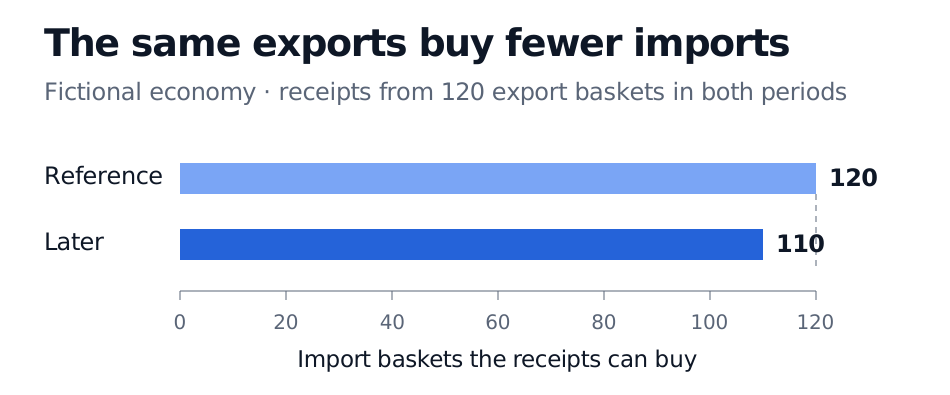
At the later prices, the same export volume buys 10 fewer import baskets.
What changes in the national accounts
Trade balance. The trade balance subtracts the value of imports from the value of exports. If the economy actually buys 100 import baskets in each period, its nominal trade surplus falls from to currency units. The terms-of-trade index by itself gives neither the sign of the balance nor its change, because both depend on the quantities traded as well as prices.
Real domestic income. Real GDP tracks the volume of domestic production. If all the quantities in this example stay fixed, real GDP stays flat. Real gross domestic income (real GDI) equals real GDP plus the trading gain or loss from the change in relative prices. The ABS uses the import deflator to express export receipts in terms of what they can buy. In the fixed-reference example, the later trade balance in import purchasing power is reference-period currency units, compared with when both flows are valued at their own reference-period prices. The difference is a trading loss of 10. Statistical agencies can choose different deflators for this adjustment. Australian Bureau of Statistics, Real income measures, §§20.10–20.15 · UN, System of National Accounts 2025, §§18.197–18.206
From a commodity price to a macro scenario
Where exports are concentrated in one commodity, its global price can move the national export deflator substantially. A sustained price rise can lift export receipts and taxable profits before production changes. In its 2025–26 Budget, the Australian Treasury used a permanent iron ore price shock to model changes in nominal GDP and tax receipts. A real output response depends on how producers adjust investment and production. The Reserve Bank of Australia found that the temporary supply disruptions behind much of the 2019 iron ore price rise brought little expansion in Australian capacity or production. Australian Treasury, Budget 2025–26, Statement 7 · RBA, Determinants of the Australian Dollar Over Recent Years
The price shock can also affect the currency, especially if it changes the outlook for investment and export income. To track the currency separately, use a trade-weighted currency index, which combines bilateral exchange rates using trade weights. The terms of trade compare prices of traded goods and services. RBA, Exchange Rates and their Measurement
Sources
- Australian Bureau of Statistics, Australian System of National Accounts. Real income measures, edition 8, §§20.3–20.15.
- Australian Bureau of Statistics, National Income, Expenditure and Product methodology, June 2026, Glossary entries for terms of trade and real gross domestic income.
- United Nations, System of National Accounts 2025, white cover version, chapter 18, §§18.197–18.206.
- Australian Treasury, Budget 2025–26, Statement 7, “Movements in iron ore prices.”
- Reserve Bank of Australia, Determinants of the Australian Dollar Over Recent Years, March 2021, “Commodity prices and the terms of trade.”
- Reserve Bank of Australia, Exchange Rates and their Measurement, “Trade-weighted index (TWI).”