A trade-weighted currency index measures how a home currency moves against a basket of trading partners’ currencies. Each bilateral exchange rate contributes according to a weight derived from trade. An analyst can use the index to tell whether a move in a single currency pair carries through to the broader trade basket. BIS effective exchange rates
Two partners, one index
Put every exchange rate in the same direction. Let be the number of units of partner ’s currency per unit of home currency. A rise means the home currency appreciates against that partner. Invert any input quoted as home currency per unit of partner currency before combining rates. Divide each rate by its own value at base date so each change is unitless and starts from the same reference point.
With fixed weights that sum to one, the base-100 geometric index is
Suppose a fictional economy gives partner A a 60% weight and partner B a 40% weight. Both bilateral indexes start at 100. A rises to 110 and B falls to 95, so the home currency strengthens against A and weakens against B. The basket rises to
The home currency appreciates 3.73% against this basket from the base date. Each partner’s weight multiplies its log exchange-rate change, so the contributions add in log terms. Converting the sum of about 3.67 log percentage points back to an ordinary percentage change gives 3.73%.
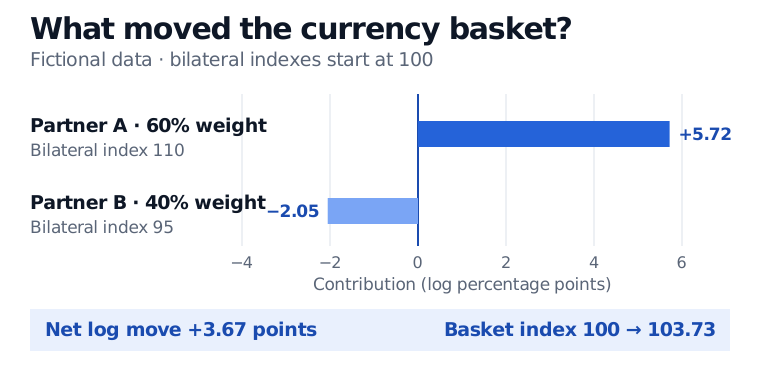
Partner A’s larger weight gives its exchange-rate move more influence. The bars show additive log contributions, and the basket level converts their sum back to index points.
What changes the reading?
The basket and its weights. Equal weighting gives each included currency the same influence. A trade-weighted series ties that influence to its trade methodology. The Federal Reserve’s broad dollar index uses bilateral US imports and exports of goods and services, with exclusions including oil, gold and military equipment. The BIS derives its weights from manufacturing trade and also accounts for competition in third markets, where two economies sell to the same buyer market. Federal Reserve construction note · Federal Reserve H.10 currency weights · BIS methodology
The base date and the weight schedule. Rebasing a series divides every observation by its value at the new base date and multiplies by 100. That changes index levels while preserving percentage changes between dates. Updating weights changes how exchange-rate moves enter the index. The BIS chain-links changes computed with the applicable weights for each period. BIS effective exchange rate FAQ
Relative prices. The exchange-rate-only basket is a nominal effective exchange rate (NEER). The real effective exchange rate also adjusts for changes in home prices relative to partner prices. The BIS uses consumer prices. Under its appreciation-up convention, faster home inflation raises the real index relative to the nominal index, all else equal. BIS effective exchange rates
The issuer’s cash flows. In the example, a home firm with a fixed invoice payable in partner B’s currency needs more home currency to settle it even as the trade-weighted index rises. National trade weights describe the economy’s basket. The firm’s exposure depends on the currencies and amounts of its own revenues, costs, debt and hedges.
Sources
- BIS Data Portal, Effective exchange rates and effective exchange rate FAQ, covering direction, trade weights, chain-linking and consumer-price adjustment.
- Federal Reserve Board, Revisions to the Federal Reserve Dollar Indexes, section I, and H.10 currency weights, covering the geometric calculation and broad index weight definition.