The real effective exchange rate (REER) measures the value of a home currency against a trade-weighted basket of partner currencies, adjusted for home prices relative to partner prices. Under the Bank for International Settlements (BIS) convention, a rise means real appreciation. FX analysts use it to track whether the home economy is getting more expensive relative to its trading partners, even when the currency barely moves against the dollar. BIS effective exchange-rate methodology
From a currency quote to a real index
A bilateral foreign exchange rate measures the home currency against one other currency. The nominal effective exchange rate (NEER), a trade-weighted currency index, combines multiple bilateral rates geometrically. Use foreign currency units per unit of home currency so that a rise in each quote means home appreciation. If your data give home units per foreign unit, invert the quotes before constructing the index in this convention.
The real index adds the relative-price adjustment. For a fixed set of weights, combine the partners’ consumer price indices geometrically with the same weights used for the NEER. With both price indices and the NEER rebased to 100 in the same period,
Using the same weights makes this equivalent to averaging the bilateral real indices geometrically. The BIS uses manufacturing trade to weight its partners, accounting for direct trade and for exporters who compete in a third market. Its published series use changing weights and are chain-linked. To reproduce a published series, match its partner coverage, weights, price measure and linking method. BIS data documentation · Klau and Fung, weighting methodology
When domestic prices reinforce a stronger currency
Suppose all three indices start at 100. Over the same period, the fictional NEER rises to 110, home CPI to 104 and the weighted partner CPI to 102. The home currency appreciates 10% in nominal effective terms. Faster price growth at home makes the home basket more expensive still after currency conversion.
That is 12.16% real appreciation from the base period. At a nominal index of 110, relative prices add 2.16 index points. If home and partner prices had grown at the same rate, the price ratio would have stayed at one and the real index would have ended at 110.
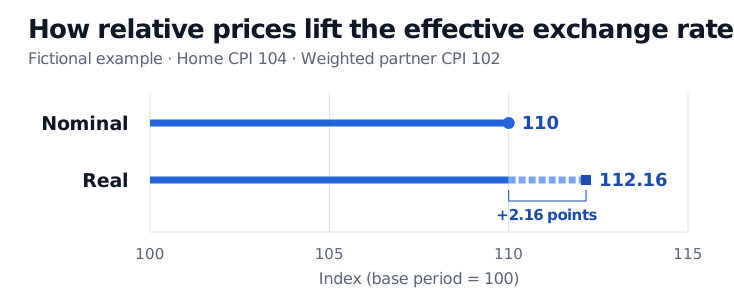
The dashed segment isolates how much higher relative prices add to the index after nominal appreciation.
What 112.16 tells you
The reading measures appreciation since the base period. An analyst calling a currency overvalued would need a separately justified equilibrium benchmark. Exact relative purchasing power parity would leave the real index flat for a fixed basket if nominal changes offset relative inflation for every partner. Relative prices can also shift as an economy develops. For example, the Balassa–Samuelson effect shows how stronger tradable-sector productivity can raise local service prices. BIS FAQ on interpreting index levels
A rise in a CPI-based REER usually signals weaker price competitiveness on that measure. Consumer prices include local services, so the index can rise even if manufacturers’ labour costs per unit of output are stable. The ECB publishes real indices using several price or cost measures, including manufacturing unit labour costs, and uses manufacturing trade weights for its manufacturing-focused variants. Which series fits depends on whose prices or costs you are comparing. ECB effective exchange-rate methodology
Sources
- BIS Data Portal, Effective exchange rates — index construction, weighting and interpretation of base-period levels.
- Marc Klau and San Sau Fung, The new BIS effective exchange rate indices, BIS Quarterly Review, March 2006 — the original weighting methodology and its limitations.
- European Central Bank, Effective exchange rates — alternative deflators and manufacturing-specific weights.