Skip to content

Balassa–Samuelson effect

How productivity gains in tradables raise wages and local service prices, and when the resulting price gap leads to real exchange-rate appreciation.

The Balassa–Samuelson effect describes how faster productivity growth in tradables than in nontradables can raise wages across both sectors and push up the price of local services relative to tradable goods. When the resulting price pressure is stronger at home than abroad, it can contribute to real currency appreciation. This gives FX analysts a reason why a catching-up economy can move away from purchasing power parity over time. Czech National Bank analysis

Why a more productive factory can make a haircut dearer

Take a fictional economy that produces an export good and a local service. The export good sells at a fixed world price, and we hold the nominal exchange rate fixed. In this simplified model, labour is the only input, firms compete, and workers can move between sectors, so both sectors pay the same hourly wage. With ATA_T and ANA_N denoting units of output per labour hour in tradables and nontradables, competition equates prices to unit labour costs. The tradable price PTP_T pins down the wage ww, and the service price PNP_N covers that same wage at local productivity.

w=PTAT,PN=wAN.w=P_T A_T,\qquad P_N=\frac{w}{A_N}.
At a tradable price of 20 home currency units per unit of output, raising factory output from 5 to 6 units per labour hour raises the hourly wage from 100 to 120. Service workers still deliver 5 units per hour, so a unit of service rises from 20 to 24. The relative price PN/PTP_N/P_T goes from 1 to 1.20, a 20% increase. The exporter's unit labour cost stays at 20 because its productivity rises with its wage bill per hour. If service productivity had kept pace with factory productivity, the extra output per hour would also have covered the service sector's higher wages. Mihaljek and Klau, analytical framework

From local prices to the real exchange rate

A home basket of three tradables and two services costs 100 before the shock and 108 after it. Services account for 40% of initial spending, so a 20% increase in service prices raises this basket's cost by 8%. At the fixed nominal rate, the home currency appreciates 8% in real terms if the trading partner's basket stays at 100. If the partner has the same basket and experiences the same shock, both baskets rise to 108 and the bilateral real exchange rate stays flat.
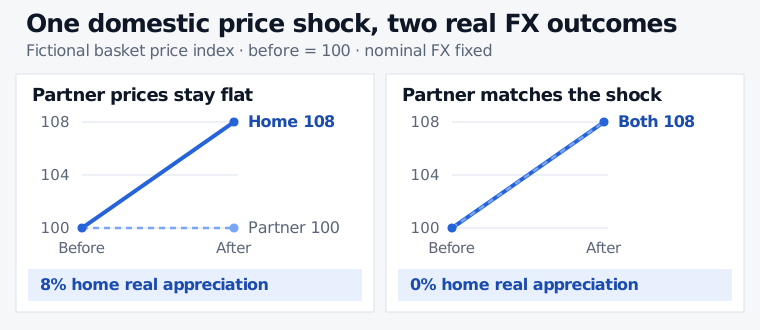
In both fictional scenarios the nominal exchange rate is fixed and the home basket rises from 100 to 108. Home appreciates 8% in real terms if the partner basket stays at 100, and 0% if the partner basket also rises to 108.
The same domestic service-price shock gives different bilateral outcomes depending on the partner's basket.
For a consumer-price-based real effective exchange rate, sector productivity and spending shares matter in each country, and trade weights determine how much each partner counts. A floating nominal rate can also move, so the mechanism alone leaves the direction of spot FX open. In a study of six Central European economies, sectoral productivity differences explained only a small share of the observed inflation gaps with the euro area. BIS effective exchange-rate methodology · Mihaljek and Klau, empirical estimates

Sources

Last updated
  • foreign exchange
  • labour productivity
  • relative prices
  • real exchange rate
← Back to the glossaryBack to top ↑