Exchange-rate pass-through measures how much a price in home currency responds to a change in the exchange rate. The price can be an import price at the border, a retail price, or the consumer price index (CPI). An inflation model needs a response for the relevant price measure and horizon. An importer's budget may instead need the immediate cash cost of the next shipment.
The same invoice costs more at the border
In a fictional example, a supplier charges 100 foreign currency units for the same item at two dates. The spot rate rises from 1.20 to 1.32 home currency units per foreign unit. One foreign unit now costs more at home, so the home currency has depreciated against the invoice currency.
At spot, the invoice translates from 120 to 132 home currency units, before local costs and any hedge. Both the quote and the translated invoice rise by 10% because the price in the invoice currency is fixed. Suppose the same item's retail price rises by 4% over that window. Its simple percentage-change ratio relative to the FX move is
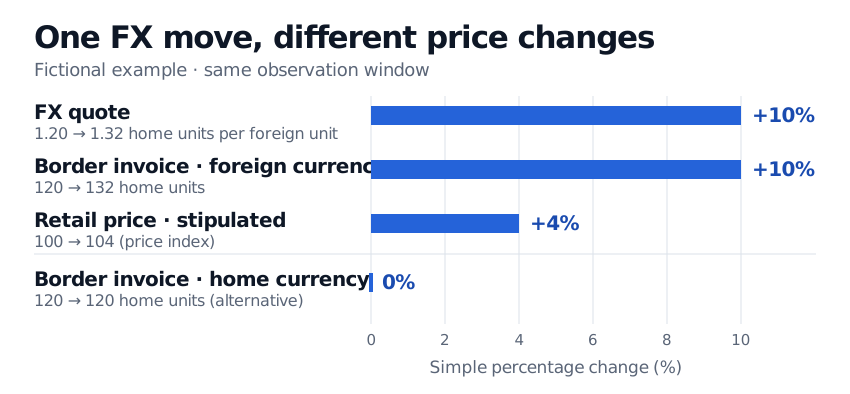
Both price stages use the same FX move as a reference. The bottom row shows the alternative border price if the invoice were fixed in home currency.
What changes when firms can reprice?
A fixed home-currency invoice of 120 would stay at 120 until the supplier resets the price. If the invoice were fixed in a third currency, the spot translation would depend on that currency's rate against the home currency. The immediate effect comes from the currency named in the contract. At a price reset, changes in the supplier's production costs can also move the invoice amount. Using 1994–2005 data, Gopinath, Itskhoki and Rigobon found pass-through of roughly 25% for U.S. imports priced in dollars and 95% for those priced in other currencies, even conditional on a price change. Their estimates compare groups that chose different currencies in that sample. Gopinath, Itskhoki and Rigobon, Currency Choice and Exchange Rate Pass-Through
At retail, local storage, transport and selling costs can dilute the import cost in the shelf price. A seller can also absorb some of the change in its markup, or reprice when it replaces existing stock. The CPI combines many goods and services using expenditure weights. It can pick up exchange-rate effects through imported inputs used in domestic production as well as through the prices of finished imports. Campa and Goldberg, Pass-Through of Exchange Rates to Consumption Prices
A matching FX forward can lock the home-currency cash outlay for the amount and settlement date it covers. That hedge leaves the supplier's invoice and its spot translation unchanged. It can affect the buyer's pricing decision through its effective costs, depending on coverage and when the hedge expires. Reserve Bank of Australia, Limiting Foreign Exchange Exposure through Hedging
For a worked currency conversion and the mechanics of fixing a future exchange rate, see the SelfMadeQuant FX lesson. The preview is public and the full lesson is free with sign-in.
What an estimate should specify
Name the price series, the direction and coverage of the FX quote, and the response horizon. A one-month import-price estimate can reflect contracts that have yet to reset. A one-year CPI estimate can incorporate repricing and indirect input-cost effects. With the reciprocal exchange-rate quote, a depreciation has the opposite sign in log changes, so the quote convention matters when comparing estimates.
The example's 0.4 is a ratio of two simple changes. Taking logs of the same endpoints gives . A regression uses many observations and may include lags and controls for other price drivers. The reason the exchange rate moved matters for a causal interpretation. In a model fitted to U.K. data, Forbes, Hjortsoe and Nenova estimated a smaller fall in import prices for a sterling appreciation driven by stronger domestic demand than for a comparable move driven by tighter monetary policy. Their model used restrictions to distinguish the shocks and left the import-price responses unrestricted. Forbes, Hjortsoe and Nenova, The Shocks Matter
Sources
- Gopinath, Itskhoki and Rigobon (2010), American Economic Review, on invoice currency and estimates before and after price adjustment. Currency Choice and Exchange Rate Pass-Through
- Campa and Goldberg (2006), Federal Reserve Bank of New York Staff Report 261, on local distribution costs and imported inputs. Pass-Through of Exchange Rates to Consumption Prices
- Becker and Fabbro (2006), Reserve Bank of Australia Research Discussion Paper 2006-09, on importers' use of FX forwards. Hedging Instruments
- Forbes, Hjortsoe and Nenova (2018), on how the price response to sterling varies with the shock that drives the exchange rate. The Shocks Matter