A structured investment vehicle (SIV) is a leveraged special purpose vehicle that buys longer-dated securities and funds them with a mix of short-term debt, medium-term notes and junior capital. It seeks to earn the spread between what the portfolio pays and what it costs to fund. That maturity mismatch creates a deadline for the risk analyst. Can the vehicle raise enough cash when the next notes mature, even if the underlying securities are still making their scheduled payments? Committee on the Global Financial System, Annex 3
What made an SIV different from a receivables conduit?
Both could issue asset-backed commercial paper (ABCP). A traditional multi-seller conduit bought loans or receivables from several originators and typically had a committed sponsor liquidity line. An SIV actively managed a portfolio of securities, typically highly rated, and used medium-term notes to push some maturities further out. Junior capital notes absorbed losses ahead of the senior debt. The SIVs in the Federal Reserve's 2007 study lacked a committed backstop covering all their short-term liabilities and relied on managing liquidity, including selling assets when needed. In a cash forecast, count a facility only to the extent its terms allow a draw by the due date. Covitz, Liang and Suarez, §II(ii)
The SIV is an example of shadow banking. It carried out bank-like maturity transformation outside the regular banking system, using wholesale debt to fund longer-term assets. Its portfolio and funding structure are what distinguish it within the wider class of special purpose vehicles. Bank for International Settlements, Step-in Risk
The junior cushion and the cash deadline
Consider a fictional SIV whose assets are initially marked at 100 currency units. It issued 80 of ABCP, 10 of medium-term notes and 10 of junior capital. Keep the two senior claims at par and ignore fees and accrued interest for this comparison. At an asset mark of 100, the junior residual is . At a mark of 90, it falls to .
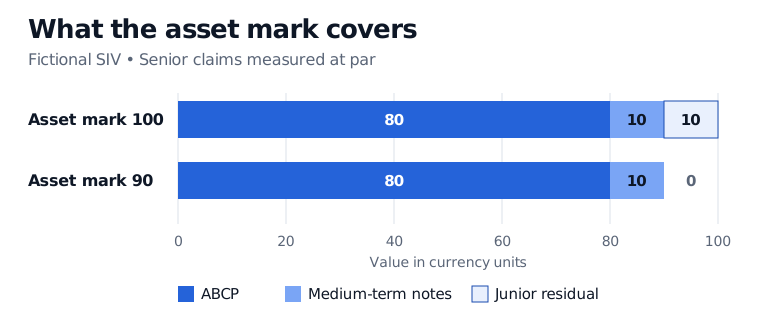
The asset mark falls by 10 currency units, consuming the entire junior cushion when senior claims are measured at par.
That zero is a result of the valuation assumptions. A lower bid can reflect reduced market liquidity or worse expected cash flows. Actual credit losses depend on collections and recoveries. A contractual wind-down depends on the tests in the vehicle documents, and legal insolvency has its own criteria. The CGFS documented both cash-outflow tests and capital tests, including net asset value triggers in some SIVs. Committee on the Global Financial System, Annex 3.2
The cash test can fail at the original mark of 100. Suppose 12 of the 80 of ABCP falls due tomorrow, with 4 held in cash as part of the 100 in assets. If the SIV cannot roll the paper by issuing new notes and no collections or committed draws arrive by the deadline, the vehicle needs another 8 in cash. Its junior residual was still 10 at that mark. To estimate funding liquidity risk, put the maturities and available cash on the same dated schedule. Count sale proceeds only if the trade can settle in time, at a price the market will actually pay.
What happened in 2007
In the Federal Reserve study, U.S. ABCP outstanding for SIVs fell from USD 84 billion at the end of July 2007 to USD 15 billion at the end of December. The authors found SIVs were especially prone to runs and pointed to both concerns about holdings such as mortgage-backed securities and the lack of full liquidity support. If vehicles sell into the same falling market, those sales can depress bids and push other vehicles towards their own wind-down triggers. Covitz, Liang and Suarez, §IV(b) and Table 2 Committee on the Global Financial System, Box 2