A soft-dollar arrangement uses commissions paid by client accounts on securities trades to buy research or other brokerage services for the investment manager. The clients pay through their trades, and the adviser gets services it would otherwise have to buy or produce itself. The commission belongs in the client’s transaction costs. That benefit can influence which broker the adviser picks and how often it trades to generate commission credits. SEC Release 34-54165, §I
What the extra commission tells you
A fictional U.S. adviser can send the same set of stock orders to a broker that charges USD 1,200 and supplies research, or to an execution-only broker that charges USD 800. Assume both brokers offer comparable execution quality and settlement terms for orders of this size and urgency. Under the bundle, the client accounts pay the full USD 1,200. They bear the USD 400 difference through their commissions.
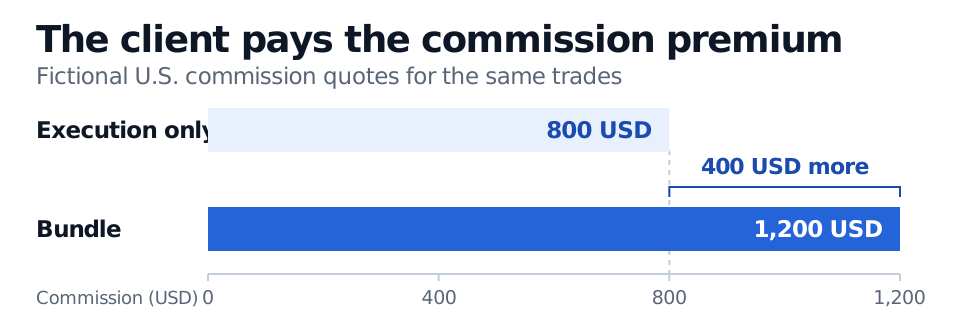
The execution-only quote gives a benchmark for the extra commission. A separately quoted research price would give the adviser another piece of evidence for valuing the research.
What qualifies under U.S. Section 28(e)
Section 28(e) of the Securities Exchange Act gives managers exercising investment discretion a limited safe harbor. It protects a manager against a claim based solely on paying a higher securities commission if the manager determines in good faith that the commission is reasonable in relation to the value of the brokerage and research services the broker-dealer provides. The manager can assess that value for the particular transaction or in light of its overall responsibilities for discretionary accounts. The statute excludes security futures products. 15 U.S.C. § 78bb(e)
The SEC’s 2006 interpretation asks three questions. SEC Release 34-54165, §§III.B–G
- Is the service eligible? Issuer analysis and securities market data can qualify as research. Services involved in effecting trades, such as routing and settlement, can qualify as brokerage. Office rent, furniture and general administrative software fall outside the safe harbor.
- How does the adviser actually use it? The service must give lawful and appropriate assistance in carrying out the adviser’s investment responsibilities. For a mixed-use service, the adviser makes a reasonable allocation based on actual use and keeps records supporting it.
- Is the commission reasonable in relation to what the adviser receives? The adviser makes that judgment in good faith. A standalone research quote can inform the analysis. The USD 400 commission difference by itself establishes only the extra client charge.
Suppose instead that the adviser is considering a separately quoted USD 400 portfolio analytics service. The service supports investment decisions and client marketing. If the adviser can substantiate a USD 300 allocation to eligible investment use, that is the portion it can consider paying with client commissions under the safe harbor. The adviser pays the remaining USD 100 for marketing from its own funds. The allocation comes from how the product is used. The difference between the two brokers’ quotes supplies no evidence for that split. SEC Release 34-54165, §§III.F–G
The adviser’s fiduciary duty still requires it to seek best execution when it chooses brokers. Compare commissions alongside fill prices, completion and execution capability on orders of similar size and urgency. The SelfMadeQuant Post-Trade Analysis lesson (public preview, full lesson for members) shows how to include explicit fees and unfilled shares in that comparison. SEC Release IA-5248, §II.B.2
An adviser that receives soft-dollar benefits needs to describe the actual conflicts with enough detail for clients to make an informed decision. Form ADV Part 2A asks about the research and other benefits received, the incentive to route trades for those benefits, whether clients may pay higher commissions, and which accounts benefit. One account’s trading can pay for research that the adviser uses across several accounts. SEC Release IA-5248, §II.C · Form ADV Part 2A, Item 12.A.1
What unbundling changes
Research unbundling separates the price of research from the price of executing trades. With separate prices, the adviser can compare execution providers on comparable orders and judge whether a research service is worth renewing. Who pays is a separate decision. An adviser can pay a research invoice from its own budget. In a U.S. client commission arrangement, a broker that effects trades can track a separately negotiated research charge as part of the commission the client pays. The broker can use that amount to fund qualifying third-party research when it meets the SEC’s conditions for providing the research. The price is visible and the client still bears the charge. SEC Release 34-54165, §§III.G–I · Loomis Sayles Funds II’s 2020 filing, “Client Commission Arrangements”
Sources
- U.S. Securities Exchange Act §28(e), 15 U.S.C. § 78bb(e)
- SEC Commission Guidance Regarding Client Commission Practices, Release 34-54165, effective 24 July 2006
- SEC Commission Interpretation Regarding Standard of Conduct for Investment Advisers, Release IA-5248, effective 12 July 2019
- SEC Form ADV Part 2A, Item 12.A.1, Research and Other Soft Dollar Benefits
- Loomis Sayles Funds II’s 2020 filing, “Client Commission Arrangements”