A reinsurance sidecar is a vehicle that lets outside investors take on underwriting risk from a defined book of insurance or reinsurance business. An industry loss warranty (ILW) is a protection contract with a payout tied to a measure of insured losses across the industry from a specified event or set of events. A sidecar can add capacity for a sponsor to underwrite more business. An ILW buyer can transfer part of its exposure to a large industry event. Aspen Insurance Holdings, 2024 Form 10-K, “Aspen Capital Markets” · Pioneer Diversified High Income Fund, 2022 Annual Report, “Structured reinsurance investments”
A sidecar takes a share of a book
When a sidecar uses quota-share reinsurance, the sponsor cedes an agreed percentage of covered premiums and corresponding losses to the vehicle. Investors supply capital that can secure the vehicle’s obligations. Their results depend on claims in the ceded book, premiums and the agreed costs and commissions. Heavy covered claims can consume investor capital. Aspen’s 2024 filing describes using collateralised quota-share sidecars to bring third-party capital into defined portfolios. Aspen Insurance Holdings, 2024 Form 10-K, “Aspen Capital Markets” · Pioneer Diversified High Income Fund, 2022 Annual Report, “Structured reinsurance investments”
An ILW can jump at the trigger
Consider a fictional ILW that pays USD 20 million if the contract’s designated index report puts insured industry loss from a qualifying event at USD 10 billion or more. There is no buyer-loss condition in this example. Let denote the reported industry loss in USD billions. The payout in USD millions is
where the indicator equals one when the stated condition holds and zero otherwise. This all-or-nothing shape resembles a digital payoff. The stipulated report is USD 11 billion, so the payout is USD 20 million, before the cost of buying protection. A report of exactly USD 10 billion also pays USD 20 million because the clause says “or more.”
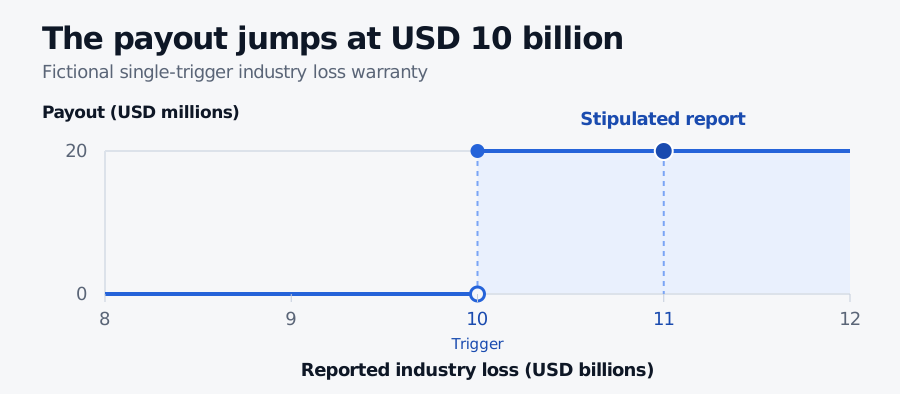
The filled dot at the threshold includes equality. Once triggered, the fictional contract pays the same amount for any higher qualifying loss report.
The operative number comes from the named index and the report the contract specifies, with any adjustments the wording calls for. Check which perils, regions and loss categories count, as well as which report date or revision controls settlement. Verisk’s Property Claim Services, for example, can revise its preliminary industry loss estimates as claims develop. In some ILWs, a second trigger requires the buyer’s own covered losses to exceed a separate threshold. In an indemnity-based design, those losses can also determine how much the contract pays once both conditions are met. Verisk PCS methodology, “Catastrophe insured loss reporting” · Gatzert, Schmeiser and Toplek, §2.1
When the industry estimate misses the buyer’s loss
An insurer concentrated in one coastal county can face heavy claims even when the industry report falls below the trigger. Conversely, a widespread event can trigger the single-trigger cover while largely missing that insurer’s policies. This mismatch is basis risk. To assess the cover, model the insurer’s own losses and the industry index for the same events. A trigger frequency tells you how often the contract pays. The joint scenarios show how often it pays when the insurer’s own losses are large. Gatzert, Schmeiser and Toplek, §§1 and 2.3
Sources
- Aspen Insurance Holdings, 2024 Form 10-K, “Aspen Capital Markets”
- Pioneer Diversified High Income Fund, 2022 Annual Report, “Structured reinsurance investments”
- Verisk, Everything You Need to Know about PCS, §I
- Gatzert, Schmeiser and Toplek, An Analysis of Pricing and Basis Risk for Industry Loss Warranties, working-paper version