A side pocket separates illiquid fund assets and gives eligible investors a distinct claim with its own payout terms.
Side Pockets and Illiquid Asset Segregation
A side pocket segregates hard-to-sell or hard-to-value investments from a fund's main portfolio and gives eligible investors a separate interest in those assets. The main portfolio can deal under its own terms while the eligible investors keep their share of the pocket's gains and losses. For an allocator forecasting cash, the key distinction is between the value reported for each interest and when that interest can pay out. FCA investor guide to side pockets
One interest becomes two
A fictional fund has net asset value (NAV) of USD 100 million, including an illiquid asset marked at USD 15 million. On the effective date, the fund allocates that asset to a pocket and gives an eligible investor with a 10% fund interest 10% of each sleeve. Assume the mark stays the same at the split, with no sale, fees or cash flows.
Marked interests, USD millions
Before segregation
At segregation
Fund
100 in one portfolio
85 in the liquid sleeve + 15 in the pocket
Eligible 10% investor
10 in one interest
8.5 in the liquid sleeve + 1.5 in the pocket
The split preserves the investor's combined marked value.
0.10(100−15)+0.10(15)=8.5+1.5=10.
The fund pays out zero cash and realises no gain at segregation. If the investor later redeems the liquid interest under the fund's terms, they can still hold the pocket interest. In a separate scenario with no prior redemption, if the fund later writes the pocket down from USD 15 million to USD 5 million while the liquid sleeve stays at USD 85 million, the investor's pocket mark falls to USD 0.5 million and their combined marked value falls to USD 9 million.
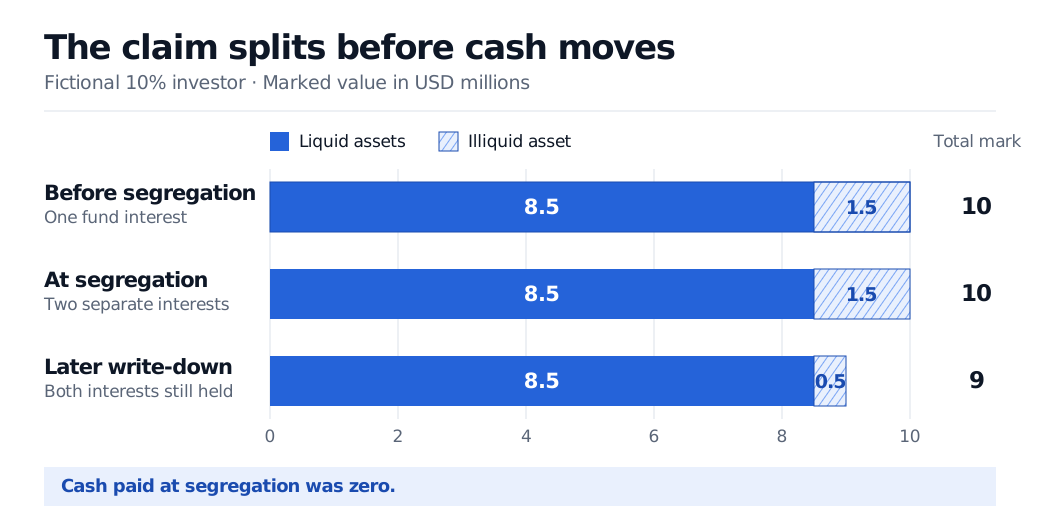
Three bars show a fictional 10% investor's marked value in USD millions. Before segregation, one interest is worth 10. At segregation, the two interests are worth 8.5 and 1.5, totalling 10, with zero cash paid. A later write-down leaves 8.5 and 0.5, totalling 9.
Bar widths show marked value. The later write-down assumes the investor still holds both interests.
Which claim can pay, and when?
A redemption gate caps how much eligible investors can withdraw over a period. A side pocket assigns specified assets to a separate claim with its own dealing or distribution terms. Both tools can apply to the same fund. The pocket can reduce pressure to sell the segregated asset to meet ordinary redemptions, but the asset's market liquidity still determines how easily the fund can sell it. An asset can carry a positive mark under the fund's valuation policy and still have no executable bid. Evanston Multi-Alpha Fund prospectus, Calculation of Net Asset Value
In a split like this, new subscribers can enter the liquid sleeve without buying into the original asset. Cash-flow estimates depend on the fund documents and applicable rules for effective-date eligibility, redemption or distribution timing, and the fees and expenses charged to each sleeve. A pocket that pays out from asset disposals may yield little or no cash after costs. FCA investor guide to side pockets
The UK's FCA introduced COLL 7.8, effective 11 July 2022, in response to Russia's invasion of Ukraine. The section allows qualifying UK authorised UCITS and non-UCITS retail schemes to set up classes for defined affected investments under specified conditions. For these classes, COLL 7.8.36 bars preliminary issue charges, redemption or cancellation charges, and performance-related management fees. Permitted operating costs can still erode proceeds. FCA policy statement PS22/8 · FCA Handbook COLL 7.8
For a worked account of how redemption pressure drives executable prices below model marks during a crowded unwind, see Arbitrage Crashes and Forced Deleveraging. The preview is public and the full lesson requires membership.