A fund of funds invests primarily in other funds. An investor owns shares or interests in the outer fund, often called the wrapper, and gains exposure to the holdings of the underlying funds. Fee layering occurs when both levels charge costs. The underlying funds pay their expenses from their own assets, reducing the value of the wrapper's holdings. Any expenses the wrapper charges then reduce the value left for its investors. A net return comparison depends on knowing which of those costs the reported series already reflects. SEC investor bulletin on mutual fund and ETF fees
Follow the two fee bases
Suppose a fictional investment opens at USD 100 and finishes at USD 110 before fees. There are no cash flows, taxes or carried interest. The underlying fee is assessed at the end of the period as 1% of opening value, so USD 1 comes out of USD 110 and leaves USD 109. The wrapper then charges 0.5% of that USD 109, or USD 0.545. The investor ends with
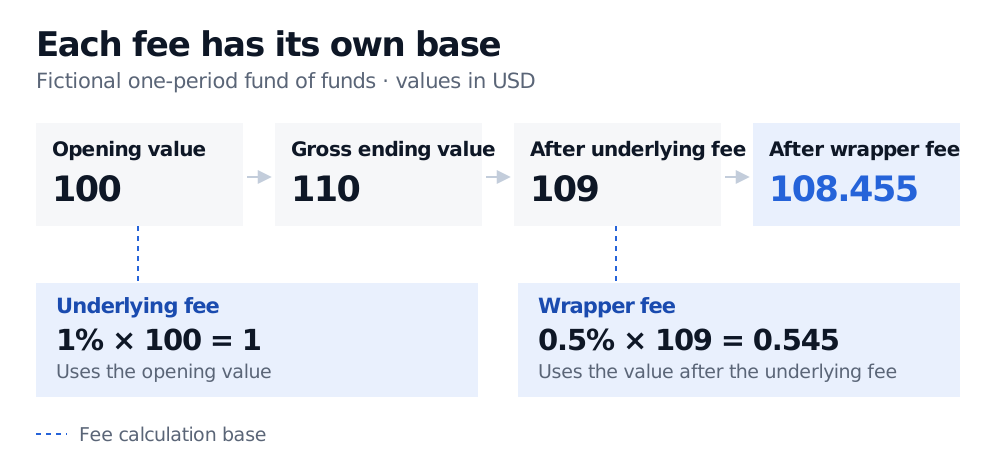
Dashed lines trace each fee to its calculation base. The underlying fee uses opening value, and the wrapper fee uses the amount left after the underlying charge.
Here the gross return is 10% and the investor's return after both fees is 8.455%. Subtracting the quoted rates from the gross return would give 8.5%, as if both charges used opening value. In a model built from the underlying fund's reported 9% return after its own fee, start the wrapper calculation at USD 109. If the input is the wrapper's reported 8.455% return after both layers, both fees are already accounted for. Actual fee bases and accrual schedules come from the fund documents. The rates in this example apply once to the stated balances.
Read what the prospectus total includes
In a U.S. open-end fund prospectus filed on Form N-1A, Acquired Fund Fees and Expenses (AFFE) generally appears as a line within the annual operating-expense table. It captures costs borne indirectly through investments in other funds and is included in the table's total. The expense ratio in the wrapper's financial highlights can differ because that ratio reflects its own operating expenses. SEC Form N-1A, Item 3
The January 2026 summary prospectus for Vanguard Target Retirement 2055 Fund Investor Shares shows the distinction. The fund holds other Vanguard mutual funds and lists a 0.00% management fee, 0.08% AFFE and 0.08% total annual fund operating expenses. Use the 0.08% total as printed when comparing operating expenses. Adding AFFE to it would count the underlying expenses twice. Vanguard Target Retirement 2055 Fund summary prospectus, 28 January 2026
The AFFE calculation generally uses underlying funds' annualised expense ratios from shareholder reports, along with the amounts invested and the days held. SEC staff explains that the relevant reports are those available when the wrapper calculates AFFE. The disclosed figure can therefore reflect earlier holdings and expense data. A private wrapper can use different terms and reporting schedules. For a private hedge fund allocation, the offering documents and investor reports help identify the fee bases and whether reported performance reflects charges at both levels. SEC staff guidance on AFFE timing, SEC hedge fund investor bulletin
What does the wrapper add?
In the fictional ledger, a direct holding in the same underlying portfolio on the same terms would still bear USD 1. The incremental wrapper cost is USD 0.545. A like-for-like comparison weighs that extra cost against a specific service. For example, the Vanguard wrapper shifts its asset mix as the target date approaches and thereafter. The relevant comparison is the cost and effort of maintaining a comparable allocation yourself, including rebalancing. For a multi-manager wrapper, compare the underlying exposures and liquidity as well, since different fund names can conceal overlapping holdings. Vanguard summary prospectus, principal investment strategies
The expense-ratio section of Mutual Funds, ETFs, and Fund Structure connects recurring fund fees with the difference between gross and net performance. The linked page is a public preview, and the full lesson requires membership.
Sources
- SEC Form N-1A, Item 3, instructions for annual fund operating expenses
- SEC staff, Questions Regarding Disclosure of Fund of Funds Expenses, question 4
- Vanguard Target Retirement 2055 Fund Investor Shares, summary prospectus, 28 January 2026
- SEC Investor.gov, Mutual Fund and ETF Fees and Expenses, fund-of-funds section
- SEC, Hedge Funds investor bulletin, offering documents, performance and fees