A redemption gate limits fund withdrawals. See how fund-level and investor-level gates, allocation bases and deferred requests change the cash an investor receives.
Redemption gate
A redemption gate limits how much investors can withdraw from a fund on a redemption date or over a specified period. In a hedge fund, the fund documents set the mechanism, subject to applicable law. For a quant planning cash flows, a withdrawal request is therefore not the same as cash available to meet an obligation.
A gate can give the manager more time to sell assets, reducing pressure to accept distressed prices. The cost falls partly on investors who must wait. It changes the timing of access to capital; it does not create cash or establish that the portfolio is solvent. The AIMA/CAIA liquidity paper, pp. 12–13, describes how fund withdrawal terms interact with asset liquidity.
A 10% gate does not mean 10% of your request
Consider a fictional hedge fund with these stipulated terms for one redemption date:
Pre-redemption net asset value (NAV) is USD 100 million.
Total eligible redemption requests are USD 30 million.
An activated fund-level gate caps aggregate withdrawals at 10% of that same pre-redemption NAV.
Capacity is allocated in proportion to eligible amounts requested; unfulfilled requests carry forward. There are no priority tiers, additional fees or NAV changes in this single-date arithmetic.
The permitted aggregate withdrawal is 0.10×100=10 million. Each eligible request receives the fraction
Fulfilled fraction=3010=31.
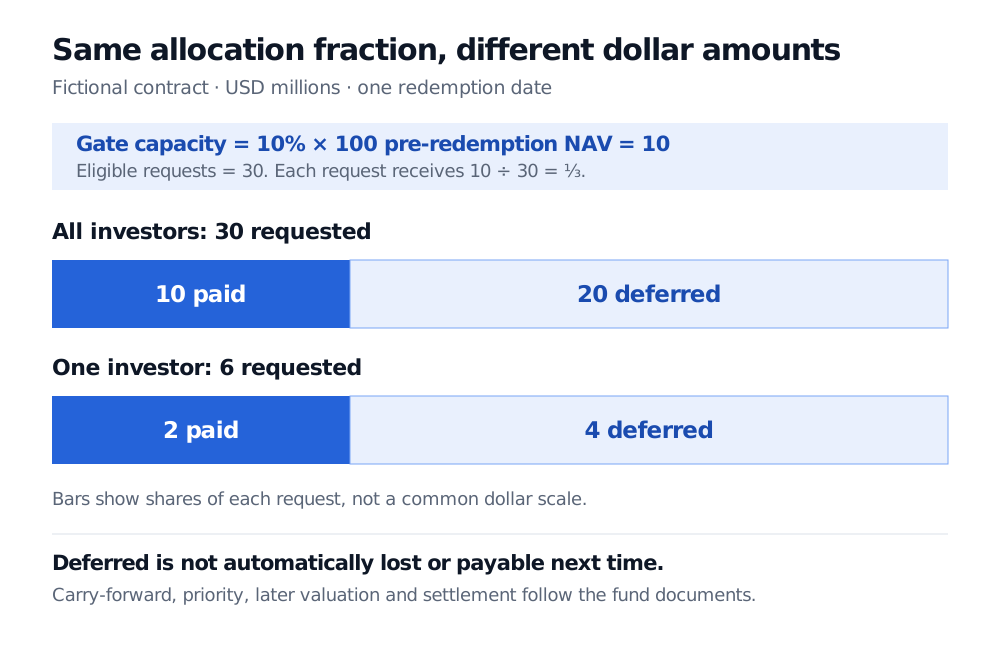
An investor requesting USD 6 million receives USD 2 million, with USD 4 million deferred. The remaining investors requested USD 24 million; they receive USD 8 million and have USD 16 million deferred. Across the fund, USD 10 million is paid and USD 20 million is deferred.
Fictional fund with USD 100 million pre-redemption NAV and USD 30 million requests pays USD 10 million and defers USD 20 million under a 10 percent NAV gate. An investor requesting USD 6 million receives USD 2 million and has USD 4 million deferred. Both receive one third of their requests.
Fictional contract, one redemption date, USD millions. Each bar shows proportions of its own requested amount; bar lengths do not share a dollar scale. No fees or NAV movement.
Multiplying the investor's USD 6 million request by 10% would give USD 0.6 million and use the wrong base. Here, 10% applies to the whole fund's starting NAV; one third applies to each request. Neither 10% nor request-based pro rata is a universal rule.
Read the denominator and the queue
A fund-level gate constrains aggregate redemptions. An investor-level gate constrains an individual investor's withdrawal, potentially even when no one else requests money. The 2021 AIMA/PwC report, p. 31, illustrates the fund-versus-investor distinction. The two may coexist; a share-class restriction can have a different scope again. AIMA/CAIA, p. 13 and footnote 8 on p. 17, also distinguishes these bases and allocation by request size versus investor holdings.
The documents must resolve more than the headline percentage:
Contract term
Why it changes the result
Measurement base and date
A percentage of fund NAV, share-class NAV or an investor's holdings is a different capacity calculation.
Trigger and discretion
Crossing a threshold may permit activation rather than require it.
Allocation rule
Request-based pro rata, holdings-based allocation and priority tiers need different calculations.
Treatment of the remainder
Check automatic carry-forward, cancellation or resubmission, and whether older requests rank ahead of new ones.
Valuation and settlement
A dealing date, the applicable NAV and the date cash arrives are separate inputs.
Deferred does not mean written off. It also does not mean guaranteed payment at the next date. Where the unredeemed interest remains invested, later market moves and fees can change its value. AIMA/CAIA, pp. 13 and 16–17, explains continued investment and priority provisions. Its historical observations about industry practice should not replace the actual contract.
A lock-up limits when withdrawal rights begin; notice specifies how early a request must arrive; a gate limits the amount processed; a suspension can stop redemptions altogether. The SEC's hedge-fund investor guidance identifies withdrawal restrictions and possible suspension as matters to check in the offering materials.
Cash-flow modelling needs a gated scenario
For an allocator facing its own payment deadline, model the withdrawal under the stated gate and queue rules alongside the ordinary dealing terms. In the example, treating the USD 6 million request as immediately available cash overstates that date's receipts by USD 4 million. A longer notice period alone would not fix this error.
The fund's ability to sell assets concerns market liquidity risk; the investor's ability to meet a deadline concerns funding liquidity risk. A gate connects those problems by slowing withdrawals. Liquidity and Limits to Arbitrage develops the related risk that withdrawals and financing pressures force a strategy to exit before its investment thesis pays off. Its preview is public; the full lesson requires membership.
The U.S. money-market-fund historical trap
Older discussions may describe temporary gates under U.S. money-market-fund Rule 2a-7. The SEC's 2023 reform removed that gate provision, effective 2 October 2023. The adopting release, §II.A.2 explains the concern that anticipation of a gate could encourage early withdrawals. The current Rule 2a-7 instead includes its applicable liquidity-fee framework; a fee and a withdrawal limit are different mechanisms.
This did not abolish contractual gates across hedge funds. Nor did it abolish every possible money-market-fund suspension: Rule 22e-3 retains a conditional exemption connected with liquidation, including board approval and SEC notification. Product type, jurisdiction and the operative documents determine which rules belong in the model.