Annual recurring revenue (ARR) is the annualised run rate of recurring revenue at a measurement date. Net revenue retention (NRR) measures how much revenue the same customers generate relative to an earlier period or date, including the effects of upgrades, downgrades and cancellations. Customer acquisition cost (CAC) payback estimates how many months of gross profit it takes to recover the cost of winning customers. For a software-as-a-service (SaaS) business, rising ARR can coincide with a shrinking opening cohort or slower payback on new customers. ChartMogul, Annual Run Rate, Net MRR Retention and CAC Payback Period.
Follow the opening customers
For fixed subscriptions, one convention takes monthly recurring revenue (MRR), the normalised monthly subscription run rate, and multiplies it by 12. A one-time setup fee stays outside that run rate. Consider a fictional company with opening ARR of USD 100 thousand per year. Over one year, upgrades add 20, downgrades subtract 5 and cancellations subtract 10 from those same customers. Assume no currency effects, acquisitions or reactivations. The opening cohort finishes at 105. Customers acquired during the year add 24 of closing ARR, bringing the company total to 129. ChartMogul, Annual Run Rate report.
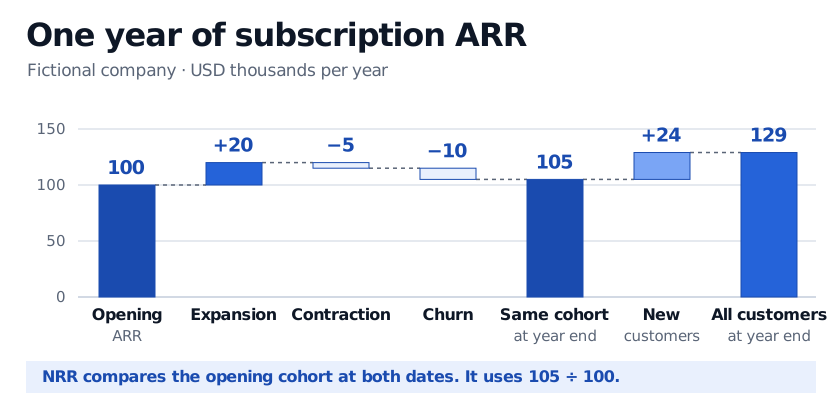
Of the 29 added to ARR, the opening cohort accounts for 5 and new customers account for 24.
An NRR above 100% can conceal customer losses. The upgrades here more than offset the 15 lost to downgrades and cancellations. Under the same conventions, gross revenue retention excludes the 20 of expansion, so it is 85%. Both measures weight by revenue. To measure how many customer accounts stayed, use customer retention. ChartMogul, Net MRR Retention report.
Match acquisition spend to the new cohort
Suppose the company spent USD 24 thousand in attributable sales and marketing costs to win the new cohort. Its closing ARR of 24 corresponds to MRR of 2, in USD thousands. At an 80% gross margin, the cohort earns 1.6 thousand of gross profit per month after the cost of delivering the service. If subscriptions continue at that run rate and margin, with no churn or discounting of future gross profit, the simple estimate is
CAC usually means acquisition spend per new customer. Dividing both cohort totals by the same customer count gives the equivalent per-customer calculation. Check which sales costs are allocated to new customers and when the spend occurred. A long sales cycle can put much of the spend in a prior quarter. Using net new ARR across the whole business would bring the existing cohort’s changes into a new-customer calculation. At 15 months, payback extends beyond a one-year subscription and depends on customers staying past that term. If the new cohort ramps up slowly or shrinks, use its projected monthly gross profits and find when their sum reaches acquisition spend. ChartMogul, CAC Payback Period, Updata Partners, SaaS Metrics Framework.
Read the definition in the filing
In its FY2026 Form 10-K, CrowdStrike annualises subscription contracts at the reporting date, assumes renewals on existing terms for contracts expiring within the following year and can include expired subscriptions while actively negotiating renewal. Its retention rate compares ARR for the same subscription customers at two dates 12 months apart. Snowflake instead divides the second year’s product revenue by the first year’s product revenue for a cohort of capacity-contract customers who used its platform in the first month of the first year. In that convention, the timing and volume of consumption affect retention. For issuer comparisons, check the revenue basis, measurement window, cohort rules and treatment of renewals, usage, foreign exchange and acquisitions. CrowdStrike FY2026 Form 10-K, Key Metrics, Snowflake FY2026 Form 10-K, Key Business Metrics.
ARR is a snapshot. Recognised revenue measures what the company earned over a period as it delivered service, and deferred revenue is a liability for service still owed on amounts paid or due. In a separate billing illustration, assume the new cohort prepays USD 24 thousand for a year of service delivered evenly. At the end of the first month, the cohort still has ARR of 24 thousand per year. The company has recognised 2 thousand of revenue and carries 22 thousand of deferred revenue. Cash collection happened up front, so the 15-month gross-profit payback estimate answers a different question from when cash comes in. CrowdStrike FY2026 Form 10-K, Note 1, Deferred Revenue and Revenue Recognition.