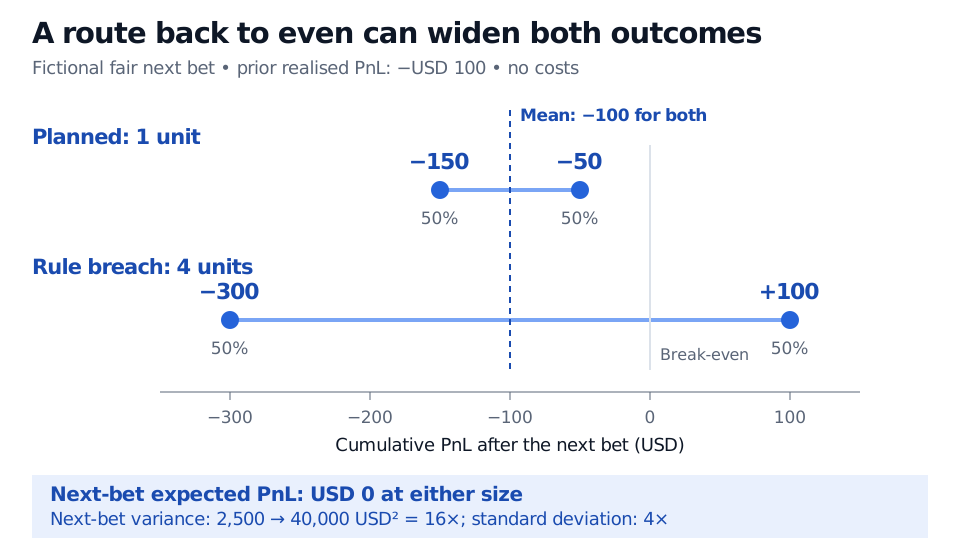
Revenge trading lets the urge to recover a loss override a trading plan. A fair-bet example separates a chance to get back to even from an improvement in expected PnL.
Revenge trading
Revenge trading is impulsive trading driven by the urge to recover a recent loss, with that urge overriding the trader's intended decision process or risk limits. It can mean raising size, forcing an entry without the usual signal, or taking a new position mainly to erase the day's deficit. For a quant, the practical consequence is that the executed strategy has acquired a loss-dependent risk rule that may never have been researched.
The defining issue is the recovery motive and departure from the decision process. A trade after a loss is not automatically revenge trading. A planned hedge, a model-driven rebalance or a justified update to forecasts can change the optimal position after a loss. An increase in one instrument's position can even reduce the whole portfolio's risk.
“Get back to even” changes the question
Consider a fictional trader who has already realised a loss of USD 100. Their pre-existing rule permits one unit on the next opportunity. Instead, wanting to recover immediately, they override it and trade four units.
To isolate the sizing decision, stipulate that the next opportunity is independent of the past and has two equally likely outcomes: +USD 50 or −USD 50 per unit. All units share the same outcome. There are no fees, slippage or funding costs. These are supplied teaching probabilities, not estimates for financial markets.
Next decision
Next-bet PnL, win / loss
Cumulative PnL, win / loss
Expected next-bet PnL
Follow the rule: 1 unit
+50 / −50 USD
−50 / −150 USD
0 USD
Override it: 4 units
+200 / −200 USD
+100 / −300 USD
0 USD
At one unit, neither outcome recovers the original loss. At four, the winning branch ends USD 100 above the starting point. The chance of finishing at or above that point has changed from zero to one-half in this toy model. But the losing branch now leaves a USD 300 deficit, and expected cumulative PnL remains −USD 100 under both decisions.
The attraction of recovering the loss has displaced the question of whether the next position offers a better opportunity. Increasing size has not improved the bet's expected value.
Fictional fair next bet after a realised USD 100 loss: one unit ends at cumulative PnL minus 150 or minus 50; four units ends at minus 300 or plus 100. Each outcome has 50% probability, and both means are minus 100. Next-bet variance rises from 2,500 to 40,000 USD squared.
Original fictional scenario. Four units are exposure to the same next outcome, not four independent bets. The wider position creates a chance to recover the prior loss while multiplying next-bet variance by sixteen.
Let X be next-bet PnL for one unit and q the number of units selected before its outcome is known. Here E[X]=0 and Var(X)=2,500 USD squared. Because the larger position scales the same payoff,
E[qX]=qE[X]=0,Var(qX)=q2Var(X).
Four units therefore have variance 16×2,500=40,000 USD squared: sixteen times the variance, or four times the standard deviation. This is not the variance calculation for four independent bets. The Expectation, Variance and Covariance lesson develops the mean-versus-spread distinction; the full lesson requires a free account.
In a real strategy, a loss may reveal new information, reduce available capital or alter constraints. The independence assumption deliberately removes those channels. The calculation neither recommends one unit as an optimal size nor establishes that trading after a loss is always unattractive.
What the research supports
Thaler and Johnson's 1990 experiments found that opportunities to break even can become particularly attractive following losses. Their work concerns how prior outcomes enter subsequent risky choices; it does not imply that every loss increases risk-taking.
Coval and Shumway's study of CBOT Treasury-bond futures market makers found greater afternoon risk-taking following morning losses than following gains. The published paper examines competing explanations, including wealth, margin and incentive effects (§I.C), and tests the relationship using several risk measures (§III). Its historical trading-record evidence supports studying loss-conditioned behaviour; it does not identify anger or a rule breach in every individual trade.
The direction of the response also depends on how the loss is experienced. In Imas's experiments, risk-taking was lower after realised losses than after otherwise comparable paper losses. Our fictional trader's reaction to a realised loss is a stipulated case, not a claim about the average experimental response. “Revenge trading” is a trading-behaviour description here, not a clinical diagnosis.
Nor is it interchangeable with loss aversion, which concerns the relative subjective weight of losses and gains, or the disposition effect, which concerns realising winners more readily than losers. A trader can close a losing position and then chase recovery in a different instrument.
Audit the decision that existed before the result
A useful review preserves the signal, permitted size, total portfolio exposure, information available and reason recorded at decision time. Then compare the actual trade with the policy that was in force. Did new evidence justify the change, or did the loss-recovery target become the reason to relax an entry criterion or exposure limit?
For systematic research, a backtest of a fixed sizing rule does not validate discretionary overrides made after losses. If a proposed adaptive policy changes size after losses, specify that policy explicitly and evaluate it with realistic costs, constraints and information timing. It then has measurable behaviour that can be compared with the original rule.
A profitable recovery does not retroactively validate an unsupported override; that would be outcome bias. Equally, a subsequent loss does not prove that a documented hedge was irrational. Precommitted review triggers or order limits can make departures visible, but this example establishes no universal cooling-off period, daily stop or trade-count limit. Those controls require a stated objective and evidence about the strategy they govern.