Outcome bias confuses a realised result with decision quality. Separate the information and objectives available at the time from what later outcomes can teach.
Outcome bias
Outcome bias is judging a decision by its realised result in a way that disregards the information, alternatives and objectives available when the decision was made. On a trading desk, this can mean rewarding a rule-breaking trade because it made money, or condemning a justified trade solely because it lost. Profit and loss matter; a single result is an unreliable substitute for evaluating how the risk was chosen.
The winner can have the worse proposition
Consider two fictional, one-shot money gambles. All probabilities and payoffs are known before the choice. The decision maker is risk-neutral, maximises expected monetary payoff, can afford either loss, and faces no additional costs or constraints.
B is preferable under the stated objective. A's high win probability conceals a loss large enough to outweigh its frequent small gains.
Now reveal one selected result for each gamble: A wins +1; B loses −1. A delivered the better result. It did not thereby become the better choice before the draw. Calling A's decision superior solely because it won is the error. Nor does B's loss prove the decision maker was incompetent.
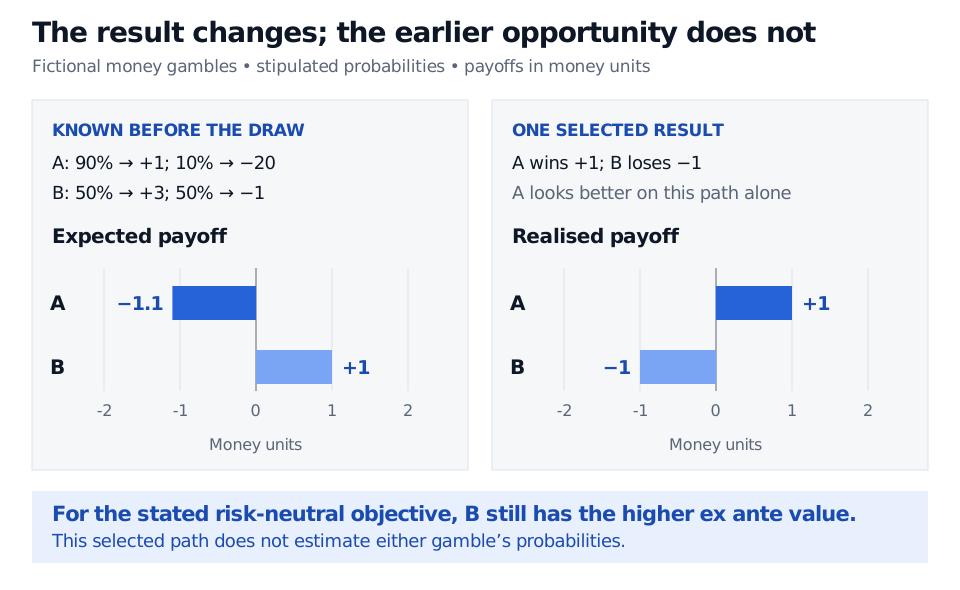
Fictional known gambles: A has a 90% chance of plus 1 and 10% of minus 20, giving expected payoff minus 1.1; B has equal chances of plus 3 and minus 1, giving expected payoff plus 1. One selected result instead gives A plus 1 and B minus 1. The expected-payoff ranking remains B above A.
Original fictional example with known probabilities and payoffs in money units. The two panels use the same scale. The selected realised results reverse the ranking of the expected payoffs, without changing either opportunity before the draw.
Expected money is the criterion in this example because it was explicitly stipulated. With different utility preferences or risk aversion, capital limits or obligations, decision quality requires those considerations too. In a real strategy, the probabilities themselves are estimates to challenge. “It had positive expected value” is not a defence if that expectation came from an invalid model or ignored available evidence.
What the experiments isolate
Baron and Hershey's 1988 experiments, using undergraduate participants and medical or monetary scenarios, varied outcomes while controlling relevant decision information. Favourable outcomes improved evaluations of thinking or competence. These were controlled judgement tasks, not estimates of the prevalence or financial cost of the bias among professional traders.
The distinction from hindsight bias is useful: hindsight changes how foreseeable an outcome seems; outcome bias changes the evaluation of the decision. “The loss was obviously going to happen” differs from “the decision was bad because it lost.” They can occur together. The original paper separates these channels on pp. 570–571.
Review the decision, then use the result
A practical review can keep two records side by side:
Record
Questions to answer
Decision at the time
What was known? Which alternatives were feasible? Were the forecast, sizing and risk limits defensible?
What subsequently happened
What was earned or lost? Did execution match the plan? What evidence challenges the model or its assumptions?
This is a proposed review structure, not a claim that a checklist eliminates the bias. Write down the reasoning before the result arrives, including the forecast distribution and what would count against the thesis. Otherwise the explanation can quietly change to fit the realised path. A useful counterfactual check is: with the same information and action, would I give the process a different grade if the random outcome had gone the other way?
A profitable trade may still reveal a known limit breach. A losing trade may reveal a previously unknown execution failure. Both warrant investigation, but the relevant evidence is the breach or failure and what could reasonably have been known, rather than the sign of P&L alone. Following a written process also does not make the process sound: the model, controls and available alternatives remain open to criticism.
Outcomes can legitimately teach us about unknown probabilities, hidden information or a changing environment. Baron and Hershey explicitly discuss these uses on pp. 569–571. In research, preserve the full sample and examine the model that connects observations to beliefs; do not turn “avoid outcome bias” into a reason to dismiss persistent failure. Conversely, the stipulated probabilities in the toy example are already known, so the chosen path supplies no new estimate of them.
For a fuller research record, Quant Research Dossier develops an evidence package covering chronology, search history, simulation and bounded recommendations. Its assessment rubric evaluates research quality rather than realised profit. The public page is a preview; the full lesson requires membership.
Sources
Jonathan Baron and John C. Hershey (1988), Outcome Bias in Decision Evaluation, Journal of Personality and Social Psychology, 54(4), 569–579. See pp. 569–571 for the information boundary, legitimate learning and hindsight distinction; pp. 571–572 for Experiment 1; and p. 578 for the discussion and limits concerning judgements of one's own decisions. The gambles and trading-review illustration above are original teaching examples.