A retail liquidity program is an exchange arrangement that reserves specified non-displayed trading interest for qualifying retail orders, seeking better execution prices for those orders. For a quant modelling fills, this changes the accessible order book: seeing a favourable price, or submitting a small order, does not establish permission to trade against that interest.
This is a particular use of hidden liquidity. The exchange knows the resting orders; public market data need not reveal their exact prices and quantities. The liquidity provider chooses to offer a price concession in return for access to the program's qualifying flow. The retail customer accesses the mechanism through a participating broker, rather than directly choosing an exchange order flag.
Three roles behind one fill
For a concrete, dated mechanism, consider Cboe BYX's Retail Price Improvement program, using the rulebook updated 27 October 2026. The worked example uses an ordinary RPI order in a stock priced above one dollar.
| Role | Meaning in the BYX program |
|---|---|
| Retail Member Organization, or RMO | An exchange member, or division, approved to submit Retail Orders. |
| Retail Order | A qualifying natural-person-originated order submitted through an RMO. Eligibility includes restrictions on algorithmic origination and changes to price or side; small size alone is insufficient. |
| Retail Price Improvement order, or RPI order | Non-displayed interest eligible to trade with incoming Retail Orders. For stocks priced at or above one dollar, it must improve the relevant protected bid or offer by at least 0.001 dollars to execute. |
BYX Retail Orders are immediate-or-cancel orders. Its definition permits agency, qualifying riskless-principal and principal orders, with principal orders subject to additional requirements in Rule 11.24(h). These are venue eligibility rules, not a definition of every individual investor's transaction. BYX Rule 11.24(a).
One tenth of a cent, applied to the filled quantity
Take a fictional eligible buy for 1,000 shares. Stipulate an unchanged protected best ask of 50.020 dollars per share, an ordinary RPI sell executable at 50.019, and enough available quantity to fill all 1,000 shares. The buy's limit permits that execution, and all other matching conditions are satisfied.
The price improvement relative to that ask is
The share purchase costs 50,019 dollars, compared with 50,020 dollars at the stipulated ask. The improvement is one tenth of a cent per share, not one cent. For a sale, the favourable direction reverses: a higher execution price improves the seller's receipt relative to the bid.
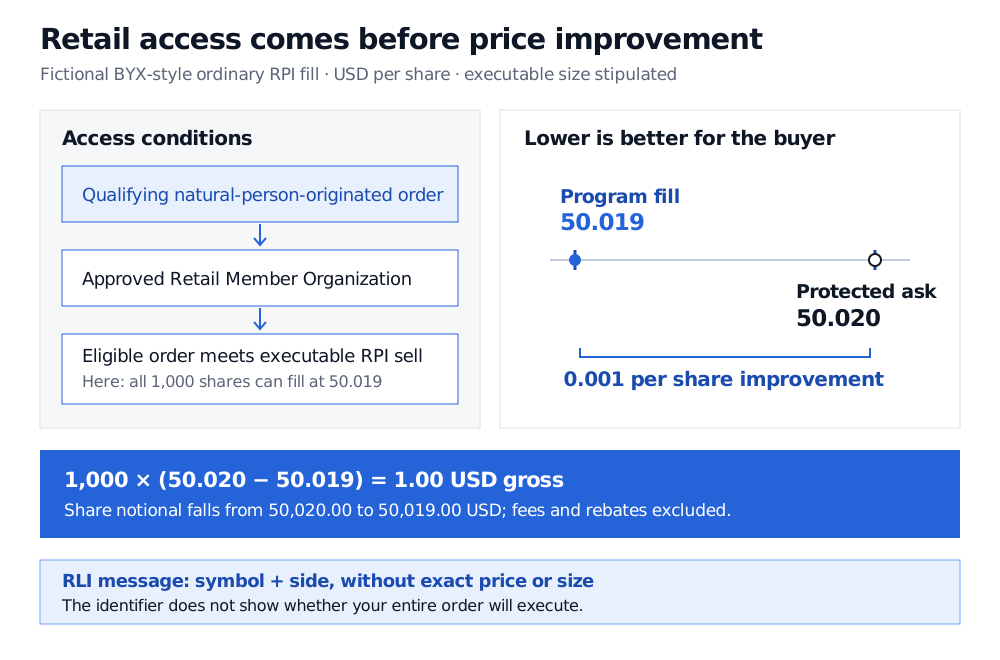
Original fictional BYX-style example. Eligibility and sufficient executable quantity are assumed; the price comparison excludes fees and rebates.
This dollar is a gross price comparison on completed shares. It neither promises a full fill for another order nor establishes the lowest total execution cost. The BYX fee schedule has separate transaction codes and charges or rebates. The customer's commission and any treatment of exchange rebates must also be accounted for separately; an exchange member's rebate is not automatically an additional customer saving.
An indicator is not a quantity commitment
BYX's Retail Liquidity Identifier (RLI) signals the symbol and side of qualifying price-improving interest without publishing its ranked price or size. It cannot establish that 1,000 shares are available for the example. Under BYX's Type 1 designation, a Retail Order seeks RPI and other price-improving interest, and its unfilled portion cancels. BYX Rule 11.24(e)–(f).
A fill model therefore needs the actual venue, eligibility, order instructions, reference quote, arrival time and executable quantity. Applying an assumed improvement to the whole submitted order would manufacture savings on shares that never traded. The Order Books lesson develops the difference between observed depth and justified fill assumptions. It has a public preview; the full lesson requires membership.
The program name does not standardise the rules
Cboe also offers Enhanced RPI orders with a Step-Up Range; their execution pricing can differ from the ordinary fixed-price example. Its current product documentation describes both BYX and EDGX programs. Cboe Retail Price Improvement.
IEX's Retail Program, by comparison, uses non-displayed Retail Liquidity Provider orders that trade with eligible Retail orders at the midpoint. Its retail order instructions and RLI threshold are its own. An RMO label does not make the BYX price grid, minimum improvement, indicator conditions or fees portable across exchanges.
The sub-penny rule also requires care. On 16 January 2026, the SEC granted BYX a limited Rule 612 exemption allowing it to accept and rank RPI interest priced at or above one dollar in 0.001-dollar increments. The exemption is conditional on operation within Rule 11.24; it is not general permission for every exchange order to use that grid. SEC Release 34-104625, §§II–III.
Status checked 31 October 2026: the separate SEC order of 11 June 2026 extends relief from the amended minimum-pricing-increment and access-fee-cap requirements until the first business day of November 2027. The 2024 adoption therefore does not justify assuming those amended requirements already govern this example. This extension concerns the specified amendments, rather than suspending Regulation NMS as a whole. SEC Release 34-105656, §§II–III.
Sources
- Cboe BYX rulebook, updated 27 October 2026: Rule 11.24(a), (e)–(f), eligibility, RPI prices, identifier and order handling.
- Cboe Retail Price Improvement, BYX offering and Enhanced RPI description; accessed 31 October 2026.
- Cboe BYX fee schedule, effective 19 October 2026: Transaction Fees and General Notes; accessed 31 October 2026.
- IEX Equities Retail Program, Retail Order Type and Retail Liquidity Provider; accessed 31 October 2026.
- SEC Release 34-104625, 16 January 2026: BYX's limited Rule 612 exemption, particularly §§II–III.
- SEC Release 34-105656, 11 June 2026: temporary relief for specified Regulation NMS amendments, particularly §§II–III.