A related-party transaction is a transfer of goods, services, money or other resources or obligations between a reporting company and a person or entity related to it. The definition covers arrangements where no price is charged, such as a free guarantee. A supplier controlled by the company's CEO is one example. The relationship matters to an analyst because it can change who gets the benefit of a deal and whether today's margins or payment terms will hold if the company has to use an independent supplier. IAS 24, paragraphs 5–11 and 21
Read the purchase flow and the payable separately
A fictional manufacturer buys USD 50 million of components from a company controlled by its CEO. The vendor sits outside the manufacturer's consolidated group. The manufacturer buys USD 200 million of comparable components from all vendors during the same fiscal year, on the same reporting basis. The related vendor's share of those purchases is . The financial statement note separately reports USD 12 million owed to that vendor at year-end.
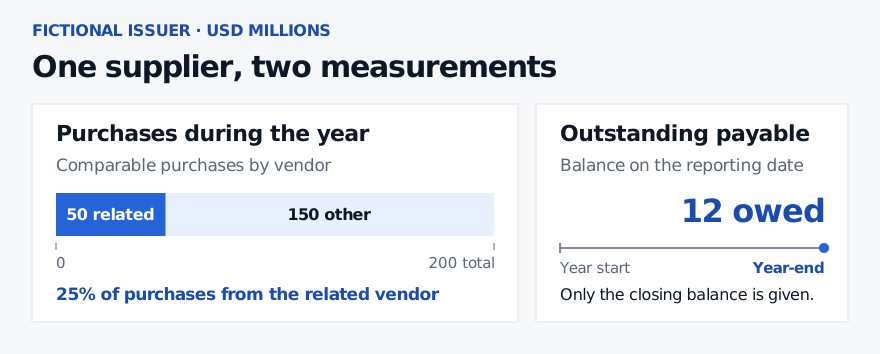
The bar breaks down purchases for the whole fiscal year. The dot marks the date used to measure the payable.
The purchase share measures concentration within the specified component category. Using cost of goods sold as the denominator would mix purchases with the cost of inventory sold, potentially from a different period. The year-end payable can include earlier invoices, and the year's purchases can include invoices already settled. Estimating cash paid would require the opening payable and any non-cash adjustments, such as credits or currency movements, as well as the year's purchases and closing balance.
Reporting scope matters too. Under IAS 24, purchases and balances between entities in the same consolidated group generally cancel on consolidation, even though they can appear in the entities' own statements. There is a specific exception for transactions and balances between an investment entity and subsidiaries it measures at fair value through profit or loss. The CEO-controlled supplier in the example is outside the reporting group, so its payable survives consolidation. A large supplier can also create concentration risk without qualifying as a related party through sales volume alone. IAS 24, paragraphs 3–4 and 9–11
What would change the assessment?
- Who benefits? Match the vendor and the insider's interest across the financial statements and any ownership or governance disclosure. The CEO can influence the buyer's choice and benefit through the supplier. Look for who reviewed the purchase and whether the filing describes any departure from the approval policy.
- How do the terms compare? A similar unit price may tell you little if the company also agreed to prepay, guarantee the supplier's debt or buy a minimum volume. An independent quote is more informative when its volume, quality, delivery and payment terms are comparable. IAS 24 permits a claim that terms were equivalent to an arm's-length deal only when that claim can be substantiated. IAS 24, paragraphs 18, 21 and 23
- Can differences in reporting be explained? Match dates, entities and what each amount measures before treating a discrepancy as a red flag. A transaction amount, a year-end balance and a future purchase commitment can all describe the same relationship. Public filings may show the approval policy without showing the bids or other evidence that would let a reader assess the deal independently. An unexplained premium, guarantee or approval exception would sharpen the question of who bears the costs. Each is a lead to investigate. A finding of wrongdoing would require further evidence. PCAOB AS 2410, paragraphs .11–.12 and .18
Where the rules draw the line
IFRS financial statements. IAS 24 calls for disclosure of the nature of the relationship and information about the transactions and outstanding balances, including commitments, that users need to understand its potential effect. A link to an insider can make information about a modest transaction material if it could influence users' decisions. A purchase percentage alone does not decide what must be disclosed. IAS 24, paragraphs 18–24, IFRS Practice Statement 2, paragraphs 5–8 and examples I–J
U.S. SEC filings. Item 404(a) of Regulation S-K has a separate test. The general test looks for a transaction involving the registrant since the start of its last fiscal year or a currently proposed one. The amount involved must exceed USD 120,000 and a related person must have a direct or indirect material interest. The rule includes exceptions, and smaller reporting companies have a separate threshold under Item 404(d). For a Form 10-K filer, start with Part III, Item 13, and follow any reference to the definitive proxy or information statement. When applicable, Item 404(b) also calls for disclosure of review procedures and certain departures from them. Regulation S-K, Item 404(a), (b) and (d), SEC Form 10-K, General Instruction G(3) and Part III
Sources
- IFRS Foundation, IAS 24 Related Party Disclosures
- IFRS Foundation, IFRS Practice Statement 2 Making Materiality Judgements
- Electronic Code of Federal Regulations, Regulation S-K Item 404
- U.S. Securities and Exchange Commission, Form 10-K
- Public Company Accounting Oversight Board, AS 2410 Related Parties