Realized capitalization values a cryptoasset's current supply at historical market prices assigned when the units last moved on-chain. MVRV, short for market value to realized value, divides current market capitalization by realized capitalization. It gives analysts a way to compare today's spot valuation with a rough proxy for holders' aggregate acquisition cost. The strength of that proxy depends on what caused coins to move. Coin Metrics, State of the Network 41.
Mark the same coins two ways
For a Bitcoin-style ledger, take the set of unspent transaction outputs (UTXOs) at the valuation cutoff. Each output holds coins and was created on day . Coin Metrics multiplies each quantity by the USD closing price for its creation day and sums the marks. In this matched-supply version, market capitalization applies one price to the same coins. Coin Metrics, Market Capitalization.
Suppose a fictional ledger has two unspent outputs holding all five coins. One holds two coins created on a day when the reference price was USD 100 per coin. The other holds three coins created on a day marked at USD 200 per coin. The current reference price is USD 300 per coin.
| Marking rule | Calculation | Value (USD) |
|---|---|---|
| Mark each output at its creation-day price | 800 | |
| Mark all five coins at today's price | 1,500 |
MVRV is . Dividing the realized cap by the five coins gives a realized price of USD 160 per coin, the quantity-weighted average of the historical marks. Since both caps cover the same five coins, the ratio also equals . An MVRV above one means spot exceeds that average. Counting how many holders or coins are in profit requires more information than the ratio supplies.
A wallet move can change the ratio
Keep spot at USD 300 and suppose the owner spends the older two-coin output to a fresh address in their own wallet, with no fee in this example. The old output drops out of the snapshot. Its replacement enters at today's price, changing its realized contribution from USD 200 to USD 600. Realized cap rises to USD 1,200 and MVRV falls to 1.25. Ownership, supply and spot price are identical across the two snapshots.
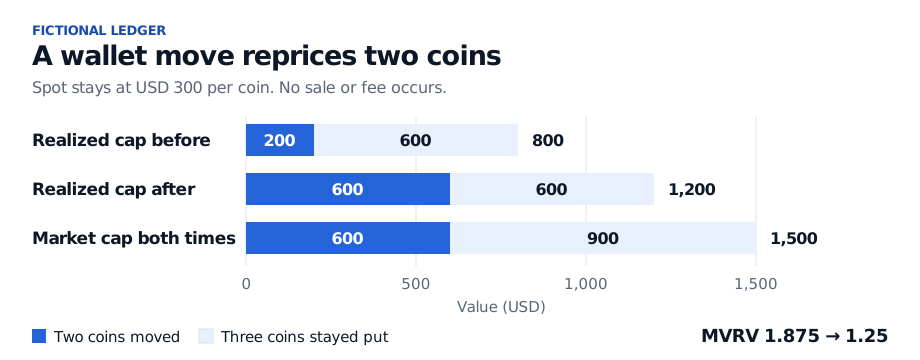
At an unchanged spot price, the raw ratio falls because the two moved coins receive a higher historical mark.
A payment can also create a fresh change output that returns to the sender. Conversely, a spot sale recorded only in a custodian's books leaves the blockchain's outputs as they were. Both cases separate the on-chain mark from the price a holder actually paid. Dormant coins keep their historical marks. A low mark can reduce their weight in realized cap even though the chain alone cannot tell whether the keys are lost. Coin Metrics, Realized Capitalization Overview · Glassnode, Change Volume.
What makes two readings comparable?
- Unit of observation. Coin Metrics dates a UTXO by its creation day. On an account-based chain it uses the more recent of account creation and the last day the account sent a ledger change to date the balance. Glassnode's entity-adjusted Bitcoin variant instead uses address clustering to estimate common control and filter movements it classifies as internal. Cluster errors can leave self-transfers in the calculation or filter out actual transfers between entities. Coin Metrics, Realized Market Cap · Glassnode, Entity-Adjusted MVRV.
- Supply and USD marks. The per-coin identity above needs matching supply. Coin Metrics' free-float variant deliberately changes the numerator to free-float market cap while keeping the realized-cap denominator. A close also depends on the chosen price series and cutoff. When a USD series uses non-USD trades, it needs an explicit conversion rate for the quote asset. Coin Metrics, Free Float MVRV · Coin Metrics, Reference Rate Metrics.
- Snapshot and data vintage. A chain reorganisation can replace the block used for a recent snapshot and change which outputs were unspent at the cutoff. In an entity-adjusted series, newer address evidence can also revise historical estimates. A historical study that uses revisions available only after its decision time can introduce look-ahead bias. Bitcoin Developer Guide, Block Height and Forking · Glassnode, Point-in-Time Metrics.
Sources
- Coin Metrics, Market Capitalization. Market cap, realized cap and free-float MVRV definitions.
- Coin Metrics, State of the Network 41 (2020). The distinction between last movement and the holder's acquisition price.
- Murad Mahmudov and David Puell, Bitcoin Market-Value-to-Realized-Value Ratio (2018, archived republication). Original formulation of the ratio.
- Coin Metrics, Reference Rate Metrics. Quote conversion and close conventions.
- Glassnode, Introducing Account-Based On-Chain Metrics and Entity-Adjusted MVRV. Change outputs, account and entity methods.
- Bitcoin Developer Guide, Block Height and Forking and Glassnode, Point-in-Time Metrics. Chain selection and historical revisions.