A proxy adviser researches matters on shareholder ballots and recommends how investors could vote on items such as director elections, executive pay and shareholder proposals. Firms such as Institutional Shareholder Services (ISS) and Glass Lewis help institutional investors cover many companies during proxy season. When estimating support for a proposal, a quant has to distinguish the recommendation, the votes an investor can exercise and the votes that are ultimately counted. D.C. Circuit opinion on proxy voting advice, pp. 2–4.
Who decides and who submits?
A proxy adviser may apply its own benchmark voting policy or a client's custom policy. The same firm may also supply software that pre-fills or submits voting instructions. The voting mandate determines who may decide how to vote. A pension fund can, for example, retain authority over director elections while giving an investment manager discretion over other items. The fund chooses the candidate and the platform transmits its instruction. In a proxy fight, the competing sides seek voting support, while the proxy adviser can evaluate the competing slates for its clients. SEC guidance on proxy voting responsibilities, introduction and questions 1–2.
Under U.S. Advisers Act Rule 206(4)-6, an investment adviser registered or required to register with the SEC that exercises voting authority over client securities must use written policies and procedures designed to ensure it votes in clients' best interests. Those procedures must address material conflicts between the adviser and its clients. Using a proxy research or execution service leaves those duties with the investment adviser. The quality of the proxy firm's analysis matters too. For example, its choice of peer companies can affect its assessment of executive pay. Current rule and SEC guidance, questions 3–4.
Four million votes, two denominators
A fictional company has 100 million shares of common stock in the only class eligible to vote on a proposal. Each share carries one vote. An investor entitled to vote 4 million of those shares has the following potential share of class voting power.
Suppose the investor casts all four million votes and 50 million votes in total are cast on that proposal, including the investor's votes. The investor accounts for a larger share of the votes cast.
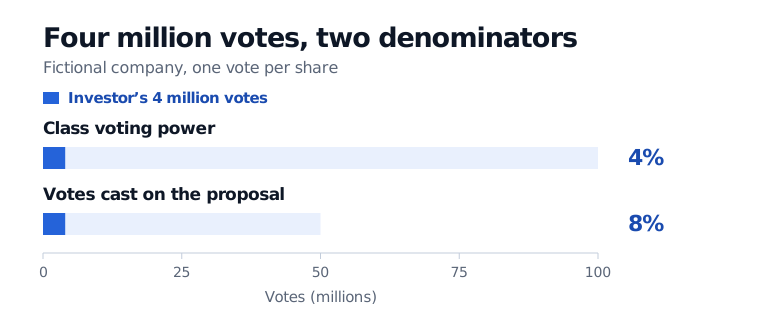
Both bars use the same vote-count scale. The blue segment stays fixed as the total falls.
The approval threshold can use a different denominator again. For example, Applied Materials' 2026 proxy statement specifies a majority of votes cast for director elections and a majority of shares present and entitled to vote for the executive pay proposal. Abstentions affect those two counts differently. Applied Materials' 2026 proxy statement, voting requirements.
The example assumes the investor was entitled to vote all four million shares on the record date. If some shares are out on loan, a lender generally needs them returned in time for that date to vote them. A recall request may still be outstanding when eligibility is determined. Investor.gov on record dates and SEC on voting rights under fund securities lending.
For U.S. registered funds that report on Form N-PX, the filing separates shares voted from shares on loan and unrecalled in time to vote. The reported vote count can reflect the fund's instructions if the actual count was unconfirmed when it filed. SEC Form N-PX reporting guide.
The SelfMadeQuant lesson on Equities, Indices and Corporate Actions compares the voting rights of common and preferred shares. The preview is public. The full lesson requires membership.