The primary-secondary mortgage spread is the difference between the note rate offered to a mortgage borrower and a benchmark rate on newly issued agency mortgage-backed securities (MBS). In the U.S. conventional 30-year mortgage market, the gap helps track how much of a move in secondary-market rates reaches borrowers. When the MBS benchmark falls faster than new mortgage quotes, the spread widens. Federal Reserve Bank of Dallas.
Build the benchmark, then take the gap
The current coupon represents the coupon at which a hypothetical agency MBS would price at par, meaning its face value. One way to estimate it is to interpolate between coupon quotes straddling par in the to-be-announced (TBA) forward market. TBA contracts specify the coupon and settlement date while leaving the exact pools to be identified later. A data series may report the estimated par coupon or a representative yield. A cash-flow yield is the discount rate that reproduces the price from projected payments, including assumed prepayments. If traded coupons fail to bracket par, the current-coupon estimate may require extrapolation. Vickery and Wright, §3.1 and Fuster et al., §3.2.
Suppose a lender offers a 6.50% note rate on a fictional conventional 30-year fixed-rate purchase loan at zero discount points. At the same observation time, quotes for the relevant agency and delivery month are 99 per 100 face at a 5.50% MBS coupon and 101 at 6.00%. Linear interpolation puts par halfway between them, at 5.75%. Both rates are annual. Using that par coupon as the secondary benchmark, the spread is 75 basis points.
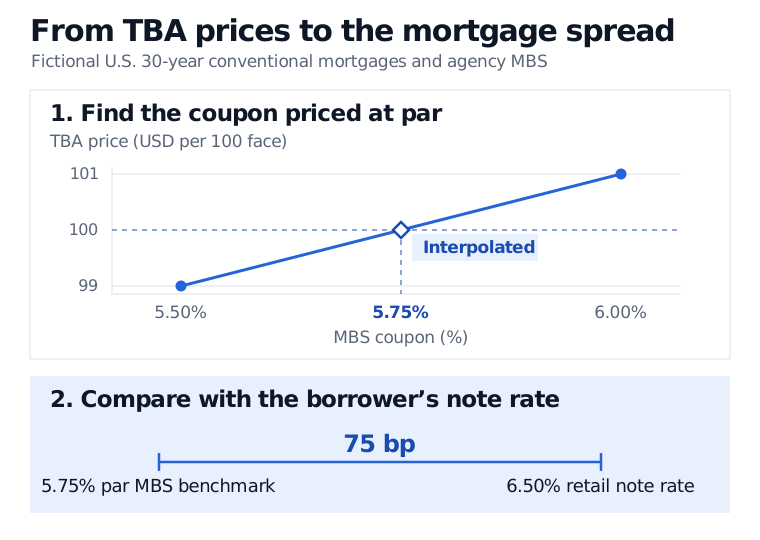
Same observation time and TBA delivery month in the fictional example. The diamond marks the estimated par coupon between the two traded coupon quotes.
What changes the reported spread?
A borrower can pay discount points up front for a lower note rate. Each point costs 1% of the loan amount. At the same MBS benchmark, paying points for a lower rate narrows the measured gap while raising the upfront cost. A like-for-like retail series holds the borrower and loan profile, points convention and lock period fixed. Fuster et al., §2.4.
Freddie Mac's Primary Mortgage Market Survey averages qualifying purchase-application rates from Thursday through Wednesday. In November 2022 it switched from a lender survey to application data and stopped publishing fees and points. Pairing the weekly average with a single day's MBS close can mix market moves with changes in retail pricing. For a lock-based measure, align the MBS observation with the lock date and use a delivery month consistent with when the loans can be pooled. Freddie Mac's survey FAQs and Fuster et al., §§3.2 and 4.1.
From spread to originator economics
For a specific pass-through pool, servicing compensation and the agency's running guarantee fee reduce the share of borrower interest available to pay the security coupon. The SelfMadeQuant mortgage cash-flow lesson covers those deductions in §4 (public preview, full lesson for members).
The originator's economics depend on the actual sale price for the coupon it delivers, borrower points or credits, the value of retained mortgage servicing rights, and guarantee, production and hedging costs. A rate lock exposes the lender to market moves before delivery, and some locked loans never close. The 75 bp gap alone cannot reveal the profit on that loan. Fuster and co-authors estimate a separate dollar measure. For each USD 100 of loan principal, they take the MBS sale proceeds above or below par, add borrower points and the estimated value of servicing cash flows, and account for guarantee charges. Their measure, originator profits and unmeasured costs, still includes costs the researchers could not isolate. Fuster et al., §§2–4.
Sources
- Fuster et al. (2013), The Rising Gap between Primary and Secondary Mortgage Rates
- Vickery and Wright (2013), TBA Trading and Liquidity in the Agency MBS Market
- Freddie Mac, Primary Mortgage Market Survey methodology and FAQs
- Federal Reserve Bank of Dallas (2026), What drives mortgage rates and their response to monetary policy changes