A payment system is an arrangement of participants, an operator, rules and infrastructure for transferring funds. It determines when banks can use money they expect to receive to fund their next outgoing payment. In securities settlement, for example, the securities system can coordinate delivery while the payment system moves the cash between the parties’ settlement banks. PFMI, §1.10 and Annex D
When is the cash actually there?
Messaging carries payment instructions and status updates. Clearing checks and reconciles instructions and establishes what is due, possibly through a clearing house. Where the rules allow netting, clearing may combine eligible obligations before funds move. Settlement transfers the funds, for example by debiting one bank’s account at the central bank and crediting another’s. These functions can be integrated or handled by separate systems. BIS, “Payments: a primer”
Settlement finality is the legally defined point when that transfer is unconditional and irrevocable. A delivery acknowledgement confirms that the instruction arrived. Even an instruction the sender can no longer cancel may still be waiting for settlement. The international standards for systemically important payment systems call for the rules to specify the point of finality and the point after which a participant can no longer revoke an unsettled instruction. PFMI, Principle 8 and Annex D
Two payments, two schedules
Suppose Bank A owes Bank B 100, and B owes A 70, in units of the same currency. Both obligations are due in the same batch under a stipulated, enforceable bilateral payment-netting agreement. For comparison, consider how the obligations could settle without netting. Assume no fees, intraday credit or other payments, and that each scheduled transfer completes.
- Real-time gross settlement (RTGS) settles individual payments in full as they pass the system’s checks. If A pays first and B later sends 70 back, gross turnover is . With B starting at zero, A needs 100 to make the first payment. B can fund its payment out of the incoming 100.
- Deferred net settlement (DNS) accumulates eligible obligations for settlement in a scheduled batch. Under this agreement, the batch calls for one payment of from A to B. A needs 30 by the settlement window. B receives the money when the batch settles.
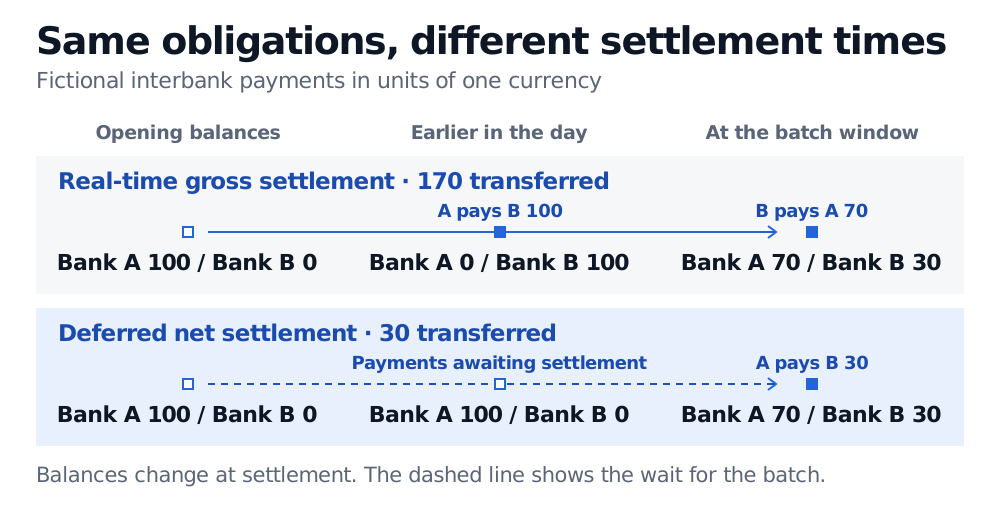
The two timelines start with identical balances so the timing of the cash movements is directly comparable.
Gross turnover counts payments, while funding depends on the order of payments, the reuse of receipts and access to credit. RTGS brings earlier finality for payments that can settle. A payment short of funds may queue or be rejected, depending on the system. Deferred netting can lower the funding needed for a batch, but banks relying on receipts must wait. A missed receipt can leave a bank short of cash for its own payment cut-off, passing the liquidity pressure to the next bank expecting funds. If a participant defaults before settlement, there is also credit risk. Who bears any loss depends on the system’s default rules and protections. PFMI, Principle 7 and Annex D
Queued payments can settle together
Hybrid designs combine features such as immediate settlement for funded payments and frequent matching of offsetting payments in a queue. Australia’s Reserve Bank Information and Transfer System (RITS) illustrates one liquidity-saving mechanism. When its queue settles qualifying opposing payments together, it posts both gross amounts. RITS also settles some batches that other systems have already netted. The simultaneous debit and credit of the participants’ Exchange Settlement Accounts is what makes a correctly processed RITS transfer final. RBA, About RITS · RITS Regulations, clause 16
Sources
- CPSS–IOSCO, Principles for Financial Market Infrastructures, April 2012, §1.10, Principles 1, 7–9 and Annex D.
- BIS, Innovations in payments, March 2020, “Payments: a primer”.
- Reserve Bank of Australia, About RITS, “Real-time Gross Settlement (RTGS)” and “System Liquidity”.
- Reserve Bank of Australia, RITS Regulations, effective 1 July 2026, clauses 13 and 16 and Schedule 4.