Estimate a cash-flow-adjusted portfolio return using the time each contribution or withdrawal affects capital, with a 9.6% worked example and the limits of the approximation.
Modified Dietz return
Modified Dietz return divides a portfolio's investment gain by a capital base adjusted for the timing of external contributions and withdrawals. It is useful when beginning and ending values and flow dates are available, but valuations at every flow are not. A deposit increases account wealth without creating investment profit; its timing also determines how long the additional capital was available to earn a return.
Modified Dietz belongs to the family of cash-flow-sensitive, money-weighted return methods. It is a linear approximation to an internal rate of return, and can be used within an approximate time-weighted return process. Those descriptions do not make it an exact IRR or an exact flow-neutral TWR.
Give each flow the time it had left
Let VB and VE be beginning and ending portfolio values in the same currency. Write Ci for an external flow, positive into the portfolio and negative out of it, and wi for the fraction of the reporting period remaining after that flow:
RMD=VB+∑iwiCiVE−VB−∑iCi.
The numerator is investment gain after removing net external money. The denominator is a principal-time approximation to capital employed, rather than the actual average of marked portfolio values. Earlier contributions add more to this base; earlier withdrawals subtract more.
For calendar-day records with end-of-day flows, the GIPS handbook's Modified Dietz discussion uses wi=(D−di)/D: D is the period's calendar-day count and di is the flow's day number. A beginning-of-day convention instead uses (D−di+1)/D. Declare and apply the timing policy consistently.
A portfolio grows from 100 to 132
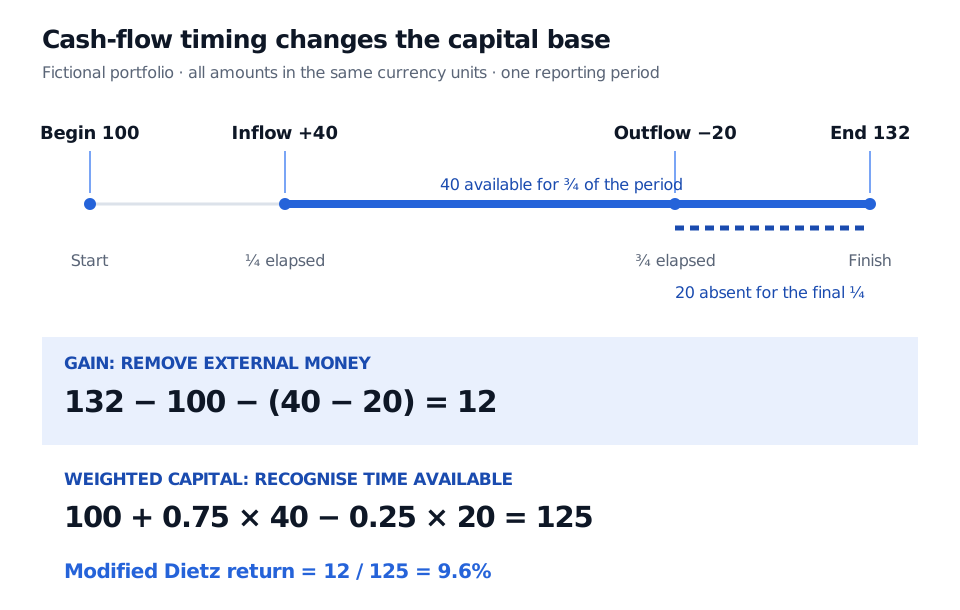
Consider a fictional reporting period, with amounts in one currency unit and no other external flows. A contribution of 40 arrives exactly one-quarter of the way through; a withdrawal of 20 occurs exactly three-quarters through. These are explicit fractions of elapsed time, not rounded calendar dates. The remaining-period weights are therefore 0.75 and 0.25.
Item
Calculation
Result
Net external contribution
40−20
20
Investment gain
132−100−20
12
Weighted capital
100+0.75(40)+0.25(−20)
125
Modified Dietz return
12/125
9.6%
Fictional period: beginning value 100, contribution 40 at one-quarter elapsed, withdrawal 20 at three-quarters elapsed, ending value 132. Remaining-period weights 0.75 and 0.25 give gain 12, weighted capital 125 and Modified Dietz return 9.6%.
The timeline shows external-flow timing, not a path of observed portfolio values. Contributions and withdrawals change both the gain reconciliation and the time-weighted capital base.
The account grew by 32%, but 20 of its 32-unit increase came from net contributions. Dividing the 12-unit gain by beginning wealth alone gives 12%, which still ignores the additional capital's time in the portfolio. Modified Dietz reports 9.6% for this reporting period, without annualising it.
A purchase funded from cash already inside this portfolio is an internal transaction, not another contribution. Income retained in the account is part of investment performance, not new client money. Keep the portfolio boundary fixed.
Why the approximation appears
A constant compounded period return r that reconciles the same dated flows would satisfy
VE=VB(1+r)+i∑Ci(1+r)wi,r>−1.
Linearising each accumulation factor around r=0, so that (1+r)wi≈1+wir, gives
VE−VB−i∑Ci≈r(VB+i∑wiCi).
Solving this linear equation produces Modified Dietz. The approximation discards nonlinear compounding. Its accuracy as an IRR approximation and its accuracy as an exact TWR approximation are separate questions: exact TWR additionally needs the portfolio's valuations around the flows.
When to use finer valuations
The ratio here assumes positive weighted capital. A zero denominator makes it undefined; a negative or very small base can give a percentage with little useful interpretation as an ordinary return on invested wealth.
The GIPS handbook warns that approximation quality deteriorates particularly when large flows coincide with volatile performance. For the non-private-market portfolios in composites covered by provision 2.A.24, a TWR process requires subperiod returns at large flows when daily returns are not calculated, and geometric linking of periodic and subperiod returns. A single whole-period Dietz ratio does not establish GIPS compliance; provision 1.A.9 also prohibits describing a calculation methodology itself as compliant.
For the next step from return measurement to manager evaluation, see Risk-Adjusted Performance Measures (public preview; full lesson requires membership).