MiCA, the EU's Markets in Crypto-Assets Regulation (Regulation (EU) 2023/1114), sets rules for issuing, publicly offering and admitting in-scope crypto-assets to trading, and for providing crypto-asset services in the EU. Crypto-assets that qualify as financial instruments are outside its scope. For a desk holding a stablecoin, the framework helps identify who owes the cash on redemption and which firm is responsible for giving the desk access to its tokens. MiCA, Articles 1–3, 49 and 75.
One euro token, two firms
Issuer A plans to offer a fictional token to the EU public that aims to hold its value against the euro alone. That single official currency reference makes the token an e-money token (EMT). A token that instead aims to track a basket of euros and dollars falls under the asset-referenced token (ART) definition, assuming it is otherwise in scope. ARTs have their own reserve and redemption rules. The reference used to define the peg determines the distinction. MiCA, Articles 3(1)(6)–(7), 36 and 39.
For A's public offer, MiCA requires A to be authorised as a credit institution or electronic money institution, notify the competent authority of its crypto-asset white paper and publish it. A issues the tokens at par on receipt of funds. The holder has a claim against A and can request redemption in funds at par at any time. MiCA also prohibits A and service providers from granting interest in relation to the token in their respective roles. MiCA, Articles 48–51.
Custodian B is a separate, stand-alone EU business that safeguards the same tokens on behalf of clients. That custody activity requires authorisation as a crypto-asset service provider (CASP) covering custody. Certain already regulated financial entities can provide specified services through the Article 60 route. B must keep a position register for each client, segregate client tokens from its own holdings and have procedures to return the tokens or the means of access as soon as possible. MiCA, Articles 3(1)(15)–(17), 59–60 and 75.
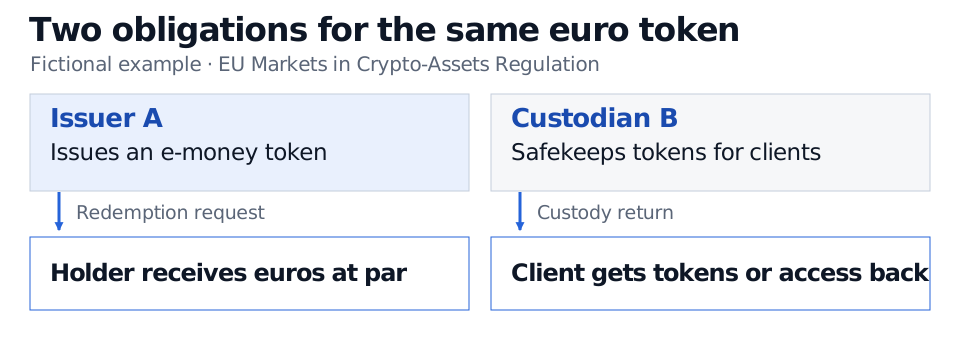
The holder's redemption claim is against A. The ability to retrieve the tokens held in custody depends on B.
A withdrawal outage at B can delay the desk's access even while A is meeting redemption requests. The token could also trade below par while the statutory claim against A still exists. A position record can track that price, the issuer's redemption terms and the amount available to move as separate inputs. ESMA's register lists EMT issuers and CASPs separately and identifies the services each CASP provides. ESMA MiCA register.
Dates that matter when reviewing old records
MiCA's ART and EMT titles began applying on 30 June 2024. Its general application date, including the CASP regime, was 30 December 2024. A provider already operating lawfully before 30 December 2024 could qualify for temporary continuation. A grant or refusal of authorisation could end that transition early. Member States could shorten or omit it if they considered their prior rules less strict than MiCA. The EU-wide outer limit was 1 July 2026. ESMA distinguished ordinary service from the limited activities needed for an orderly exit. MiCA, Articles 143(3) and 149 · ESMA's June 2026 transition statement.
Transfers have their own rule. The EU's Crypto Travel Rule comes from Regulation (EU) 2023/1113, which specifies what originator and beneficiary information accompanies covered transfers. Regulation (EU) 2023/1113, Articles 1–2 and 14.
Hong Kong uses a different issuance test
Hong Kong's Stablecoins Ordinance regime began on 1 August 2025. It generally requires a Hong Kong Monetary Authority (HKMA) licence to issue a specified fiat-referenced stablecoin as a business in Hong Kong. The issuance rule also reaches business issuance outside Hong Kong when the token references the Hong Kong dollar in whole or in part. If A began issuing its euro token in Hong Kong, the location of that issuance would bring it within Hong Kong's issuer regime even with the euro peg unchanged. HKMA regime overview · HKMA licensing note, sections 2.2–2.3 and 2.7–2.8.
Sources
- Regulation (EU) 2023/1114, current consolidated text. MiCA scope, classifications, issuer and custody duties, and application dates.
- ESMA statement on the end of the MiCA transition, 23 June 2026. Transition end and wind-down expectations.
- ESMA MiCA register. Separate entries for issuers and service providers.
- Regulation (EU) 2023/1113. Information accompanying covered transfers.
- HKMA regulatory regime for stablecoin issuers and HKMA licensing note. Commencement and scope of the Hong Kong issuer regime.