Crypto wallet and key custody is the arrangement that determines who controls the signing keys used to move crypto assets and who can restore that control if access is lost. A position can keep the same marked value while becoming impossible to transfer. That makes custody a source of operational risk even when the price is unchanged.
A wallet, a ledger and an account balance
The blockchain records the asset state. A wallet manages or accesses the private keys that produce signatures. In a key-based spending policy, the network uses public-key cryptography to check that a transaction satisfies the signature requirements. When a wallet uses a recovery phrase to derive its keys, losing the device and losing the ability to sign are separate events. SEC staff custody bulletin
With self-custody, the holder manages the signing credentials needed to move the assets. In a typical hosted exchange account, the exchange or its custodian controls signing. The customer requests a withdrawal, and the provider authorises the on-chain transfer if it processes the request. A login authenticates the customer to the provider. The provider's keys satisfy the network's spending rules. SEC staff custody bulletin
A provider can pool multiple customers' assets in an omnibus wallet and track individual entitlements in an internal ledger. The on-chain total describes the pooled assets, while the internal ledger identifies the amount credited to each customer. Signing authority is a technical capability. Legal ownership and rights to recover assets depend on the arrangement and applicable law. For example, New York's September 2025 custody guidance expects covered firms that use omnibus wallets to keep customer assets separate from corporate assets and maintain records identifying each customer's beneficial interest. A visible wallet balance therefore answers only part of the question addressed by proof of reserves and exchange solvency. New York DFS custody guidance, sections I–II
What two signatures change
Consider a fictional 2-of-3 spending policy with distinct keys A, B and C. Assume the policy has no alternative spending path, the legitimate holder can use every remaining key, and an attacker who steals one key cannot obtain a second signature. If A becomes unavailable, B and C can still sign. If an attacker obtains only A, the attacker falls one signature short. The same logic applies to each of the three keys.
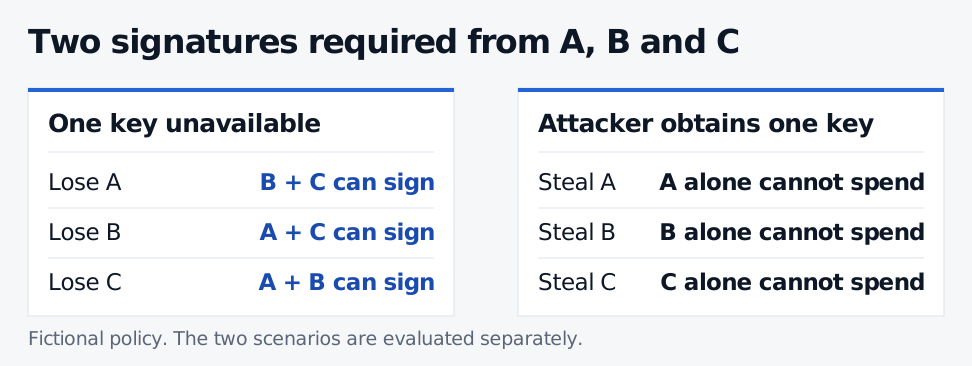
In the fictional policy, the unavailable key and the stolen key are separate scenarios. The threshold is two distinct valid signatures.
The policy can survive one unavailable key. If one incident makes two keys unavailable, the remaining key cannot authorise a spend. If one incident compromises two keys, the attacker can meet the signing requirement. Counting keys alone leaves open whether they share the same failure or compromise path.
Bitcoin's BIP 11 describes an example of this type of multisignature spending condition. It checks separate signatures against the relevant public keys. A threshold-signing protocol such as FROST instead has participants use shares of one group signing key to produce a single signature that verifies against the group public key. The multisignature and MPC custody comparison turns on that difference in what the verifier sees. RFC 9591, section 5
Sources
- SEC staff, Crypto Asset Custody Basics for Retail Investors, 12 December 2025, educational bulletin on wallets and custody.
- New York DFS, Updated Guidance on Custodial Structures for Customer Protection in the Event of Insolvency, 30 September 2025, sections I and II on segregation, ledger records and beneficial interests.
- Gavin Andresen, Bitcoin BIP 11, M-of-N Standard Transactions, 2011, 2-of-3 use cases and the original spending condition.
- RFC 9591, The FROST Protocol, June 2024, section 5 on participant shares and group signature verification.