Proof of reserves (PoR) is a point-in-time verification of assets a crypto exchange or custodian reports holding. When the review also measures corresponding customer claims, it can show how much of those claims the eligible assets cover. A trading desk can use that comparison to spot a custody shortfall on a venue where it keeps collateral.
Match the assets and the claims
Suppose a fictional exchange has USD 100 in eligible reserves against USD 120 in customer claims. Both amounts refer to the same legal entity, token and snapshot, and both use the same USD reference price. Assume the exchange can use the reserves to meet these claims.
The eligible reserves leave a USD 20 shortfall before any other obligations are considered. Customer fiat balances, claims in other tokens and amounts owed to lenders could all fall outside this comparison. For in-kind withdrawals, compare quantities token by token. An ETH surplus can meet a BTC withdrawal only if the exchange can source and deliver BTC in time.
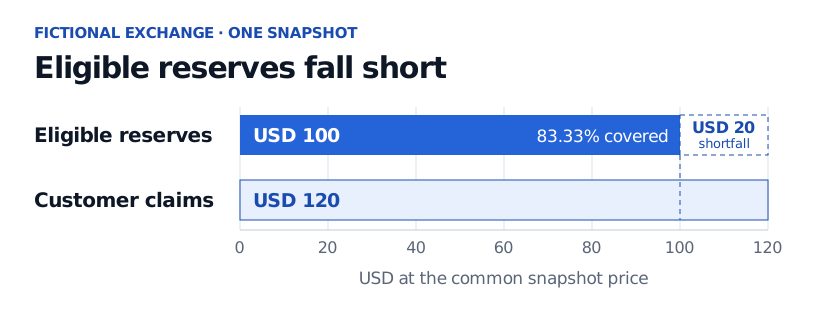
The dashed segment shows the additional eligible reserves needed to cover the remaining claims.
What each check establishes
Wallet control. On-chain balances show what was at an address at the chosen block. Where supported, a fresh signed challenge can show the venue has access to the relevant wallet signing authority. A test transfer can demonstrate the ability to move funds. Check legal rights and restrictions separately. A venue may control a wallet whose tokens are pledged to a lender, or it may have borrowed tokens for the snapshot and owe them back. A valid signature also leaves open whether someone else can sign for the same wallet. Kraken’s proof-of-reserves methodology
Customer claims. A Merkle tree can commit to customer records without publishing every balance. Against the authenticated root for the snapshot, a customer can check that their own balance was included. Even a verified sum of the committed records covers only the records supplied to the tree. Testing completeness means reconciling the extract to the in-scope account ledger and checking the account filters, product exclusions and netting rules. Loans and other corporate debts require separate evidence. PCAOB Office of the Investor Advocate advisory
Scope and dates. In its historical Crypto.com report, Mazars used test transfers to check control of listed addresses. It observed the production database extract, checked row counts and sums, computed a Merkle root and compared holdings with net customer claims for specified assets. The snapshot was 7 December 2022 at 00:00 UTC. The report was signed on 9 December. Balance changes after the snapshot were outside its scope. It recorded findings from agreed-upon procedures and expressed no audit opinion or assurance conclusion. The PCAOB’s Office of the Investor Advocate highlighted this distinction in its March 2023 staff advisory on PoR reports. Mazars report · PCAOB staff advisory
From reserves to solvency and liquidity
Balance-sheet solvency compares the entity’s total recognised assets and liabilities on a stated accounting basis. The reserve ratio covers a narrower set. A reserve shortfall can coexist with positive book equity if other assets are sufficient. Full reserve coverage for selected customer claims can coexist with negative book equity if other liabilities are large enough.
Liquidity depends on whether the exchange can deliver the assets or cash owed as withdrawals and other payments fall due. An exchange can have positive book equity and still miss withdrawals if assets are locked or slow to settle. To assess that funding liquidity risk, compare what the exchange can mobilise by each deadline with what it owes by then. BIS Financial Stability Institute, Solvency as a requirement for emergency liquidity support
Sources
- PCAOB Office of the Investor Advocate, Exercise Caution With Third-Party Verification/Proof of Reserve Reports (8 March 2023)
- Mazars, Proof of Reserve Report for Crypto.com (9 December 2022)
- Kraken, Proof of Reserves methodology and limitations
- BIS Financial Stability Institute, Solvency as a requirement for emergency liquidity support (December 2025)