The Crypto Travel Rule requires covered providers to collect and pass on specified information about the sender and intended recipient of a crypto-asset transfer. The information helps authorities trace transfers for anti-money laundering and counter-terrorist financing. For a desk moving assets between venues, it explains why a transfer can appear on a blockchain before the receiving provider makes the assets available to its customer. Regulation (EU) 2023/1113, Articles 1 and 14–17.
The Financial Action Task Force (FATF) sets the international standard. The Interpretive Note to Recommendation 15 applies Recommendation 16's payment transparency requirements to virtual assets. Jurisdictions implement the standard through their own rules. FATF's July 2026 update found that adoption had advanced while supervision and enforcement still varied. FATF Recommendations, Interpretive Note to Recommendation 15, paragraph 7(b) · FATF's July 2026 update, section 2.5.
One transfer between two EU providers
Mara asks Provider A to send crypto-assets to Leon at Provider B. Both are crypto-asset service providers (CASPs) with registered offices in the EU, and both act for their customers. The transfer uses a public chain and falls under Regulation (EU) 2023/1113, which has applied since 30 December 2024. Mara is the originator and Leon is the beneficiary. EU regulation, Articles 2, 3 and 40.
- A verifies Mara's required information before initiating the transfer. It uses reliable, independent evidence and sends B the required data for both parties through a secure channel before or at initiation. The message includes both names, the applicable ledger addresses and any crypto-asset account numbers used for the transfer. For Mara, it also carries either the specified address and identification details or her date and place of birth. EU regulation, Article 14 · EBA Travel Rule Guidelines, paragraph 25.
- B checks the message against the transfer. The public chain records the amount, ledger addresses and a transaction reference. B uses a shared reference to match that entry to the secure message. The identity details travel off-chain in this example, subject to the regulation's data protection requirements. EU regulation, Articles 14(4) and 25 · EBA Travel Rule Guidelines, section 4.3.
- B verifies Leon's required information against reliable, independent evidence before making the assets available. Suppose B sees the chain entry but Mara's name is missing from the message it received. B acts without undue delay under its risk-based procedure. It can request the missing information and hold the assets while it waits. If A supplies the missing information and B completes its checks, B can make the assets available to Leon. Article 17 also provides for rejecting the transfer or returning the assets. EU regulation, Articles 16–17.
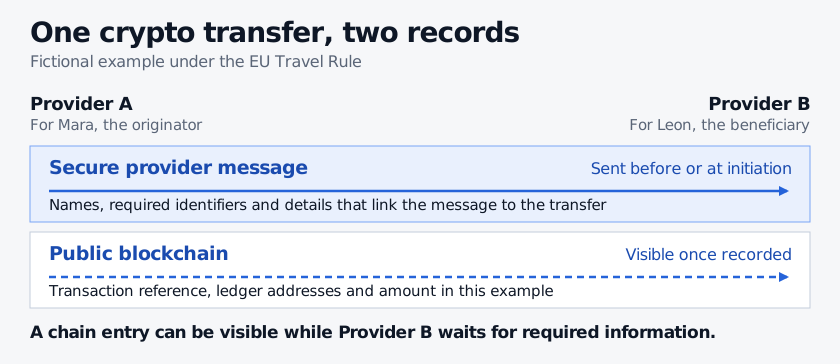
A provider can match a secure message to a public-chain entry using a shared reference. The receiving provider controls when the customer can use the assets.
For a desk reconciling cross-venue balances, the time Leon can use the assets for trading or margin comes from B's records. The public chain supplies the time the transaction was recorded. Separate controls for sanctions screening support the implementation of applicable restrictions. EU regulation, Articles 17 and 23.
When one side uses a self-hosted address
A direct person-to-person transfer with no CASP involved falls outside the EU regulation. A transfer between a covered provider and a self-hosted address, a ledger address independent of any CASP or equivalent non-EU provider, follows a different path. The CASP obtains and holds the required originator and beneficiary details and makes sure it can identify the individual transfer. In this scenario the provider collects information about the other party from its customer. EU regulation, Articles 2(4), 3(20), 14(5) and 16(2) · EBA Travel Rule Guidelines, section 4.8.
For a transfer exceeding EUR 1,000 to or from a self-hosted address, the relevant provider must also take adequate measures to assess whether its customer owns or controls that address. That is the originator for an outgoing transfer and the beneficiary for an incoming one. The amount threshold applies to this additional assessment. The underlying duty to obtain and hold transfer information still applies at or below that amount, and other risk-based measures may apply. EU regulation, Articles 14(5) and 16(2).
Sources
- Financial Action Task Force, The FATF Recommendations, amended June 2026. Recommendation 15 and its Interpretive Note connect virtual-asset transfer information to Recommendation 16.
- Financial Action Task Force, Seventh Targeted Update on Implementation of the FATF Standards on Virtual Assets and VASPs, July 2026. Section 2.5 reviews implementation and enforcement across jurisdictions.
- Regulation (EU) 2023/1113 on information accompanying transfers of funds and certain crypto-assets. Articles 1–3, 14, 16–17, 23, 25 and 40 cover scope, transfer information, verification, missing data, restrictive measures, data protection and application.
- European Banking Authority, Travel Rule Guidelines, EBA/GL/2024/11. Sections 4.3, 4.6 and 4.8 cover messaging, missing information and transfers to or from self-hosted addresses.