Sanctions screening is the process of checking parties and transaction details for restrictions imposed by a sanctions authority. A U.S. bank might screen the sender, beneficiary and banks named in a wire instruction before processing it. An alert sends the payment for review and can delay settlement. The analyst needs to establish who is involved and which restrictions apply. The U.S. bank in this example is subject to sanctions administered by the Office of Foreign Assets Control (OFAC). OFAC FAQ 5, steps 1–3 · OFAC FAQ 11
An exact name can belong to two companies
A U.S. bank receives an instruction to pay Lantern Gauge Trading Ltd. for equipment. Its screening system flags the name against OFAC’s Specially Designated Nationals and Blocked Persons List (SDN List). The beneficiary’s incorporation record and the fictional list entry both say “Lantern Gauge Trading Ltd.” They show different registration numbers, registries and addresses. Those discrepancies suggest a name collision. The analyst checks the full entry, including aliases, and verifies whether the records describe different companies or two registrations for the same business. If the evidence remains incomplete or contradictory, the analyst escalates the alert under the bank’s procedure. OFAC’s search score measures the similarity of the names. Corroborating identifiers help establish whether they refer to the same party. OFAC FAQ 5, steps 3–4 · OFAC FAQ 247
Ownership can make an unlisted company subject to blocking
Even if the analyst rules out the name match, the payee may be blocked through ownership. Under OFAC’s 50 Percent Rule, an entity is itself blocked when one or more blocked persons together own at least 50% of it, directly or indirectly. Ownership stakes can count across different OFAC sanctions programs. The entity can be blocked even if its name never appears on the SDN List. OFAC’s revised 50 Percent Rule guidance, 2014 · OFAC FAQ 399
Suppose a separate, verified ownership record shows that blocked owner A holds 60% of Rivet Holdings, which holds 30% of the payee. Blocked owner B holds another 20% of the payee directly. Assume the other shares have no blocked owners. Rivet is itself blocked because A owns 60% of it. Count Rivet’s full 30% stake in the payee and B’s 20% stake. That gives , so the payee is blocked under the rule in this ownership scenario. The calculation uses the shares held by Rivet as a blocked entity. Multiplying along the chain would answer a different question about A’s proportional equity interest. OFAC FAQ 401, examples 2–4
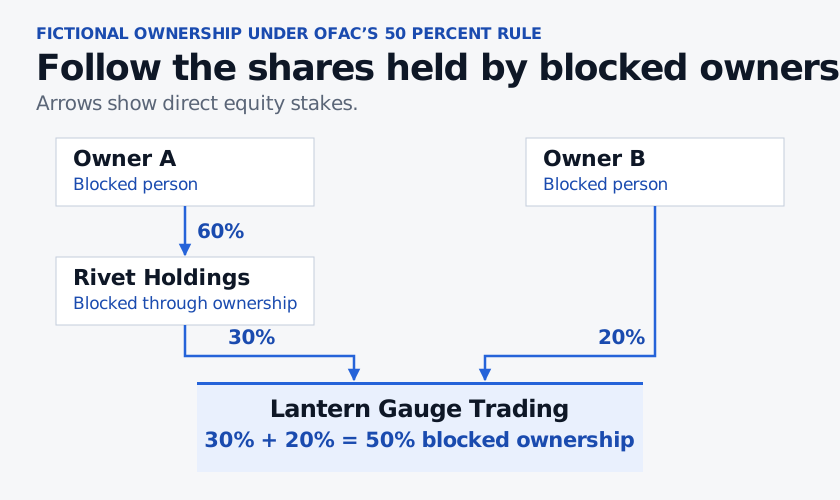
Once Rivet qualifies as blocked, its entire stake in Lantern Gauge counts toward the threshold.
The 50 Percent Rule tests ownership. Control alone falls outside that test. Separate program rules can still apply. A blocked executive signing the contract, for example, may make the transaction prohibited even if the company itself falls below the threshold. OFAC FAQ 398 · OFAC FAQ 400
What determines the action on a wire?
The analyst checks the applicable sanctions program, the parties and banks involved, the countries or regions connected to the payment, and the activity it funds. Some restrictions target a sector or activity without requiring a listed party. A general or specific license may authorize an otherwise prohibited transaction on stated terms, and an exemption may apply. Resolving the name alert or working out ownership answers only part of the payment review. OFAC FAQ 5, steps 2 and 4–5 · OFAC FAQ 74
- Block when the applicable rule requires freezing a property interest and no authorization or exemption permits the transaction. The bank retains the frozen funds in a qualifying blocked account. OFAC FAQ 32
- Reject when processing the wire would violate the applicable sanctions and there is no blockable interest. The bank stops the transfer and returns the payment to the originator. OFAC FAQ 36
During review, the analyst records the list entry, identifiers and ownership evidence used to reach the decision. For a U.S. bank, an initial report is due within 10 business days after the property becomes blocked or the bank rejects the transaction under OFAC sanctions. The bank generally files through the OFAC Reporting System. OFAC FAQ 5, step 6 · 31 CFR § 501.603(b)(1), (d)(1) · 31 CFR § 501.604(a), (c)–(d)
Know Your Customer and customer due diligence supply identity and ownership records. For covered accounts and customers, the U.S. customer due diligence rule uses a separate 25% threshold to identify individual equity owners and includes a control prong. Anti-money laundering monitoring investigates suspicious activity and can lead to a Suspicious Activity Report. Sanctions screening asks which restrictions apply to the parties, property and activity in the transaction. 31 CFR § 1010.230(d) · FFIEC BSA/AML Manual, SAR Decision Making
Sources
- OFAC FAQ 5, Assessing OFAC name matches. Updated 9 September 2026. Steps 1–6 cover alerts, verification, applicable restrictions and reporting.
- OFAC FAQ 11, Who must comply with OFAC sanctions?. Explains how scope depends on the implementing regulations.
- OFAC FAQ 247, Sanctions List Search score. Explains what the name similarity score measures.
- OFAC, Revised Guidance on Entities Owned by Persons Whose Property and Interests in Property Are Blocked. The 13 August 2014 guidance sets out the 50 Percent Rule.
- OFAC FAQ 399, Aggregate ownership. Explains how to add ownership interests of blocked persons.
- OFAC FAQ 401, Indirect ownership. Examples 2–4 show how to count an intermediary’s stake.
- OFAC FAQ 398, Control and ownership. Explains the treatment of control under the 50 Percent Rule.
- OFAC FAQ 400, A blocked person acting for another entity. Explains restrictions where a blocked individual acts for an entity.
- OFAC FAQ 74, General and specific licenses. Updated 9 September 2026. Defines the two license types.
- OFAC FAQ 32, Blocking an account or funds transfer. Updated 26 October 2026. Describes how banks hold blocked funds.
- OFAC FAQ 36, Rejecting or blocking a transaction. Updated 26 October 2026. Distinguishes the required actions.
- 31 CFR § 501.603, Reports of blocked, unblocked, or transferred blocked property. Paragraphs (b)(1) and (d)(1) govern initial blocked-property reports.
- 31 CFR § 501.604, Reports of rejected transactions. Paragraphs (a), (c) and (d) cover reportable rejections, the deadline and filing.
- 31 CFR § 1010.230, Beneficial ownership requirements for legal entity customers. Paragraph (d) defines the ownership and control prongs for customer due diligence.
- FFIEC BSA/AML Manual, Suspicious Activity Reporting. The SAR Decision Making section describes the investigation and filing decision.