A master-feeder structure pools capital from one or more feeder funds in a master fund that runs the investment portfolio. An investor who subscribes through a feeder owns shares or partnership interests in that feeder. The feeder, in turn, owns an interest in the master, sometimes through an intermediate vehicle. A hedge fund manager can use this structure to run one trading book for several investor groups while giving each group its own subscription vehicle and terms. For a quant, the master is where to start when measuring portfolio exposures. The feeder is where to reconcile the return reported to its investors.
One trading book, two claims on the gain
In a fictional example, feeder A subscribes USD 60 million and feeder B subscribes USD 40 million. They buy units in the same master class at the same price and are the only investors. There are no subsequent flows or distributions, and the master incurs no costs or taxes in this period. The master starts with USD 100 million and earns USD 10 million. A and B own 60% and 40% of the units, so the value of A’s holding rises by USD 6 million and B’s by USD 4 million before feeder-specific costs and taxes.
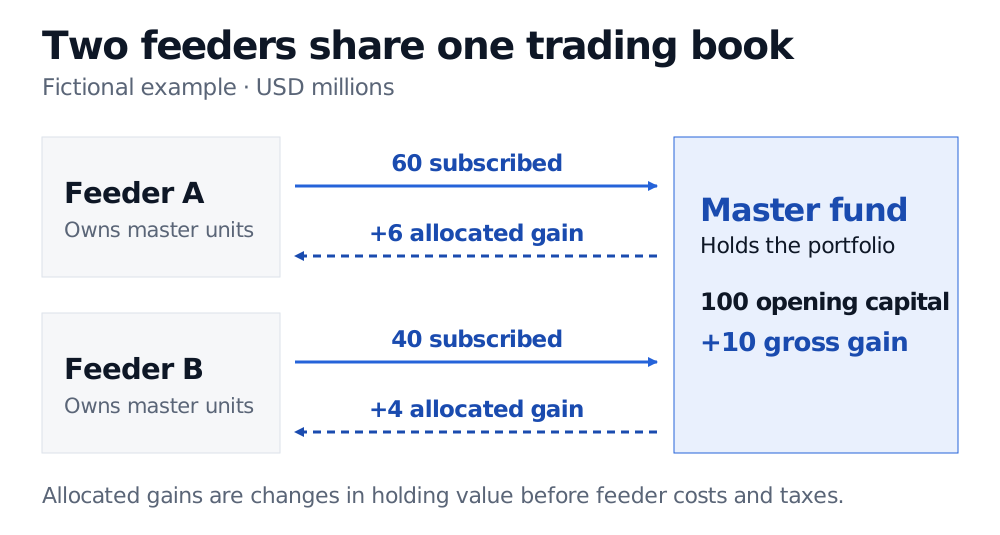
Solid arrows show opening subscriptions. Dashed arrows show increases in the value of the feeders’ interests before feeder costs and taxes.
Both feeders earn the same gross return on their master holdings even though their dollar gains differ.
The two interests finish at USD 66 million and USD 44 million, which together reconcile to the master’s USD 110 million of closing net asset value. For strategy-level exposure, count the master’s positions once. Adding the feeder holdings to the master’s NAV would count the same capital twice. A separately managed account following the same strategy has its own positions to account for.
In an actual feeder’s return, its cash balance and expenses can affect the result. If it reports in a different currency from the master, currency translation and any feeder-level FX hedge can also change the reported return. Match the period and currency, then check which charges are already reflected in the master’s valuation before deducting feeder expenses. In its March 2026 report, Cypress Creek’s Cayman feeder recorded its share of the master’s income, expenses and gains, and disclosed its own operating expenses. It reported in U.S. dollars. Cypress Creek annual report, Offshore TEI Fund notes 1–3
Where the offshore entity fits
Offshore describes a fund’s domicile relative to a reference jurisdiction. In the DIF structure reported at December 2025, a Cayman Islands limited partnership designed primarily for qualified U.S. tax-exempt and non-U.S. investors invested in a Delaware master. Cypress Creek’s March 2026 report shows an extra layer. Its Delaware TEI fund invested through a Cayman company that in turn invested in a Delaware master. DIF financial statements, note 1 · Cypress Creek annual report, organisation notes
Those entity relationships tell you who holds each interest. The audited notes tell you how it appears in the accounts. DIF’s feeder consolidated the master and showed the outside investors’ share as a non-controlling interest. Cypress Creek’s Cayman feeder recorded its master interest at fair value based on its share of the master’s capital. Tax treatment is a separate question that depends on how the relevant jurisdictions classify each vehicle, the source and type of income, and the investor’s status. Cypress Creek’s Cayman feeder disclosed U.S. withholding on certain investment income in its March 2026 report. DIF financial statements, note 2 · Cypress Creek annual report, Offshore TEI Fund notes 2–3
Sources
- DIF Feeder LP and Subsidiaries, consolidated financial statements at December 31, 2025. Notes 1–2 describe the Cayman feeder, Delaware master and accounting presentation.
- Cypress Creek Private Strategies TEI Fund, annual report at March 31, 2026. The TEI Fund, Offshore TEI Fund and Master Fund notes trace the entity chain. The Offshore TEI Fund’s notes 2–3 cover allocation, valuation, reporting currency and withholding.