Index provider market classification is the process a benchmark provider uses to group equity markets into investable categories such as developed, emerging or frontier. The category helps determine which benchmarks can include a market’s stocks. When it changes, a stock can leave one benchmark and enter another, changing the holdings that an index fund aims to replicate. MSCI Global Investable Market Indexes Methodology
What makes a market investable?
MSCI classifies equity markets as Developed, Emerging, Frontier or Standalone. Its June 2026 framework asks three questions. MSCI Market Classification Framework
- Economic development. Does the country meet MSCI’s sustained income criterion? MSCI uses this test for Developed status. Size, liquidity and accessibility distinguish Emerging from Frontier.
- Size and liquidity. Are there enough companies with sufficiently large and liquid securities? MSCI’s requirements differ by category, and its entry test looks for persistence across reviews.
- Market accessibility. Can international institutions own shares, move capital in and out, trade and settle efficiently, access investment instruments, and operate under a stable institutional framework? A market can have large listed companies and still be hard to track if foreign investors face ownership caps or difficulty converting currency.
MSCI can maintain a separate country index for a Standalone market outside its broad Emerging and Frontier benchmarks. That category can include newly eligible markets as well as markets whose accessibility, size or liquidity has deteriorated. MSCI Market Classification overview · MSCI 2026 Global Market Accessibility Review
The market label sets the universe to consider. The specific benchmark’s rules then screen securities for eligibility, including size, liquidity and, where applicable, the room left for foreign investors to buy. MSCI Global Investable Market Indexes Methodology
Greece had two implementation schedules
Providers set their own labels and timetables. FTSE Russell splits emerging equities into Advanced Emerging and Secondary Emerging. It moved Greece from Advanced Emerging to Developed from the market open on 21 September 2026. MSCI announced its decision on 31 March 2026 and scheduled Greece’s move from Emerging to Developed for its May 2027 Index Review. In November 2026, Greece was therefore Developed for FTSE Russell and Emerging for MSCI. FTSE Russell Equity Country Classification · FTSE Russell 2025 decision · FTSE Russell 2026 review results · MSCI Greece reclassification notice
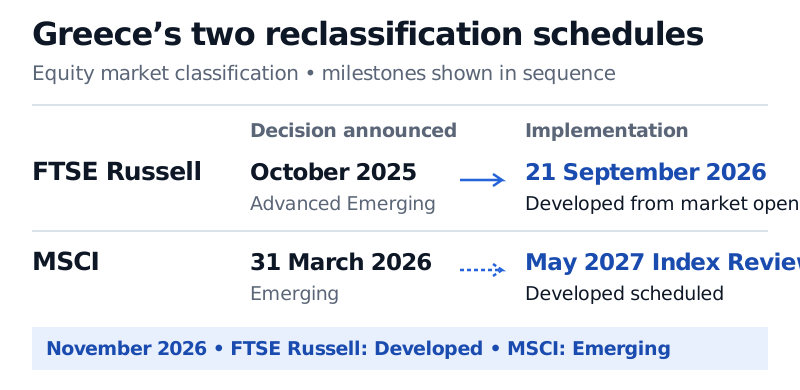
Greece’s equity classification by provider. The announcement makes the planned change public. The implementation is when the affected benchmark starts using it.
For a backtest, keep two timestamps. Use the effective timestamp to determine the benchmark membership in force at a given moment. For a signal that trades on the announcement, use the timestamp when the strategy could actually see it. Treating a future constituent as already in the benchmark can create look-ahead bias. The SelfMadeQuant Point-in-Time Data lesson works through historical eligibility and availability rules. The preview is public and the full lesson requires membership.
What a 4% addition means for a tracker
In a fictional review, an eligible stock enters an index at a 4% post-review weight. A fund with USD 500 million in net assets fully replicates that index and has no existing exposure to the stock. Holding prices, exchange rates and fund assets fixed and ignoring trading costs, its target holding is
Starting from zero, the fund has USD 20 million of exposure to add. It can finance that purchase by trimming existing holdings, with no new subscriptions. A sampled tracker may omit the stock, and a tracker using derivatives can obtain exposure without a matching purchase of the shares. To estimate actual orders, compare each fund’s target with its existing exposure and include reductions from funds that track benchmarks the stock is leaving. A price forecast would also need to account for liquidity and how much of the change traders already anticipated. SEC Investor.gov, Index Funds
Sources
- MSCI Market Classification Framework, June 2026
- MSCI Market Classification overview
- MSCI 2026 Global Market Accessibility Review release
- MSCI Global Investable Market Indexes Methodology, August 2026
- MSCI Greece reclassification notice, 31 March 2026
- FTSE Russell Equity Country Classification
- FTSE Russell equity classification announcement, October 2025
- FTSE Russell September 2026 country classification review results
- SEC Investor.gov, Index Funds