The Global Industry Classification Standard (GICS) and the Industry Classification Benchmark (ICB) group companies by their principal business activity. MSCI and S&P Dow Jones Indices maintain GICS. FTSE Russell maintains ICB. A company's classification determines which peers it is compared with and where its weight shows up in a portfolio exposure report. The same groupings can also define the eligible stocks for a sector index tracked by an exchange-traded fund. MSCI GICS overview · FTSE Russell ICB overview
| Scheme | Level 1 (broadest) | Level 2 | Level 3 | Level 4 (most specific) |
|---|---|---|---|---|
| GICS | Sector | Industry Group | Industry | Sub-Industry |
| ICB | Industry | Supersector | Sector | Subsector |
A GICS Sector is the broadest grouping. An ICB Sector sits two levels down. Even the top-level code 10 means Energy in GICS and Technology in ICB. A bare name or code is an unsafe join key. For an exposure comparison with a benchmark portfolio, classify both sets of holdings using the same scheme, level and historical snapshot. When comparing reports built on different schemes, regroup the underlying holdings under a common taxonomy where possible. S&P DJI GICS structure · ICB Ground Rules, §6
How a mixed business gets one label
Suppose a fictional issuer reports 60 revenue units from a software segment and 40 from a banking segment. That gives reported segment shares of 60% and 40%. An accounting segment can contain several activities, so the provider first has to map what each segment does to its own definitions.
- GICS. Revenue is the main input. In S&P DJI's October 2026 methodology, the first test for an initial classification looks for an activity accounting for more than 60% of total revenue. When no activity reaches 60%, the methodology considers revenue and earnings together. Further research and market perception can also inform the assignment. A review of an existing classification also weighs whether a shift in the business has persisted. The fictional software share is exactly 60%, which falls short of the first test. GICS Methodology, Classification and Maintenance
- ICB. FTSE Russell starts with the business descriptions and revenue sources in audited accounts and directors' reports. Its decision tree includes a test for at least 50% of revenue in one defined Subsector, after screening for investment schemes and diversified financial holding companies. Other branches consider the gap between the largest revenue sources, certain banking activities and diversified businesses. The share that belongs to a single ICB Subsector depends on which activities the software segment contains and how ICB defines them. ICB Ground Rules, §§4.2–4.3
In a standard single-label equity exposure report, the issuer's entire position weight goes into its assigned bucket. A revenue breakdown answers a different question and can be kept alongside the classification to show secondary business exposures.
When a classification becomes usable
On 1 October 2026, MSCI announced that Circle Internet Group would move from Application Software (Information Technology) to Transaction & Payment Processing Services (Financials) in the MSCI Global Standard Indexes, effective at the 30 October close. At a 15 October backtest rebalance, the change could already be known while the holding still counted under Information Technology. In a fictional portfolio with a fixed 4% position, the reclassification alone would lower reported Information Technology exposure by 4 percentage points and raise Financials exposure by the same amount. MSCI notice, 1 October 2026
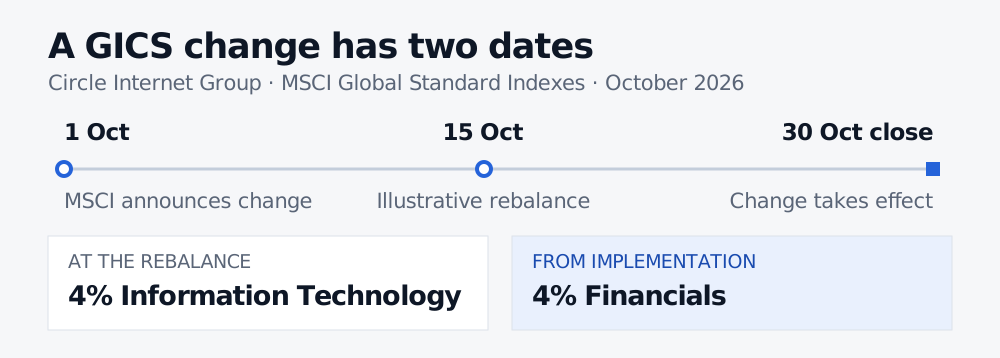
The announcement and cutover are from MSCI. The 15 October rebalance and constant 4% portfolio weight are illustrative.
Save the issuer identifier, provider, taxonomy version and classification code with the dates the record became available and took effect. In a historical join, use the record available to the strategy and in force at the decision time, resolving its code against the taxonomy in force then. Applying today's assignments to older holdings can introduce look-ahead bias. If the signal explicitly trades on pending changes, use the announcement as a separate event and retain the effective date for current exposure reporting. ICB likewise distinguishes announcements from implementation. Its Ground Rules distinguish indicative notices, confirmed notices and quarterly implementation for periodic changes, with a separate process for corporate events. ICB Ground Rules, §§4.3–5.1
Once the portfolio and benchmark share a classification, the Portfolio Constraints lesson shows how to match their sector weights in an optimiser. The preview is public and the full lesson requires membership.
Sources
- S&P Dow Jones Indices, Global Industry Classification Standard Methodology (October 2026)
- S&P Dow Jones Indices, GICS structure and sector codes
- MSCI, GICS overview
- MSCI, GICS changes announced 1 October 2026
- FTSE Russell, Industry Classification Benchmark (Equity) Ground Rules (v5.1, August 2026)
- FTSE Russell, ICB overview