What each model takes responsibility for
Write for the features and for the class label. A generative classifier models
The sum runs over the possible classes, and the denominator must be positive. Here denotes probability mass for discrete features or density for continuous features. These are model distributions, not guarantees that fitted probabilities match reality.
| Approach | Typical example | Main modelling commitment |
|---|---|---|
| Generative classification | Naive Bayes | Class priors and feature distributions conditional on each class; naive Bayes additionally assumes conditional independence of features within a class |
| Generative classification | Linear discriminant analysis | Gaussian class-conditional features with a shared covariance matrix |
| Discriminative classification | Logistic regression | A conditional class probability with a linear predictor on the log-odds scale |
One default prediction, two routes
- The default prior is .
- The alert occurs in 80% of default cases: .
- It occurs in 10% of non-default cases: .
These are illustrative assumptions, not market estimates. The generative model assigns joint probabilities of to default with an alert and to non-default with an alert. Hence
The 80% alert rate is not the answer: it conditions in the opposite direction. In 1,000 cases with exactly the assumed proportions, 160 of the 240 alerted cases default. Without an alert, 40 of 760 cases default, giving .
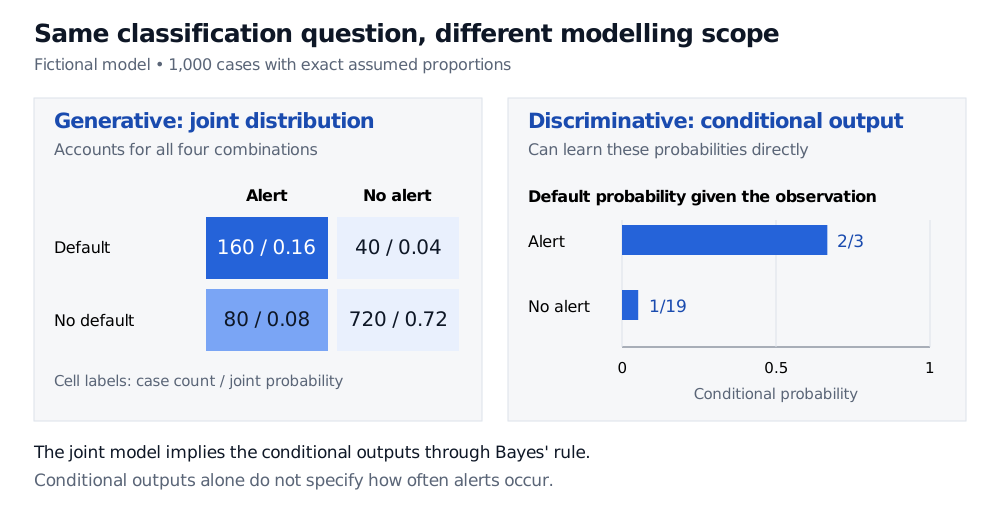
A discriminative model could learn those two conditional probabilities directly from labelled cases. Their agreement with the generative calculation would not establish which training approach produced them. Nor would those conditional outputs alone specify how frequently alerts occur. Recovering the joint distribution additionally requires a marginal model for .
Classification is not data synthesis
“Generative” also covers models that learn a distribution of observations without a class label. A model of issuer features could sample synthetic issuers; a generative classifier could sample a class first and then features conditional on that class. The toy model above can generate binary alert/default pairs, not realistic balance sheets or market paths.
Which assumptions can the data support?
Generative classifiers can benefit from strong distributional structure when labelled samples are limited. That structure can also be wrong. Ng and Jordan demonstrate different sample-size regimes for naive Bayes and its discriminative counterpart under their stated setup; their result is not a universal ranking of every generative and discriminative model.
For credit or financial-text classification, compare future-period prediction errors and probability calibration, with features available at the decision time. For synthesis, examine whether generated observations preserve the dependencies and constraints required by the intended use. A valid probability distribution need not be an adequate financial model.
Sources
- Andrew Y. Ng and Michael I. Jordan (2001), On Discriminative vs. Generative Classifiers: A comparison of logistic regression and naive Bayes, Abstract and §1: joint versus conditional learning and the scope of the comparison.
- Andrew Ng, CS229 Lecture Notes: Generative Learning Algorithms, opening discussion, §§1.2–1.3 and §2: Bayes classification, shared-covariance Gaussian models and naive Bayes.
- Ian Goodfellow and co-authors (2014), Generative Adversarial Nets, Abstract: a generator captures a data distribution while a discriminator distinguishes real from generated samples.