Financial regulators are public authorities that oversee financial activities and institutions within a legally defined remit. The relevant authority depends on the jurisdiction, the legal entity and what it is doing. For a quant team, that determines which filing, rulebook or register can support a claim about an input or a trade.
Four checks on one portfolio
Suppose a team is documenting a portfolio that holds shares in a US reporting company, hedges with oil futures on a US futures exchange, uses a UK investment adviser and consumes bond ratings from an EU-registered rating agency. Each check concerns a different activity.
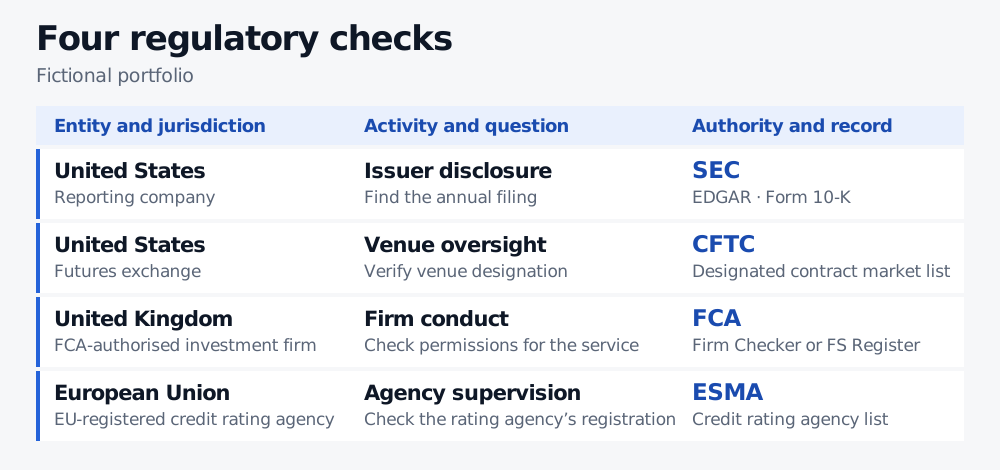
Each record answers a different question about the entity and activity in that row.
- SEC — US issuer disclosure. The Securities and Exchange Commission’s Division of Corporation Finance selectively reviews issuer filings for compliance with federal disclosure and accounting requirements. The team can retrieve the company’s annual Form 10-K from EDGAR. For a filing-based event study, keep the date the filing became available separate from the financial period it covers to avoid look-ahead bias. SEC filing review, EDGAR search.
- CFTC — US futures venue oversight. The Commodity Futures Trading Commission oversees the exchange in this example because it is a designated contract market (DCM) under the Commodity Exchange Act. The CFTC checks the venue’s compliance with requirements that include monitoring trading and enforcing its own rules. To verify the venue’s designation for the oil futures contract, look up the exchange’s legal name in the CFTC’s list. CFTC oversight and core principles, DCM list.
- FCA — UK investment firm conduct. The Financial Conduct Authority supervises the conduct of the FCA-authorised investment firm in this example. Check the firm’s permissions for the service being used, such as investment advice. The FCA’s Firm Checker covers current permissions, and its Financial Services Register can help establish a firm’s historical status. FCA remit, FCA firm checks.
- ESMA — EU rating agency supervision. The European Securities and Markets Authority registers and directly supervises EU credit rating agencies under the EU Credit Rating Agencies Regulation. The team can match the legal entity that issued a rating to ESMA’s list, which distinguishes registered and certified agencies and gives the effective date. The grade itself is the agency’s assessment of creditworthiness. ESMA credit rating agencies, ESMA authorisation list.
Where responsibilities meet
In the US, some products fall under both agencies. Security futures, including futures on a single stock or a narrow-based securities index within the statutory definition, are subject to joint SEC and CFTC oversight. CFTC on security futures.
In the EU, ESMA directly supervises rating agencies and also works with national authorities to make their supervisory practices more consistent. For an investment firm covered by MiFID II, the home Member State’s national competent authority grants authorisation. ESMA maintains the EU-wide list of authorised investment firms and their permitted activities. ESMA on supervisory convergence, MiFID II Article 5.
In a historical review, retain the entity identifier, the activity, the source and the date the relevant status or rule applied. An issuer’s filing date, a venue’s designation date and a rating agency’s registration date describe different events.
The SelfMadeQuant lesson on Earnings Calls and Filings shows how the filing date, report section and event window affect an equity research signal. The full lesson requires membership and has a public preview.
Sources
- SEC Corporation Finance filing review process and SEC EDGAR filings
- CFTC designated contract market oversight, designation records and joint regulation of security futures
- FCA remit and firm authorisation checks
- ESMA credit rating agency supervision, agency authorisation records and supervisory convergence
- MiFID II Article 5 on investment-firm authorisation