Fear of missing out can turn other people’s gains into pressure to trade. Separate social comparison from new information, momentum signals and forward expected returns.
Fear of missing out
Fear of missing out (FOMO) is apprehension that other people are enjoying rewarding experiences or opportunities from which one is absent. In financial decisions, it describes the pressure to participate because others appear to be making money and being left behind feels costly. That pressure can displace the research, entry conditions or position limits that would otherwise govern a trade.
The original psychological construct is broader than investing. Przybylski and colleagues developed a self-report measure of FOMO and studied its correlates, including social-media engagement. Their 2013 research is a basis for the definition, not an experiment showing that FOMO causes trading losses. Here, the financial application describes a decision motive; it is not a clinical diagnosis. Przybylski et al. (2013)
The comparison changes before the evidence does
Imagine a researcher who initially requires a documented signal and a position within a fixed risk budget. A stream of other people's winning trades makes waiting feel like failure. The researcher now accepts an untested entry or increases size, although the evidence supporting the trade has not improved. The relevant change is the pressure to avoid missing others' gains.
That is different from learning useful information from someone else. A peer may reveal a genuinely informative earnings analysis. A price rise may satisfy a previously tested momentum rule. Either can justify reassessment. Buying a rising asset does not, by itself, reveal FOMO; neither does acting quickly after material news.
This distinction has a financial-research counterpart. In a Brazilian brokerage field experiment, Bursztyn and colleagues separated learning about a peer's purchase decision from learning that the peer actually possessed the asset. Both social learning and social utility affected investment decisions in that setting. Their design supports separating informational and possession-related influence; it does not identify FOMO in every follower, or establish that following peers generally loses money. Bursztyn et al. (2014)
You cannot buy yesterday's entry price
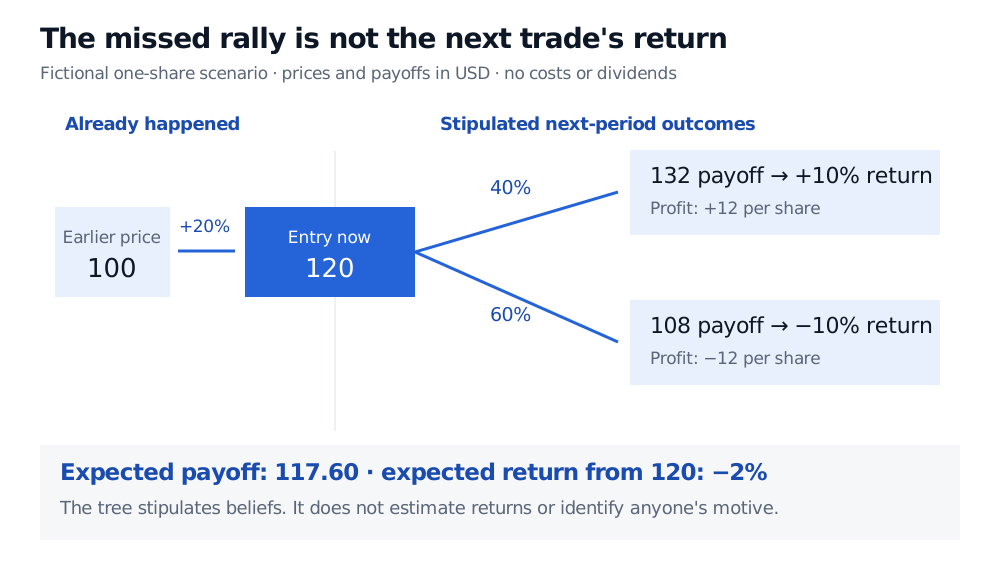
Consider a fictional asset with no dividends. Its price has already risen from USD 100 to USD 120: a 20% gain for someone who held it over that interval. A new buyer pays 120. For one stipulated future period, suppose the payoff is 132 with probability 40%, or 108 with probability 60%. Ignore costs and funding.
The simple return measured from the new entry price therefore has expectation
0.4(120132−120)+0.6(120108−120)=−0.02=−2%.
Fictional USD price rises from 100 to a current entry of 120. Next-period payoffs are 132 with 40% probability and 108 with 60%, giving returns of plus and minus 10%. Expected payoff is 117.60 and expected return from 120 is minus 2%.
Original fictional scenario. The past 20% rally and the next trade have different starting prices. Probabilities are stipulated, with no costs or dividends; neither a price rise nor this calculation establishes FOMO.
Each branch moves 10% from the entry price, but the adverse branch has the larger probability. Expected profit is minus USD 2.40 per share. The earlier gain does not enter this buyer's profit calculation. With these same two payoffs, a 50% up-state probability would give zero expected return before costs. Better evidence could change the probabilities or payoffs; the past rally alone does not supply that evidence.
These numbers are assumptions, not a forecast. The negative expectation illustrates the danger of substituting a missed historical gain for a forward assessment. It does not prove that the fictional buyer feels FOMO, and an eventual gain at 132 would not prove that the original probabilities were well founded. That latter confusion is outcome bias.
Look for the decision that changed
A useful review compares the proposed trade with the process in place before the social comparison became salient:
Evidence: What new information changed the expected payoff assessment? Another person's realised gain is not automatically evidence about the remaining opportunity.
Entry and size: Does the current price still satisfy the rule, and does the position fit the existing risk budget? Wanting to catch up does not make a larger exposure safer.
Record: What reason was recorded before the outcome was known? A later profit or loss cannot recover the motive on its own.
These questions structure a process review; they are not a validated psychological test or a guarantee of improved returns. For the practical separation of thesis, sizing, costs and limits, see From Thesis to Position: The Practitioner Alpha Pipeline (public preview; full lesson requires membership).