An explainable boosting machine learns nonlinear feature contributions that add on a model score scale. See how main effects, interactions and the inverse link produce a probability.
Explainable boosting machine
An explainable boosting machine (EBM) is a tree-based prediction model that uses boosting to learn nonlinear feature functions whose contributions can be inspected and added. It belongs to the generalised additive model family and can include selected interaction terms. For a quant examining a credit-risk forecast, this means tracing a borrower's model score to debt, liquidity and any included joint effects, rather than receiving only a probability.
The explanation comes from the model's own structure. It does not require fitting a separate approximation to a more complex predictor.
What is being added?
A common EBM form, allowing selected pairs, is
F(x)=β0+j∑fj(xj)+(j,k)∈I∑fjk(xj,xk).
Here β0 is an intercept, fj is a one-feature shape function, and I identifies included pairs. Without the last sum, changing one feature changes the score through its own curve alone. With an interaction, that feature's total contribution also depends on its partners. A two-feature surface can still be inspected; a one-feature plot no longer tells the whole story. This is the central extension in Lou and colleagues' GA2M paper, §§1–2.
The scale matters. For binary classification with the logit link, define p(x) as the probability of the designated positive class:
F(x)=log(1−p(x)p(x)),p(x)=1+e−F(x)1.
Add the terms before applying the inverse link. Adding separately transformed feature probabilities would produce a different model. InterpretML's binary-classification internals reconstruct predictions this way. For regression with an identity link, the summed score is already on the response scale.
One borrower, two possible specifications
Consider a fictional model of default within a fixed future horizon, with default designated as the positive class. For one borrower, supply these values from centred shape functions:
Term
Log-odds contribution
Intercept
−1.0
Debt burden
+0.7
Liquidity
+0.5
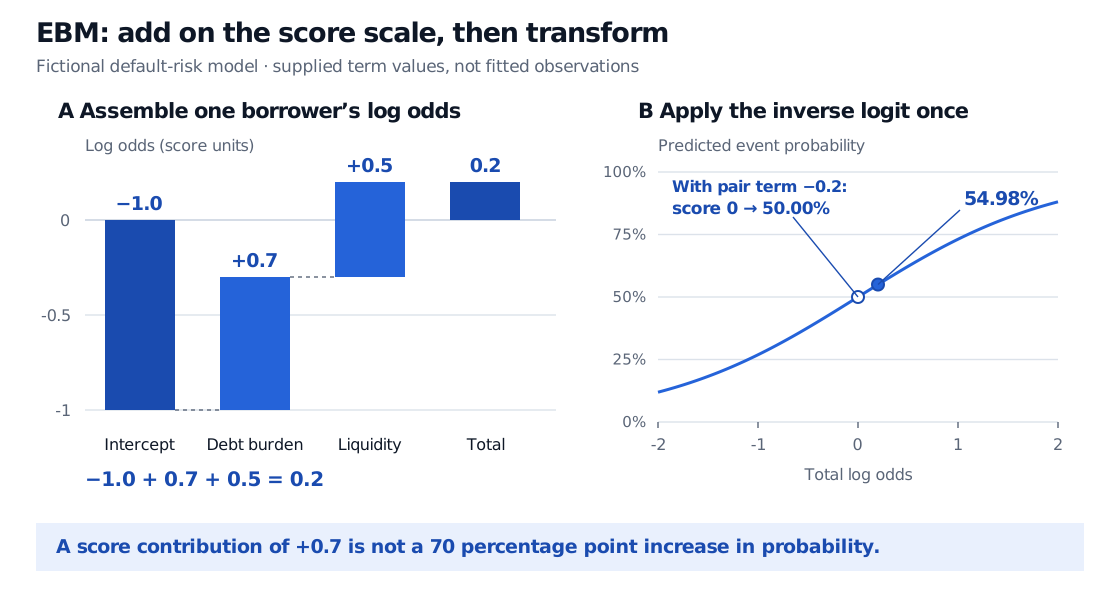
The two main terms give F=−1+0.7+0.5=0.2, hence p≈0.549834, or 54.98%. These are stipulated scores, not estimates from borrower data or a claim about real default frequencies.
Now include a pairwise contribution of −0.2 at this borrower's debt–liquidity combination, keeping the supplied intercept and main scores unchanged for the comparison. The score becomes zero and the probability becomes 50%. That is a reduction of about 4.98 percentage points, not 20 percentage points. Refitting a real model with interactions can also change its main terms; this comparison isolates only the arithmetic of the supplied pair term.
Fictional default-risk model: intercept minus 1, debt score plus 0.7 and liquidity score plus 0.5 give total log odds 0.2 and probability 54.98 percent. A pairwise score minus 0.2 reduces the total to zero and probability to 50 percent.
Original stipulated example, not a fitted credit model. The waterfall adds log-odds contributions; the sigmoid converts the complete score into a probability. The pair term changes the prediction by about 4.98 percentage points here.
“Centred” means the term's weighted average over the training reference distribution is zero, with the offset absorbed into the intercept. Zero contribution therefore identifies a reference, not “no risk”. Shifting a constant between an intercept and a term leaves the complete prediction unchanged. Nor must the inverse-logit of the intercept equal the population's average predicted probability: the inverse link is nonlinear.
How boosting becomes a set of shape functions
EBM builds on gradient boosting, restricting updates to specified features or terms. Many small tree updates combine into a feature's shape. For prediction, a numerical input is assigned to a bin, its stored term score is looked up, and all applicable scores are summed. A selected pair uses a two-dimensional lookup table. InterpretML's algorithm description explains this connection between fitting and prediction.
The historical description emphasises low-rate, round-robin updates across features, with bagging to stabilise the fit. Current software needs a more precise qualification: the classifier API documentation records greedy boosting and smoothing enabled by default since release 0.5.1 in February 2024. It also allows explicitly specified higher-order interactions. An EBM is therefore not universally a pure cyclic algorithm or a model limited to pairs. Inspect its fitted term list and training settings; higher-dimensional terms are harder to visualise completely.
Read the curves as model behaviour
A positive debt contribution says that this fitted term raises the score relative to its centring reference. It does not show how default risk would change if a lender intervened to reduce debt. Correlated predictors can share predictive information, and an apparently important term can partly represent another measured or omitted condition. An exact accounting of a model's score is not causal inference.
For financial data, inspect the observations supporting each bin and pair region, compare shapes across training windows, and evaluate discrimination and probability calibration on later observations. Fit bin boundaries and other preprocessing using training information. Readable shapes cannot reveal every form of look-ahead bias, and a smooth curve can still encode a relationship that disappears in a new regime.
For the underlying staged-fitting idea, Boosting: AdaBoost and Gradient Boosting develops residual updates and shrinkage. Its full teaching requires membership; the linked page provides a public preview.