A Eurodollar is a US dollar bank deposit booked outside the United States. The balance is an asset for the depositor and a USD funding liability for the bank. A US bank’s London branch can take a Eurodollar deposit. What matters is where the bank books the liability and the currency it owes. A deposit booked in Singapore can qualify too. BIS, A shift in London’s eurodollar market, p. 68
Banks can use these deposits to fund dollar lending, including lending to other banks. A treasury desk tracks the currency and maturity of the liability because it needs dollars when the deposit comes due. If the bank is relying on the deposit to fund a longer-dated asset, it may have to find replacement funding at a different rate. In US regulatory reporting, the Federal Reserve also collects Eurodollar transactions from certain domestic international banking facilities. BIS, A shift in London’s eurodollar market, pp. 68–70 · Federal Reserve, FR 2420 reporting overview
What a 90-day deposit pays
Suppose a company places USD 1,000,000 with a bank’s London branch for 90 days at a fixed 4% simple annual rate. The agreed day count convention is ACT/360. The deposit earns interest for 90 actual days using a 360-day denominator.
With interest paid at maturity and no fees, the bank owes USD 1,010,000 on day 90. The depositor is exposed to the bank’s ability to make that payment.
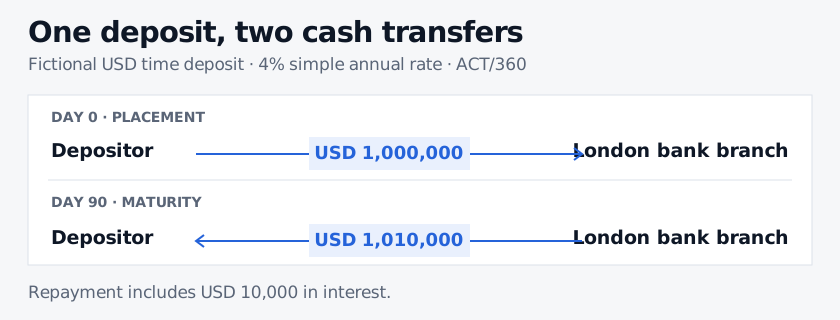
The arrows show the direction of each USD payment. The opening transfer provides funding to the branch, and the maturity payment extinguishes the liability.
What the former futures contract settled on
CME’s Three-Month Eurodollar futures contract gave traders exposure to three-month US dollar LIBOR. It settled in cash using the benchmark fixing, so holding the contract gave the trader no claim on a bank deposit. CME, historical Eurodollar futures rulebook, Rule 45203
CME used eligible Eurodollar futures positions open at the close on 14 April 2023 to establish corresponding Three-Month SOFR futures positions for the 17 April trade date. The April, May and June 2023 Eurodollar expiries were left to expire on their original schedules. The USD LIBOR bank panel ended on 30 June 2023. CME, Eurodollar fallback implementation plan · CME Clearing, production weekend notice · CME, completion announcement · FCA, USD LIBOR panel cessation
Three-Month SOFR futures settle on overnight SOFR compounded over the contract’s reference period. SOFR measures overnight borrowing secured by US Treasuries. A bank’s unsecured term deposit rate can move differently from that benchmark, leaving basis risk in a hedge of future funding costs. New York Fed, SOFR data and methodology · CME, Understanding SOFR Futures
Sources
- Offshore dollar deposits and interbank funding. BIS, A shift in London’s eurodollar market, pp. 68–70 · Federal Reserve, FR 2420 reporting overview.
- Historical settlement and 2023 conversion. CME, Eurodollar futures Rule 45203 · CME, fallback implementation plan · CME, conversion completion announcement · FCA, USD LIBOR panel cessation.
- SOFR and current futures settlement. New York Fed, SOFR data and methodology · CME, Understanding SOFR Futures.