The Euro Interbank Offered Rate (Euribor) is a set of euro benchmarks for the cost of borrowing unsecured wholesale funds at specific maturities. The European Money Markets Institute (EMMI) administers five tenors: one week, one month, three months, six months and twelve months. A loan or floating-rate note can use a named tenor to reset its interest payments as funding conditions change. EMMI's Euribor overview
One fixing sets the coupon for one period
Suppose a €10 million loan charges three-month Euribor plus a margin of one percentage point. Its contract specifies when to take the fixing, which dates accrue interest and when payment is due. Assume a fictional 3.00% fixing in advance, 90 actual days, an Actual/360 day-count convention, constant principal and no floor or cap. The interest paid at period end is
Three months selects the benchmark tenor. The actual dates determine the accrual fraction, so the next three-month period can have a different day count. A move in Euribor after the fixing leaves this period's coupon amount fixed under these terms. The next reset uses its own fixing. Before that fixing, a valuation can project it from a Euribor forward curve, but the cash flow settles using the contractual fixing.
The Finance Primer lesson on Swaps uses the same simple floating-leg accrual and shows how to net it against a fixed leg. The preview is public and the full lesson is available with a free account.
How EMMI determines each tenor
The hybrid methodology applies a hierarchy to each panel bank's contribution for each tenor.
- Level 1 uses the volume-weighted average rate of eligible unsecured euro money-market transactions for that tenor.
- Level 2 applies when there is insufficient eligible transaction data for Level 1. The prescribed sequence is adjusted interpolation from neighbouring standard tenors where applicable, eligible trades at non-standard maturities, then eligible past contributions updated with a market adjustment.
EMMI completed the phase-in of the two-level methodology in October 2024, retiring the old Level 3 expert-judgment submissions. From 29 June 2026, EMMI increased the precision of bank contributions to three decimal places and switched to historical benchmark rates as inputs to the Level 2.1 spread adjustment and Level 2.2 interpolation. The two-level hierarchy stayed in place. EMMI methodology and version history · EMMI's 2024 phase-in announcement
Why €STR changes the timing
The ECB's euro short-term rate (€STR) measures wholesale unsecured overnight borrowing by euro-area banks. A three-month Euribor coupon fixed in advance uses one published term rate. A coupon on €STR compounded in arrears needs a series of overnight observations, so the final amount becomes known near the end of the period under the contract's observation convention. The ECB's published three-month compounded €STR average looks back at realised overnight rates. A forward-looking term €STR rate, where used, has a different construction and can be known in advance. ECB overview of €STR · Euro risk-free rates working group recommendations
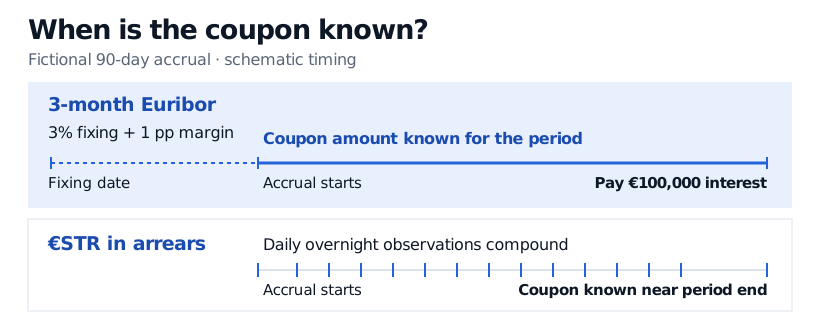
The timing of the rate and the timing of the payment are separate. The Euribor loan in the example pays at the end of the accrual period, even though its coupon is already known at the start.
When the contract changes benchmarks
Fallback terms specify the event that triggers a change and which rate applies. A temporary missing fixing may have a different treatment from permanent cessation or a formal finding that Euribor is no longer representative. For corporate loans, the euro risk-free rates working group discussed compounded €STR in arrears and a sequence that uses forward-looking term €STR first and compounded €STR if needed. A fallback spread adjustment can account for differences between the benchmarks. It serves a separate purpose from the loan margin in the example. If a loan and its hedge use different fallbacks or observation conventions, their cash flows can diverge, leaving basis risk. Working group guidance for corporate lending
Sources
- EMMI, Euribor overview
- EMMI, Euribor hybrid methodology and version history
- EMMI, completion of the updated Euribor methodology phase-in
- ECB, overview of the euro short-term rate
- Euro risk-free rates working group, recommendations on Euribor fallback triggers and rates
- Euro risk-free rates working group, guidance for corporate lending products