A Dutch auction self-tender is a share buyback in which a company invites existing shareholders to offer shares for sale within a stated price range, then buys the shares it accepts at one price. Each shareholder's tender states how many shares they will sell and the minimum price they will accept, or takes the price determined by the offer if the terms allow that election. The minimum price sets eligibility. The proration rules determine how many eligible shares the issuer buys, so a holder's proceeds depend on both the clearing price and the fill. Scholastic Offer to Purchase, Summary Term Sheet and Section 1.
The company is the buyer. In a primary Dutch auction IPO, investors bid to buy shares the company is issuing. A self-tender also differs from an accelerated share repurchase, where the company typically takes an initial delivery from a dealer and determines the final economics under a forward contract. The Equities, Indices and Corporate Actions lesson (public preview, full lesson for members) explains how buyback cash paid to sellers differs from a dividend paid across eligible holders.
Four million shares to buy, five million eligible
Suppose a fictional issuer seeks up to 4 million shares and will pay the lowest permitted price that supplies that quantity. The permitted prices are USD 18, 19 and 20 per share. All tenders below are valid and remain in the offer at expiry. The issuer applies one pro rata fill rate to eligible shares, with no priority, conditional tenders, rounding effects or increase in the target.
| Minimum price (USD per share) | Shares tendered at that price (millions) | Cumulative shares at or below that price (millions) |
|---|---|---|
| 18 | 2 | 2 |
| 19 | 3 | 5 |
| 20 | 5 | 10 |
At USD 18, only 2 million shares are available. At USD 19, the issuer has 5 million eligible shares, enough to meet the 4 million target. USD 19 is the clearing price. Every eligible tender gets the same fill fraction in this example.
The issuer buys 1.6 million shares from the USD 18 tenders and 2.4 million from the USD 19 tenders. The USD 20 tenders are ineligible. The issuer pays USD 19 for each accepted share, for a total of USD 76 million before expenses.
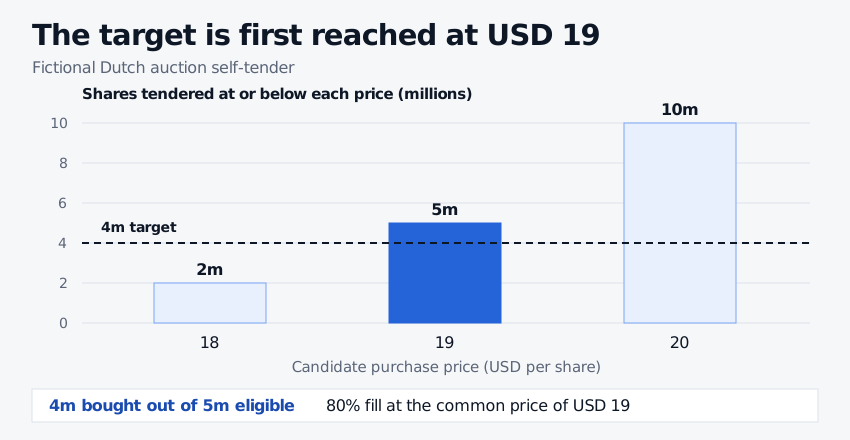
The first price that reaches the target of 4 million shares sets the price for every accepted share. Proration uses the full pool of 5 million shares at or below that price.
The offer sets the cap and allocation rules
A tender can cap the cash spent or the number of shares bought. Scholastic's 23 March 2026 offer set a cash cap of USD 200 million and a range of USD 36 to 40 in USD 0.50 increments. It sought the lowest price that would let it buy the most shares within that cap, or all valid unwithdrawn tenders if fewer shares were available. In its 23 April final results, it accepted all 2,834,018 shares validly tendered and unwithdrawn at or below the USD 40 purchase price. That came to USD 113,360,720 before fees and expenses. A price at the top of the range can coexist with unused budget. Scholastic Offer to Purchase, Section 1, Scholastic final results.
Scholastic's terms gave odd-lot priority to qualifying holders of fewer than 100 shares in total who tendered their entire holding. A permitted conditional tender could specify a minimum number of shares the holder would sell if any were accepted. If preliminary proration fell below that minimum, the offer generally treated the tender as withdrawn, with a later lottery for qualifying tenders if needed to fill the offer. The terms also reserved the right to accept additional shares subject to applicable law. Each of these provisions can change the fraction of shares an eligible holder sells. Scholastic Offer to Purchase, Sections 1 and 6.
For U.S. issuer tender offers covered by SEC Rule 13e-4, the Schedule TO filing and its amendments document the terms and final results. The rule generally requires pro rata acceptance in oversubscribed partial offers, subject to exceptions, and requires the issuer to pay each accepted holder the highest consideration it pays for the tendered securities. Rule 14e-1 also addresses timing and prompt payment or return of shares. The SEC's 16 April 2026 order permits a shorter offering period for certain equity tenders on the condition that the cash price is fixed. A Dutch auction determines the price from tenders after the offer closes. Rule 13e-4(c) and (f), Rule 14e-1(a)–(c), SEC exemptive order for equity tender offers.
Sources
- Scholastic Corporation, Offer to Purchase, 23 March 2026 describes price selection, oversubscription and priority.
- Scholastic Corporation, final tender results, 23 April 2026 reports the final accepted share count, purchase price and total before expenses.
- SEC Rule 13e-4, Rule 14e-1 and the 16 April 2026 exemptive order cover the U.S. filing, allocation and timing rules discussed above.