How a uniform-price IPO turns price-and-quantity bids into a common offer price and share allocations, and why the offering’s own rules matter.
Dutch auction IPO
A Dutch auction IPO is an initial public offering that uses investors’ price-and-quantity bids to help determine the offer price and share allocations, with successful investors paying a common offer price. The practical quant problem has three outputs: the price a bidder is willing to pay, the price actually charged, and the quantity allocated. Treating those as the same number misstates both issuer proceeds and investor exposure.
In the customary uniform-price interpretation, bids are aggregated into a demand schedule and a price is selected that can place the offered shares. This is a form of price discovery. The offering’s specific pricing and allocation terms still matter: a common payment price alone does not determine who receives how many shares.
400 shares, 600 requested
Consider a fictional IPO of 400 newly issued shares. Each bid specifies a requested quantity and a maximum price in USD per share. There is no reserve price, selling-shareholder tranche, overallotment, withdrawal, fee or issuance expense in this example.
We stipulate the following mechanism: set the uniform price at the highest price that can sell all 400 shares; fill bids strictly above that price first; then allocate the remaining shares proportionally among bids at that price. This is the example’s declared rule, rather than a universal IPO allocation convention.
Bidder
Shares requested
Maximum price (USD)
Cumulative demand at this price or higher
A
100
12
100
B
200
11
300
C
300
10
600
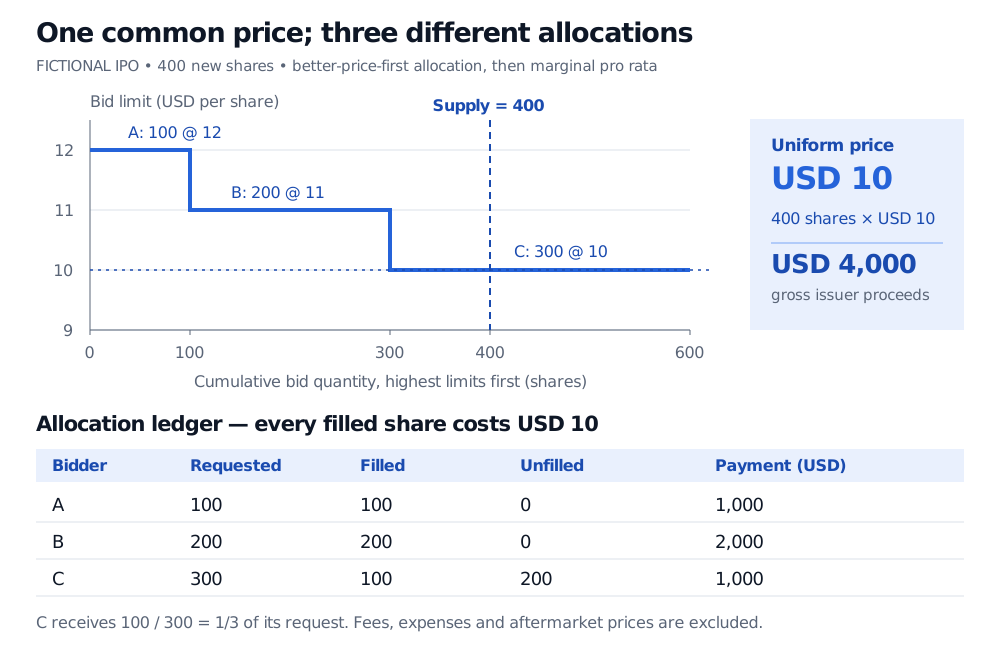
At USD 11, demand covers only 300 shares. At USD 10, demand covers 600, enough to sell the offering. Any price above 10 excludes C and leaves a shortfall. The clearing price is therefore USD 10.
A and B receive their full requests, using 300 shares. The remaining 100 go to C. Its fill fraction is
300400−100−200=31.
C receives 100 shares and leaves 200 unfilled. A pays USD 1,000, B pays USD 2,000 and C pays USD 1,000: every allocated share costs USD 10, including shares awarded to bidders prepared to pay more. Gross issuer proceeds are
400×10=4,000USD.
Those are gross proceeds for an entirely primary offering. Expenses would reduce net proceeds; proceeds from any existing shareholders’ sales would belong to those sellers.
Fictional IPO demand is 100 shares at USD 12, 300 at USD 11 and 600 at USD 10. The 400-share supply clears at USD 10. Under the stated allocation rule, A receives 100, B 200 and C 100 shares; their payments are USD 1,000, 2,000 and 1,000.
Original fictional uniform-price IPO. Better-priced bids fill first; remaining supply is allocated pro rata at the marginal price. This allocation rule is stipulated for teaching, not attributed to Google or to IPOs generally. All 400 shares are new; fees, expenses and aftermarket prices are excluded.
For comparison, Order Books works through a continuous-market purchase that consumes several price levels, then contrasts queue and proportional allocation. That contrast helps separate a bid schedule from a payment rule: walking a continuous order book need not give every purchased share the same price. The lesson has a public preview; the full lesson requires membership.
The name does not specify the whole mechanism
“Dutch” has two uses here. In standard single-item auction theory, a Dutch auction starts at a high announced price and descends until someone accepts. In financial usage, the name is also applied to uniform-price auctions that collect bids. Ausubel’s Auctions: Theory, Sections 4 and 5.A, explicitly distinguishes these meanings. Sorting submitted bids from high to low is an accounting operation; it does not establish that bidders participated in a descending clock.
An IPO auction also differs from an exchange call auction. The former places an offering with investors; the latter can match eligible buy and sell orders at a trading event. Their share supply, participation and allocation rules need separate specifications.
Google’s 2004 IPO shows why the prospectus matters. Its final prospectus dated 18 August 2004, “The Pricing Process,” defined a clearing price from submitted demand but allowed the company and underwriters to set the offer price below it. “The Allocation Process” specified a common purchase price and no preference among successful bids based on bid price; it described pro rata and maximum-share allocation alternatives. Our better-price-first example is therefore not a reconstruction of Google’s allocation. These are historical deal terms, not a statement of current requirements for other IPOs.
A bid is also a strategic input
A uniform price does not generally make truthful bidding a dominant strategy. A bidder able to influence the marginal price can affect what it pays on shares it still wins. Ausubel’s Section 5.A explains the related multi-unit incentive to shade marginal demand; the result depends on the mechanism and the bidder’s demand.
The toy offering gives a simple counterexample under its own rules. Suppose C values each requested share at USD 10. At its original bid of 10, it wins 100 shares and obtains zero value-minus-payment surplus. Holding A and B fixed, if C instead bids USD 9 for the same 300 shares, the clearing price becomes 9 and C still receives 100 shares. Its surplus becomes 100(10−9)=100 dollars. This assumes that 9 is permitted, no reserve applies and other bidders do not react. It demonstrates why truthful bidding is not guaranteed by this stipulated mechanism; it is not a bidding recommendation or a claim about Google’s auction.
Finally, clearing an offering does not identify fundamental value or ensure an aftermarket gain. The offer price and a later traded price are separate observations. IPO underpricing measures their difference under a stated convention. An issuance model needs actual allocations as well as prices before it can assign an investor any such return.