Duration Times Spread (DTS) multiplies a bond’s spread duration by its current credit spread. It lets a portfolio manager compare the price sensitivity of a shorter-duration bond with a wide spread and a longer-duration bond with a tight spread when both spreads move by the same percentage.
Which shock are you measuring?
Let be spread duration and the starting annual spread in decimal form. Hold the benchmark curve fixed and approximate the price effect of a small spread change using the starting duration. For a positive spread,
The two expressions describe the same first-order price move. Spread duration is the sensitivity to an absolute spread change, such as +20 bp. DTS is the sensitivity to a proportional change, such as +10% of the starting spread. Ben Dor and co-authors found that wider-spread US corporate bonds in their historical sample tended to experience larger spread moves in basis points. This made DTS a useful proxy for spread-driven return volatility in that sample. Ben Dor et al. (2007)
Two bonds, two spread shocks
Take two fictional bonds with option-adjusted spreads (OAS) calculated on the same benchmark curve, at the same time and under the same model conventions. Each spread duration measures sensitivity to its own OAS, with the benchmark and other model inputs held fixed.
| Bond | Spread duration | Starting OAS | DTS (bp-years) |
|---|---|---|---|
| A | 4 years | 150 bp | 600 |
| B | 3 years | 200 bp | 600 |
One basis point is in decimal form. Duration in years times a decimal annual spread gives a dimensionless sensitivity. The display value of 600 bp-years is on that scale.
A 10% relative widening takes A from 150 to 165 bp and B from 200 to 220 bp. The longer duration on A offsets its smaller 15 bp move. At first order, both prices fall by . Now apply the same +20 bp to both. B’s price still falls by about 0.6%, while A’s falls by about 0.8% because each basis point has a larger effect on A’s price.
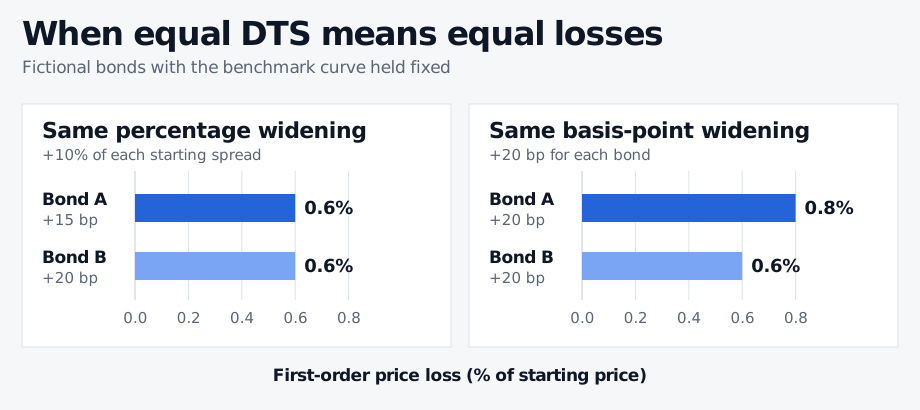
Both panels use the same price-loss scale. The estimates hold the benchmark curve fixed and omit spread convexity.
Exercise 4 in Credit-Sensitive Bonds works through an absolute spread shock in dollar terms (full lesson for members).
What a portfolio DTS tells you
For a cash bond portfolio, multiply each bond’s DTS by its starting market-value weight and add the contributions. That sum gives the portfolio’s first-order exposure to one common proportional spread shock. Estimating volatility also takes a model for the size and co-movement of relative spread changes. A jump-to-default loss depends on exposure and recovery. Ben Dor et al. (2007) and Houweling (2024)
Near zero, a small basis-point move can look enormous as a percentage of the starting spread. The ratio is undefined at zero, and multiplying a negative spread by makes it more negative. An absolute basis-point shock gives a clearer scenario in those cases. For a large move, reprice the bond under the new spread to capture changes in sensitivity. The original study excluded bonds with nonpositive spreads. Ben Dor et al. (2007), data appendix
Sources
- Ben Dor, Dynkin, Hyman, Houweling, van Leeuwen and Penninga (2007), DTS (Duration Times Spread). The Journal of Portfolio Management, 33(2), 77–100. See equations (1)–(4), the excess-return volatility analysis and the data appendix.
- Houweling (2024), Duration Times Spread: a measure of spread exposure in credit portfolios. Robeco’s practitioner explanation of proportional shocks and the distinction between spread volatility and default risk.