A due bill records the seller’s obligation to pass a distribution to a buyer whose trade carries the entitlement. A late ex-date falls after the record date. A qualifying trade in that gap can still be cum-distribution, meaning it includes the distribution. The issuer’s record-date snapshot can therefore identify the seller while the buyer is entitled to the cash or shares. For a trade ledger, assigning the distribution by record-date holdings alone can credit the wrong account. FINRA Rule 11630
One sale between record date and ex-date
Suppose a fictional stock has an 8 USD cash distribution per share and the following announced timetable. Assume consecutive trading days and one qualifying regular-way sale of one share.
| Day | Event | Consequence |
|---|---|---|
| 2 | Record date | The seller is the holder of record for the issuer payment. |
| 3 | Cum-distribution sale | The purchase includes the share and the claim to the 8 USD. The trade is scheduled to settle on Day 4 under T+1. |
| 4 | Payable date | The issuer pays against the record-date position. The seller owes the same amount to the buyer under the due bill. |
| 5 | Ex-dividend date | A new regular-way buyer buys the share without this distribution. |
Once both distribution entries clear, the seller has received 8 USD and passed on 8 USD, keeping zero. The buyer receives 8 USD in total. The share purchase price is separate from this cash ledger.
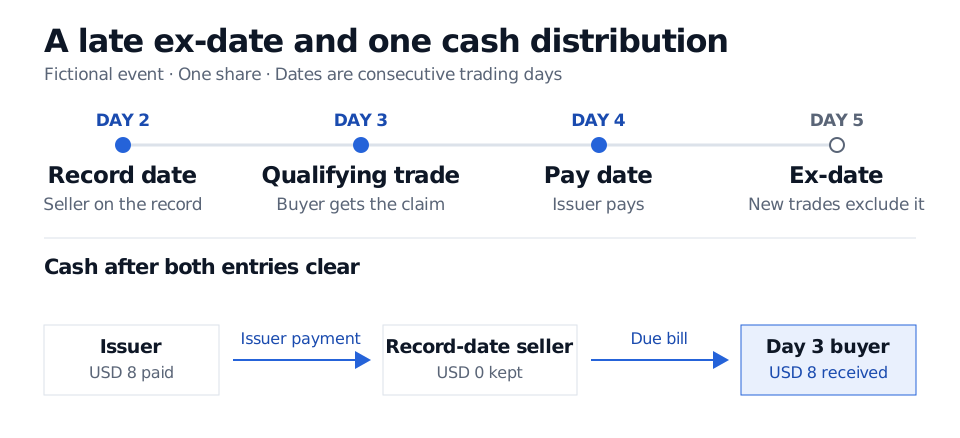
Fictional one-share cash ledger. The arrows show who bears each entry. The issuer’s payable date and the timing of a broker’s customer credit can differ.
In practice, for trades covered by its interim accounting process, the Depository Trust Company (DTC) tracks qualifying settled trades and adjusts its participants’ allocations by debiting the deliverer and crediting the receiver. The arrows above show the economic obligation. The last cum-distribution trade can settle on the ex-date, even as new trades that day exclude the distribution. DTC Distributions Service Guide, Interim Accounting
The timetable comes from the event notice
Since 28 May 2024, most U.S. securities trades have used T+1, with regular settlement due one business day after execution. NYSE ordinarily aligns the ex-date with the record date and publishes exceptions to that timing. FINRA’s T+1 notice, NYSE Ex-Date Dividends
For covered over-the-counter secondary trades between member firms, FINRA’s Uniform Practice Code specifies the timing. Under Rule 11140(b)(1), when definitive information arrives in time, a cash distribution below 25% of the security’s value normally goes ex on the record date if it is a business day. If the record date is a designated non-delivery day, the ex-date is the preceding business day. Under Rule 11140(b)(2), covered distributions worth 25% or more go ex on the first business day after the payable date. Rule 11140(c) separately allows the committee to designate a practical business day when definitive information arrives too late for the ordinary schedule. FINRA Rule 11140, FINRA Rule 11100
A real cash example. For Elme Communities’ October 2026 liquidating distribution of 1.74 USD per common share, the NYSE schedule showed 9 October as the record date, 22 October as the payable date and 23 October as the ex-date. The issuer said trades carried due bills from the record date through the NYSE close on the payable date. A qualifying buyer on 22 October therefore bought with the distribution attached. Elme’s corporate-action notice, NYSE Ex-Date Dividends
A spin-off can also put different entitlements on trades in the same parent company. In its FedEx Freight notice, FedEx specified that its regular-way line (FDX) carried the entitlement to subsidiary shares and its separate ex-distribution line (FDX WI) excluded it. For trade-level accounting, match the event notice to the line traded, assign the distribution once to the entitled position and record the cash or shares when delivered. FedEx Freight spin-off notice, Trading Details
Sources
- FINRA Rule 11630, Due-Bills and Due-Bill Checks
- FINRA Rule 11100, Scope of Uniform Practice Code
- FINRA Rule 11140, Ex-Date Designation
- FINRA Regulatory Notice 24-04, T+1 Settlement
- NYSE Ex-Date Dividends
- DTC Distributions Service Guide, Interim Accounting
- Elme Communities, September 2026 Form 8-K Exhibit 99.1
- FedEx, Board Approval of FedEx Freight Spin-off