A credit default swap succession event is a change, such as a merger or spin-off, in which another legal entity takes on debt and the swap's successor rules determine whose credit the protection follows. A single-name credit default swap can move to one successor or split into trades on several names. A covered credit event, such as a qualifying failure to pay, can trigger settlement. Succession alone changes the coverage without triggering a protection payment. 2014 ISDA Credit Derivatives Definitions, §§2.1–2.2 and 4.1
The debt determines who qualifies
For corporate CDS under the 2014 ISDA definitions, the successor test focuses on Relevant Obligations, generally qualifying bonds and loans outstanding immediately before succession. A firm can succeed by assuming debt or by issuing debt in a qualifying exchange, provided the original entity no longer owes or guarantees the relevant debt under the contractual test. An asset sale or change of ownership alone leaves the debt question open. The precise debt pool matters. For example, where the confirmation applies Financial Reference Entity Terms, a bank's senior and subordinated CDS can test different sets of obligations. 2014 ISDA definitions, §2.2(c)–(g)
The rule can leave the original issuer as one of the successors if it retains enough of the debt. In 2024, the EMEA Credit Derivatives Determinations Committee found that Optics Bidco had succeeded to more than 25% but less than 75% of Telecom Italia's Relevant Obligations and that Telecom Italia retained more than 25%. It identified both firms as successors for the specified 2014 transactions, effective 1 July 2024. EMEA DC meeting statement, §1
Two ways to allocate USD 10 million
Suppose a CDS references North Harbour with USD 10 million of notional. In this fictional split, East Harbour takes on 60% of its Relevant Obligations, West Harbour takes on 40%, and North Harbour retains none. Assume the other successor conditions are met.
- Unmodified 2014 single-name terms. East and West each qualify because each takes on more than 25% and the original issuer retains none. The standard rule divides the calculation amounts equally among the successors, giving each a USD 5 million trade. 2014 ISDA definitions, §2.2(a)(iii) and (n)
- Separate, fictional bespoke contract. Suppose the parties have signed terms that expressly allocate 60% of CDS notional to East and 40% to West. Multiplying USD 10 million by those agreed weights gives USD 6 million and USD 4 million. The unequal split follows from the signed terms.
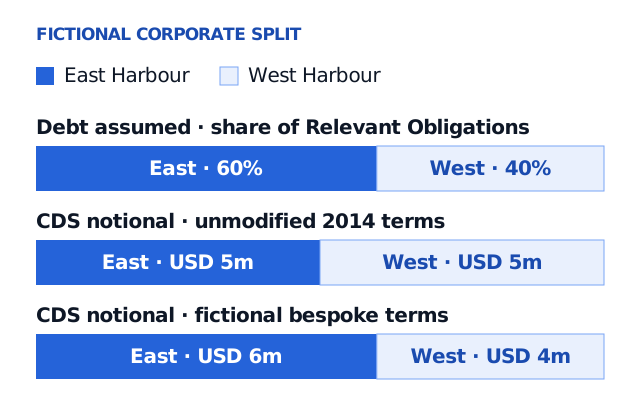
Debt shares identify the successors in this example. The contract then determines how USD 10 million of CDS notional is split.
What changes in the hedge
East can take over the specific bond that an investor hedged while the CDS now references both East and West. The book still carries USD 10 million of CDS notional in total, but the two trades respond to different credit spreads. Reconcile the new reference entities, notionals and contractual Succession Date, then compare the hedge and bond by obligor and seniority. Use the definitions and any amendments incorporated by the actual confirmation, together with the applicable determination.
The amended 2003 definitions used Succession Event as a defined term for corporate transactions. The 2014 definitions handle corporate succession under the successor provisions. The 2014 protocol amended covered legacy trades between adhering parties. July 2009 Supplement to the 2003 definitions, Article II 2014 ISDA protocol, §§1 and 3
For a worked hedge-sizing example, the SelfMadeQuant lesson on CDS overlays in convertible arbitrage sizes protection by credit-spread sensitivity and shows how the contract can leave a basis between bond and hedge. The preview is public and the full lesson requires membership.
Sources
- ISDA, 2014 Credit Derivatives Definitions, introduction, §§2.1–2.2 and 4.1.
- EMEA Credit Derivatives Determinations Committee, Telecom Italia meeting statement, 3 October 2024, §§1 and 3–6.
- ISDA, 2014 Credit Derivatives Definitions Protocol, §§1 and 3 and Schedule 1.
- ISDA, July 2009 Supplement to the 2003 Credit Derivatives Definitions, Article II, paragraph 3, replacing §2.2(b).