How CDS auctions turn eligible debt orders into a final settlement price: separate the initial midpoint, net open interest, protection payment and physical requests.
Credit default swap auction
A credit default swap auction determines a common settlement price for specified credit default swaps after a covered credit event. For a conventional single-name contract using that price, a lower auction final price means a larger protection payment. The auction turns eligible debt-market commitments into a contractual cash-settlement input.
The event decision and the price decision are separate. Where the contract incorporates their authority, a Determinations Committee can decide whether an event occurred, which obligations are deliverable and whether an auction will be held. The transaction's definitions, confirmation, applicable protocol and event-specific auction terms establish coverage; a newspaper report of default does not settle those questions. If no auction occurs, the contractual fallback matters. ISDA's July 2021 disclosure annex explains these distinctions.
Dealer quotes undergo prescribed filtering, best-half averaging and rounding to produce the initial market midpoint (IMM); it is not an average of every submitted quote.
Physical settlement requests
Valid commitments to buy or sell deliverable obligations at the eventual final price are matched. Their unmatched balance is the auction's net open interest, with size and direction.
Subsequent limit orders
When open interest remains, opposite-side limit orders, including prescribed carried-forward initial quotes, supply prices and quantities against which it is matched.
Auction final price
Matching and price constraints determine the result. The IMM need not be the final price. In these terms, zero open interest means no subsequent bidding and the IMM becomes final.
Here, open interest measures the residual debt-delivery demand, not gross CDS notional outstanding. Quote sizes, price increments, caps, eligibility and delivery provisions belong to the applicable terms; this table is not an auction implementation.
A final price of 40 is a price per 100 of par
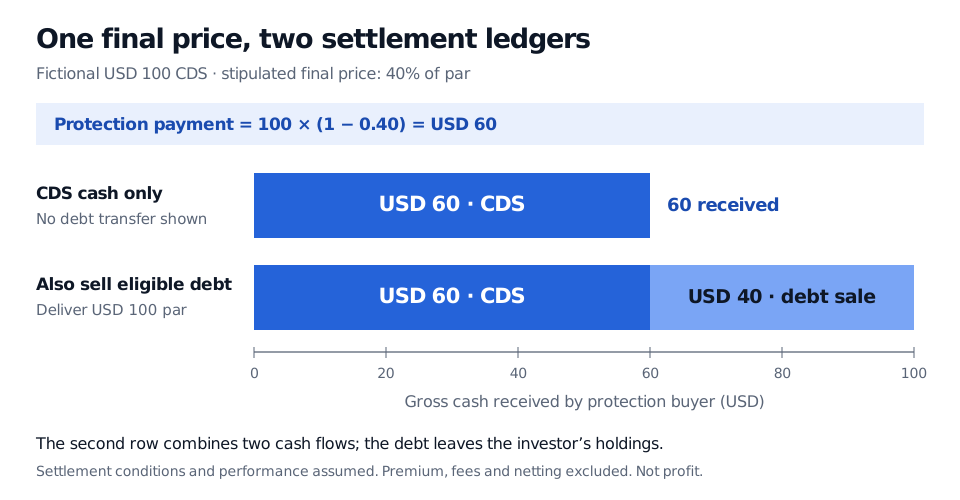
Consider a fictional USD 100 CDS notional. Stipulate a covered event, satisfied settlement conditions, a contractual reference level of 100% of par and an auction final price of 40% of par. Assume the seller performs. The buyer's cash protection receipt is
C=N(1−100Pauction)=100(1−10040)=USD 60.
The seller's cash flow is minus USD 60. The input 40 becomes the fraction 0.40: it is neither USD 40 per USD 1 notional nor a 40% protection payment. This example supplies the final price; it does not derive 40 from hypothetical auction bids. Accrued premium, fees and netting are excluded, so USD 60 is a gross protection payment rather than trading profit.
The New York Fed authors' 2009 study, “The Auction Mechanism,” explains the accompanying debt trades. Suppose the investor has an accepted physical settlement sell request for matching eligible debt with USD 100 par, and delivery completes at the stipulated price. The sale contributes USD 40: total receipts are USD 100 and the investor delivers the debt. A cash-settling protection buyer who makes no such request does not automatically surrender a bond.
Fictional USD 100 CDS with final price 40% of par: cash protection pays USD 60. If matching eligible debt of USD 100 par is also sold at 40, debt-sale cash of USD 40 brings gross receipts to USD 100 and the debt is delivered.
One price supports two distinct ledgers. The extra USD 40 requires a matching debt sale and delivery; neither bar measures profit.
This separation addresses a practical settlement problem: CDS protection can exceed available deliverable debt, so requiring every cash-settling buyer to find bonds could create a squeeze. The auction combines a common price with an avenue for eligible physical requests. It does not require every protection buyer to own the debt.
What the result cannot tell you
The final price is the contractual auction result for the specified deliverable set. It is not a guarantee of the ultimate recovery rate on every claim, nor a current mark for every bond or the CDS before settlement. Deliverability, liquidity and auction order flow can matter alongside expected recoveries. A cash bond held by the investor may have different seniority or terms.
Event-specific changes can be substantial. In its 20 August 2025 Altice France statement, the EMEA committee described replacing a contemplated cash fallback for failed representative auction-settled deliveries with delivery of a post-restructuring composite package. That historical change illustrates why the simple USD 40 debt-sale ledger cannot be assumed for every auction or contract. It is distinct from the original CDS cash protection payment.
For the portfolio consequence, Convertible Asset Swaps, Ascots and CDS Overlays examines how deliverability, recovery and documentation differences leave basis risk in a CDS hedge. The preview is public; the full lesson requires membership.
Sources
ISDA, Credit Derivatives Disclosure Annex, July 2021: “Role of the Credit Derivatives Determinations Committees,” “Settlement Methods” and “Important Considerations regarding Auction Settlement.” ISDA-authored text hosted by Deutsche Bank.