A GP-led secondary is a sale of existing private-market exposure organised by the fund's general partner (GP). A continuation vehicle (CV) is a new fund that buys one or more investments from existing funds managed by the same sponsor. It gives selling limited partners (LPs) a way to turn their exposure into cash while rolling LPs can keep exposure through the new vehicle. The transaction price, the cash distributed and the value reinvested are three different numbers to track. ILPA, Continuation Vehicles, pp. 4 and 8–9
In a typical LP-led secondary, a buyer takes over a selling LP's interest in the existing fund. In a continuation deal, the investment itself moves between vehicles. GP-led secondaries also include structures such as sponsor-organised tender offers and recapitalisations. Hamilton Lane Private Secondary Fund, prospectus filing, Investment Strategies
A sale for 100 can distribute just 40 in cash
Suppose a fictional fund sells its stake in one company to a continuation vehicle for USD 100 million. LPs entitled to 60% of the proceeds roll their full share, and LPs entitled to 40% elect cash. The CV issues identical, pro rata units. Assume no fees, carry, taxes, borrowing, price adjustments or deferred payments.
New investors subscribe for USD 40 million of CV units. The CV buys the stake from the old fund with that USD 40 million in cash and USD 60 million of CV units. In this settlement structure, the old fund distributes the cash to selling LPs and the units to rolling LPs.
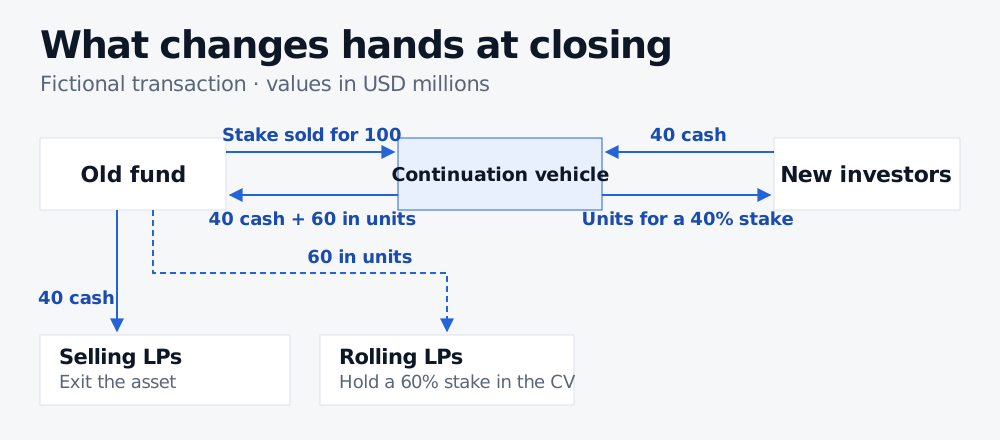
The stake moves once. The cash and rollover units go to different LPs.
After closing, rolling LPs own 60% of the CV and new investors own 40%. On a cash-flow schedule, the rollover contributes zero cash to the rolling LPs at closing, even though they receive units worth USD 60 million at the deal price. The new investors' cash ultimately goes to selling LPs. Separate follow-on funding for the company, if agreed in a real transaction, would have its own cash flows. Election menus and settlement terms vary by deal. ILPA, pp. 20–21
Who negotiates the price?
The sponsor manages both the seller and the buyer. A higher price helps selling LPs, while a lower entry price leaves more upside for new buyers, all else equal. The sponsor may also receive carried interest on the old fund's sale and negotiate new carry or fees in the CV. Comparing the bid with the old fund's reported holding value is a starting point. The dates, asset perimeter, adjustments and payment terms need to line up before the gap between those numbers tells you much. ILPA, pp. 10–11 and 15–17
The Institutional Limited Partners Association (ILPA) recommends early involvement of the limited partner advisory committee (LPAC) to review conflicts, evidence of competitive bidding or other independent price validation, and enough information and time for each LP to assess the election. An independent fairness opinion can support price validation. In the U.S., the Fifth Circuit vacated the SEC's 2023 Adviser-Led Secondaries Rule, including its opinion requirement, effective 5 June 2024. ILPA, pp. 10–16 · SEC overview of the vacated rules
The same asset can have different economics
For an LP comparing sell and roll, start with the net cash available on a sale and the future net cash flows from the CV under different exit values and holding periods. The cash available today is what the LP gives up by rolling. The same asset forecast can produce different distributions if the new vehicle changes the fee base, carry hurdle, fund term or follow-on commitments. ILPA's October 2026 guidance recommends comparing total fees and carry against the existing fund on like-for-like holding and return scenarios. A rollover on terms designed to replicate the old economics is one possible structure. ILPA, pp. 25–26
Sources
- Institutional Limited Partners Association, Continuation Vehicles: Advancing Alignment Through Best Practices, October 2026
- Hamilton Lane Private Secondary Fund, Form N-2 prospectus filing, Investment Strategies, July 2026
- U.S. Securities and Exchange Commission, Private Fund Adviser Rules Overview Chart, updated for the 2024 vacatur