See how a liquid-market sell-off can raise the reported private equity weight, and how allocators pace commitments around future cash calls.
Commitment Pacing and the Denominator Effect
Commitment pacing is the schedule an investor sets for the size and timing of new commitments to private funds. The aim is to build or maintain a private-market allocation while keeping cash available for future capital calls. The denominator effect occurs when changes in the value of the rest of the portfolio move an asset’s weight. A public-market sell-off can make private equity take up a larger share of reported assets before the allocator signs another commitment or receives a new valuation. Takahashi and Alexander, Illiquid Alternative Asset Fund Modeling · PGIM, To Roll or Not to Roll (Forward)
The private mark stays at 20 million
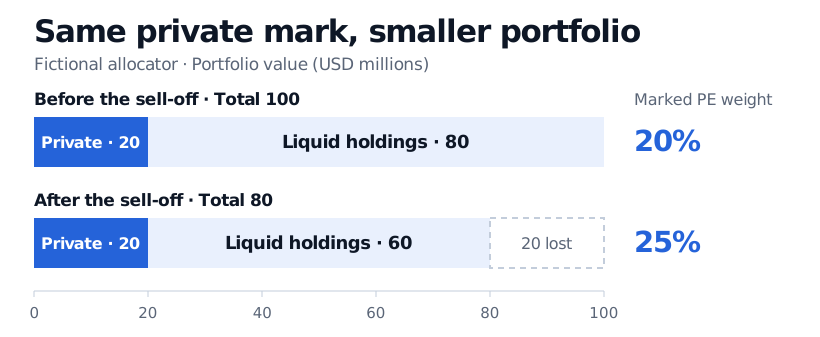
A fictional allocator holds 20 million USD in reported private equity net asset value (NAV) and 80 million USD in other holdings, all liquid. The liquid holdings fall to 60 million USD. There are no calls, distributions or other flows between the two snapshots. The allocator still carries the same private equity mark.
Marked private equity weight=Marked private equity NAV+Value of other holdingsMarked private equity NAV
The total falls from 100 to 80 million USD. The private equity weight rises from 20/100=20% to 20/80=25%.
Two bars on a common dollar scale show private equity marked at 20 million USD in both snapshots. Liquid holdings fall from 80 to 60 million USD and the reported private equity weight rises from 20% to 25%.
The dashed segment shows 20 million USD lost from the liquid holdings. The private equity segment keeps the same dollar width.
The arithmetic also works in reverse. In an April 2014 pacing update, CalPERS reported that a higher total fund value than expected had reduced the relative size of its private equity allocation. CalPERS Investment Committee, April 2014, p. 4
Which date does each value describe?
Liquid holdings with traded prices can be repriced as markets move. Private fund NAVs rely on periodic estimates of the underlying investments, and a valuation can arrive well after the date it describes. A portfolio report can therefore combine today’s liquid prices with a private mark from an earlier quarter. The 25% is a weight on those marks. The value of the underlying private businesses and the portfolio’s sensitivity to further losses can already have changed. PGIM, To Roll or Not to Roll (Forward)
Suppose, purely as a scenario, that the private holdings have also lost 25% of their value and would be marked at 15 million USD on the same date. On those assumptions, their share would be 15/(15+60)=20%. The scenario shows how the choice of marks affects the ratio. Private holdings can move by a different amount from public markets, so a public-market decline alone cannot establish the current private NAV.
A commitment sets a future cash obligation
The NAV-based weight counts existing holdings. The allocator records undrawn commitments separately in the liquidity forecast as capital that funds can call under their agreements. Suppose one existing fund has a call of 4 million USD due next month, and another is expected to distribute 3 million USD before then. If the distribution arrives on time, the allocator needs 1 million USD from other sources by the call date. If it arrives after the call is due, the allocator needs the full 4 million USD by that date.
In a pacing model, the allocator varies new commitments to funds raised in different years and projects calls, distributions and NAV under each scenario. Calls from earlier commitments can still draw cash after the allocator slows new commitments. Distributions from maturing funds can release cash and reduce private NAV. A pause can ease future funding needs, and the allocation can shrink in later years as older funds distribute proceeds. The allocator checks projected weights against the policy range and cash against the payments due on each date. Takahashi and Alexander, Illiquid Alternative Asset Fund Modeling