A debt exchange can pressure creditors to participate by worsening the position of holdouts. Trace exit consents, priority changes and the difference between face value and recovery.
Coercive exchange offer
A coercive exchange offer is a proposed swap of existing debt for new securities or other consideration whose design makes nonparticipation less attractive, for example by weakening the protections or repayment position of creditors who retain the old debt. For a quant analysing credit risk, the important object is the value of each claim after other creditors act: the old face amount alone cannot describe the exposure.
A distressed borrower may need creditors to accept reduced payments or longer maturities to avoid a worse outcome. A holdout declines the exchange and keeps the old claim, potentially hoping to collect more if other creditors provide the relief. Coercive features change that comparison. Acceptance can become individually sensible because rejection leaves the creditor with an impaired instrument, even when the creditor dislikes the restructuring as a whole.
Here, coercive describes participation incentives. It is not, by itself, a finding that a transaction is unlawful, that a creditor was compelled to tender, or that value was expropriated.
The choice changes while creditors are making it
An exit consent couples acceptance of an exchange with consent to amend the old debt's terms before the tendering holder exits. Where the required consents and other conditions are satisfied, the remaining holders can be left with fewer protections. Removing contractual restrictions, weakening enforcement provisions or reducing liquidity can lower the attractiveness of the residual debt without reducing its printed principal amount.
Bi, Chamon and Zettelmeyer's 2011 sovereign-debt model distinguishes this payoff-changing role from a minimum participation threshold, which can help coordinate creditors on an exchange that proceeds only if enough participate. Their model also shows a limit: holders able to coordinate a blocking position can obstruct exit consents. Those are results within a specified bargaining model, not universal voting rules or predictions for every issuer.
The mechanism is visible in an actual historical offering document. Total Play's 22 March 2024 exchange memorandum, printed pp. 7 and 9, proposed eliminating substantially all restrictive covenants and certain events of default from the old notes. Its Q&A warned nonparticipants that they would keep the old notes without those protections if the amendments became operative. This illustrates the contractual mechanism described in that document; it does not establish a legal conclusion about the transaction or its ultimate outcome.
Not every attractive exchange is coercive. Offering additional value can induce participation without damaging what a nonparticipant retains. Likewise, an exit consent that changes nonpayment protections is different from a collective action clause used to amend payment terms for an entire affected class. The actual instruments determine which decisions bind whom.
A smaller face amount can buy a better place in line
Consider a fictional, immediate recovery waterfall, with all amounts in USD million. Creditors A and B each hold old debt with face amount 100, ranking equally. Only 120 is available for them. There are no other claims, interest, fees, taxes or delays, so the initial pro rata allocation is
RA=RB=120100+100100=60.
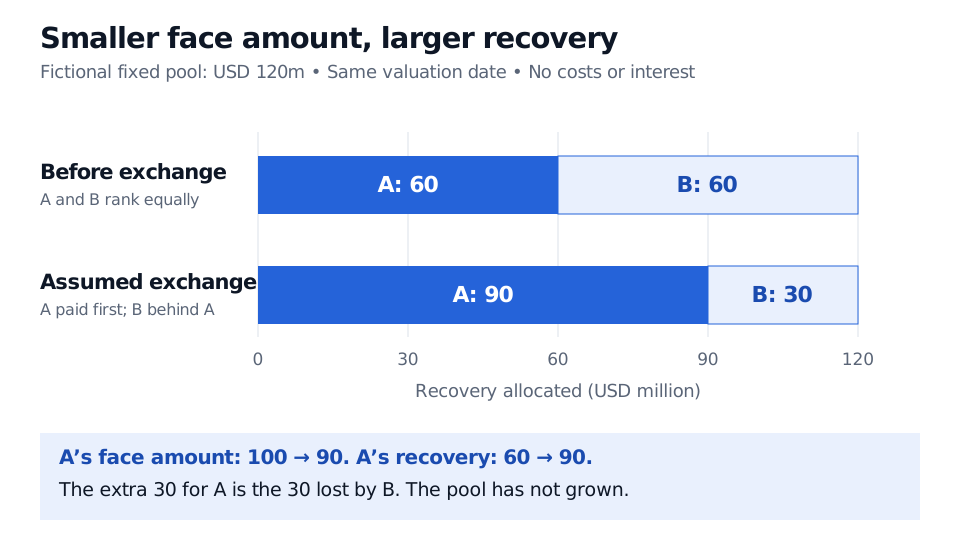
Now assume an exchange validly creates a new senior claim of 90 for consenting creditor A, while B keeps an old claim of 100 that ranks behind it. This is an assumed priority change, not a demonstration that any particular contract or jurisdiction permits one. Pay A first, then pay B from the remainder:
RAnew=min(90,120)=90,RBold=min(100,120−90)=30.
Creditor
Face before
Face after
Recovery before
Recovery after
A, consenting
100
90
60
90
B, nonconsenting
100
100
60
30
Total
200
190
120
120
A accepts a 10% nominal principal haircut yet gains 30 of recovery in this scenario. B retains a face amount of 100 yet loses 30 of recovery. The 120 available has not increased: changing priority redistributes it. Reducing the aggregate face amount from 200 to 190 does not create 10 of additional distributable value.
Fictional waterfall in USD million: A and B initially recover 60 each from a pool of 120. Assuming a valid exchange gives A a senior face claim of 90, A recovers 90 and B recovers 30. Total recovery remains 120.
Original fictional same-date waterfall. A's smaller face amount accompanies a larger recovery because the example assumes valid seniority; B absorbs the corresponding reduction. It does not model the legal steps needed to obtain that priority.
The denominator matters when reporting a recovery rate. A receives 90% of its original face amount, but 100% of its new face amount. Neither percentage means that A made a 90% or 100% investment return: that would require its purchase price and other cash flows. For the exposure and loss definitions behind this distinction, Credit Instruments, PD/LGD/EAD, and Rating Migration offers further teaching (public preview; full lesson requires membership).
This two-creditor calculation isolates a conditional redistribution. It does not specify what happens if both tender, both refuse, a threshold fails or a court rejects the assumed priority. It is therefore not a complete participation game. Nor is a deterministic immediate recovery a market quote: real replacement securities have uncertain payments, timing, liquidity and discount rates.
What belongs in the valuation scenario
For an actual exchange, construct separate outcomes for completion, failure and any material challenge to the terms. In each, identify the claim retained or received, the issuer and guarantors, collateral, payment ranking, amendment thresholds, cash consideration and settlement timing. Keep the value of the issuer's assets separate from how that value is allocated among creditors. An exchange can preserve value by avoiding disruption, redistribute value through priority changes, or do both; the fixed-pool example deliberately isolates redistribution.
A nonparticipant's remaining contractual entitlement and its likely economic recovery are separate inputs. Whether payment rights, collateral or priority can be changed requires the specific debt documents, applicable law, jurisdiction and relevant court decisions. No general conclusion about enforceability follows from the word coercive or from the waterfall above.
The label also does not establish a credit event for a credit default swap. As a historical example of the distinction, ISDA's 9 March 2012 Greece announcement tied its determination to the exercise of collective action clauses under the specified 2003 definitions, as supplemented. That historical determination is not a trigger test for another exchange; the applicable CDS documentation and actual event must be examined separately.
Sources
Ran Bi, Marcos Chamon and Jeromin Zettelmeyer, The Problem that Wasn't: Coordination Failures in Sovereign Debt Restructurings, IMF Working Paper 11/265, November 2011, introduction and §§III.D–IV: participation incentives, exit consents, thresholds and blocking creditors. This is the authors' research model, not a binding IMF rule.
Total Play Telecomunicaciones, Exchange Offer and Consent Solicitation Memorandum, 22 March 2024, printed pp. 7–9, Q&A: proposed covenant amendments and the position of nonparticipants. Historical issuer terms, not a statement of current general law.